Small businesses slow to take up WA’s new electric truck vouchers
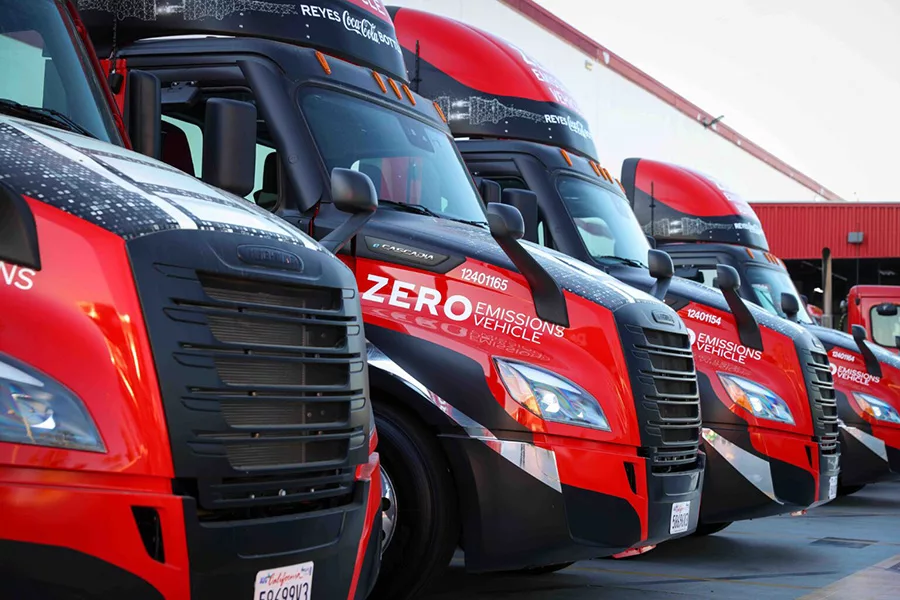
Freightliner eCascadia electric trucks used in a Coca-Cola Bottling fleet are pictured in 2023.
Courtesy Daimler Truck AG / Washington State StandardA line of work trucks sat running recently in the parking lot of Kent’s Pacific Raceways, but there was hardly any engine noise and no diesel exhaust.
The vehicles, ranging from forklifts to delivery vans to semi trucks, were all electric models eligible for the Washington Zero-Emission Incentive Program, a new funding mechanism supplied by the state’s Climate Commitment Act designed to kickstart the state’s electric work truck market.
When it comes to meeting its own greenhouse gas emissions, Washington is behind the curve on transitioning to electric vehicles. The transportation sector is the highest emitter in the state, accounting for 40% of total emissions, and will likely be the most difficult to decarbonize.
“If we really want to meaningfully reduce our state’s GHG emissions, being able to deploy zero emission technologies on our streets, near our roads and communities, is one of the best ways to do that,” said Betz Mayer, incentive programs deputy director at Catalyst Mobility, a nonprofit implementing WAZIP that specializes in electrifying transportation.
One major benefit of the incentive program is that by selling more electric work trucks, in future years they can be resold at a cheaper price, and become available for businesses that can’t afford to buy new, said Kelsey Nyland, director of communications at Clean & Prosperous, a nonprofit organization that promotes market-based clean energy.
Nearly five months after its launch, the program has been “pretty successful,” with roughly half of the $112 million in available vouchers requested, Mayer said. Some applicants have already received funding, while others are still awaiting approval.
Vouchers for heavy-duty vehicles and agriculture and construction equipment have all been requested, but “where we’re really struggling is in our class 2b through 6 – that bucket of money is moving a lot slower than we originally anticipated,” said Mayer.
Classes 2b through 6 include cargo vans and small work trucks. Less than 5% of vouchers of those available vouchers have been requested, according to agency data.
That’s because the trucking industry has spent years discussing the transition to electrify its fleet, while small business owners using cargo vans have not, said Mayer. And, they don’t have the same level of purchasing power.
Johannes Ariens is optimistic about the program, but wants to see more funding for small businesses such as food truck owners, bakeries and florists. As the CEO of Range, Washington’s only car dealership exclusively selling zero-emission vehicles, he says smaller work trucks make up the majority of the market.
But the barrier for small businesses is the upfront investment, he said.
“My personal and maybe somewhat controversial opinion is that … a significant amount of [class 7 and 8 vehicle] vouchers will not come to fruition,” Ariens said, which include heavy duty and semi trucks. The product availability and the necessary infrastructure that’s required to operate them “are far more challenging to deploy.”
Meanwhile, there’s a “massive immediate market opportunity” for smaller work trucks, he added.
Ariens called for a “drastic increase” in funding for vehicles in the classes 4 through 6 which include medium-duty commercial vehicles such as delivery trucks, utility vehicles and small buses.
“The market for those trucks is much larger and the infrastructure is much simpler,” he said.
WAZIP launched on April 29. During its six-month internal evaluation in October, program directors will reassess and reallocate the funding, said Mayer, which could potentially lead to more opportunities for small businesses.
“It’s still the same bucket of money, we’re just going to move it around a little bit,” Mayer added. “We’re going to set some new buckets to kind of help inspire investment.”
This story is republished from the Washington State Standard, a nonprofit, nonpartisan news outlet that provides original reporting, analysis and commentary on Washington state government and politics.