
These are the states where incomes grew the most, least in recent decades
WA has the 7th-highest median income out of all 50 states
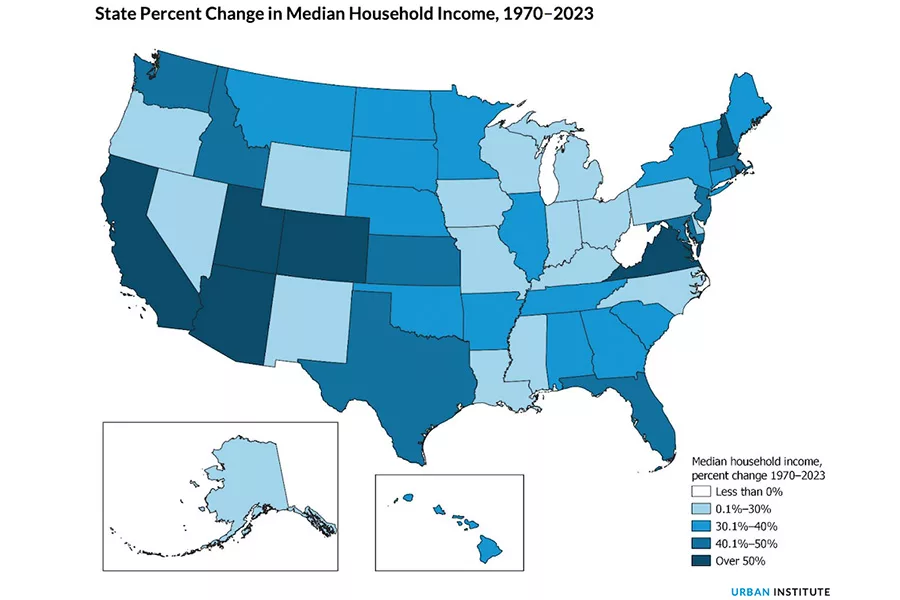
Note: Median household income is measured in 2024 dollars for all years.
Authors’ analysis of US Census Bureau decennial censuses 1980 to 2010, 2023 one-year American Community Survey, and 1970 microdata from IPUMS USA.Household incomes have grown in nearly every state over the past 50 years, but a new study concludes that growth has been uneven across the country.
An analysis of U.S. Census Bureau data, released Feb. 3 from the Urban Institute’s Center for Local Finance and Growth, found inflation-adjusted incomes in Western, mid-Atlantic and New England states have grown the most since 1970, while incomes in Midwestern states have grown the least.
Nationally, between 1970 and 2023, median household incomes grew by an average of 32%.
Washington state numbers
In Washington state, median incomes increased by 45.9% during that period, from $64,862 to $94,605. That was enough to push it to No. 7 – one spot higher compared to 1970 – on the list of states with the highest median incomes.
Top increases
Utah household incomes increased at a higher rate than any other state: The median income went up 78%, an increase of $40,820 in inflation-adjusted dollars to $93,421. Utah was followed by Colorado, New Hampshire, California, Arizona and Virginia, all of which saw more than 60% growth in median household incomes adjusted for inflation.
The study found only one state saw inflation-adjusted incomes drop over the past five decades: West Virginia’s median household income fell by 0.4%, from $56,161 to $55,948 in inflation-adjusted dollars.
West Virginia had the second-lowest household income in the study, ranking ahead of only Mississippi’s $54,203. Massachusetts ranked the highest, with a median household income of $99,858.
Factors for growth
The Urban Institute, a left-leaning think tank, found that rates of state sales and income taxes had no association with changes in median household income. The analysis also found states with colder temperatures and higher property taxes saw greater median income growth, despite popular notions that lower property taxes and warm temperatures can lead to more prosperity.
The factors most strongly associated with household income growth were educational attainment and increases in the percentage of immigrants in the state population, the study concluded.
“This could be because immigration leads to economic growth, immigrants seek out growing areas, or both,” the study said.
This story was originally produced by Stateline, which is part of States Newsroom, a nonprofit news network which includes Washington State Standard, and is supported by grants and a coalition of donors as a 501c(3) public charity.

Stay Informed. It’s Free.
Subscribe to our newsletters and get the latest news and insights delivered to your inbox.
We respect your privacy.
Unsubscribe anytime.
Thank you!
You’re subscribed. Keep an eye on your inbox for the latest updates.