Strategic site, ready workforce drive Rockwool’s Wallula project
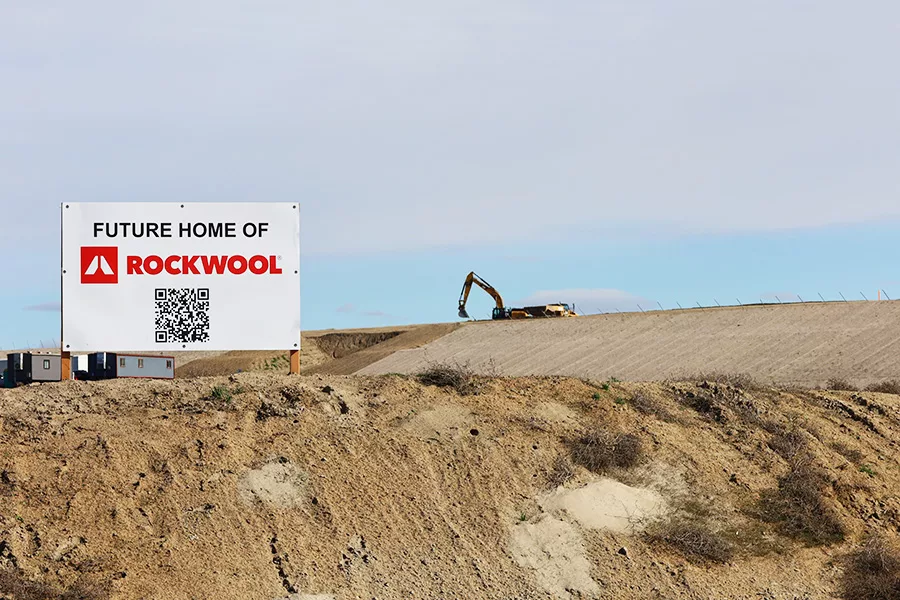
The initial phase of Rockwool’s manufacturing facility in the Wallula Gap Business Park will occupy roughly 90 acres of the total 250 acres purchased by the Danish company.
Photo by Nathan FinkeIt may look mostly bare now but Jørgen Amtoft can already map out every section of Rockwool’s future 90-acre site above the Columbia River south of the Tri-Cities.
The yet-to-be paved entrance will lead to the loading bays for basalt and other rock the Danish company uses to make its stone-derived insulation. Nearby will sit a massive transformer to power the melter, the largest the company will have in operation. Another cut in the ground is where trucks will be loaded with Rockwool products to be shipped to its burgeoning market across the West.
All that won’t be a reality for some time – Rockwool currently plans to bring the future facility online in early 2028 – but Amtoft, director of operations for the project, is already focused on the 125 people who will operate and manage the facility that about 19 miles south of the Pasco.
He’s met with leaders at Columbia Basin College and Washington State University Tri-Cities to make sure there will be a pipeline of trained workers. He’s even visited classes at Tri-Tech Skills Center in Kennewick to talk about the jobs that will be available.
“There’s no doubt we’ll get our workforce from the Tri-Cities and Walla Walla,” Amtoft told the Tri-Cities Area Journal of Business during a recent tour of the construction site off Highway 12 at 220 Petersen Road in Wallula.
That workforce focus is a key reason Rockwool selected the Port of Walla Walla’s Wallula Gap Business Park for its newest factory – a $175 million investment and its third U.S. facility.
Rockwool will have a formal groundbreaking ceremony for the project at 11 a.m. April 29.
“This is just part of our plan to continue building out our North American factory network,” said Paul Espinosa, Rockwool’s public affairs manager.
Unique insulation
The company uses a proprietary electric melting process to produce an environmentally-friendly insulation material used in commercial, residential and industrial settings.
Amtoft said the product is fire-resistant, repels water and has sound dampening qualities, making it ideal for a variety of buildings, from homes to data centers. He demonstrated the sound dampening capabilities by triggering a shrill personal safety device and dropping it into a box lined with Rockwool insulation. It did the trick once the lid was on, fully muffling the loud noise.
Selecting Mid-Columbia
Rockwool has 45 factories around the world, with 2025 revenue of about $4.5 billion and net profit of $32 million, according to its latest financial report issued in February.
Along with the two existing plants in the U.S., two more are in Canada, including one in British Columbia. The new Wallula Gap facility is a strategic move for its North America operations as it will be the only U.S. facility west of the Mississippi.
Rockwool North America announced two years ago its intent to build its newest factory in the Mid-Columbia. It bought 250 acres for $8.75 million from the port at the business park along Highway 12. Crews began grading the site last summer, with construction formally beginning in early 2026.
Amtoft said there were a number of factors that drew Rockwool to the Mid-Columbia and Wallula Gap in particular.
The site has good infrastructure, particularly for transportation needs. It’s within 45 minutes of several locations where the company plans to source the basalt it uses to make its products.
The availability of green and carbon-free energy aligns with Rockwool’s sustainability goals. A thriving population center will provide workers. And, lastly but crucially, the area has willing community partners.
“We could not have done this without the cooperation of the county and the port,” Amtoft said.
The company has said construction of the Wallula Gap factory will generate more than 600 construction jobs. It is using an outside firm, PCL Construction, to manage the project but the company has hired several Mid-Columbia and Washington-based firms to do the work on the ground, including Fowler Construction, Prairie Electric, Holaday-Parks and Southland Plumbing.
“We are very impressed with the caliber of the contractors,” Espinosa said.
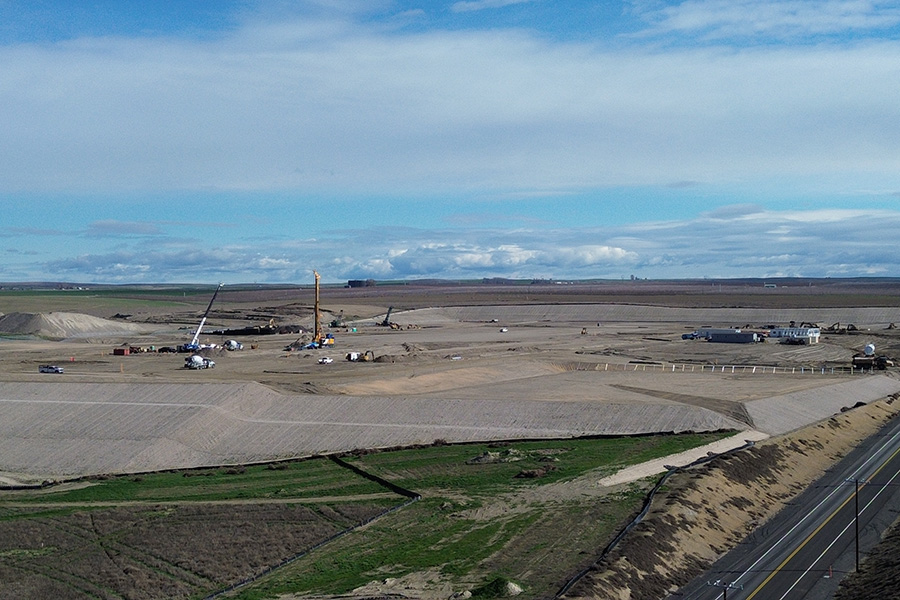
Machinery and construction workers dot the largely bare worksite that will eventually be the site of a Rockwool's stone insulation manufacturing facility.
| Photo by Nathan FinkeCommitted to region
This is not to say the project hasn’t had speed bumps.
Construction started later than initially planned as Rockwool awaited permits. Amtoft noted that during site preparation crews discovered layers of small rocks that couldn’t be fully compacted, requiring them to be excavated before pouring the foundation.
Global events also have presented challenges for the company. Rockwool leaders told investors in August that it expected its revenues to be flat this year, with tariffs instituted by President Donald Trump driving turbulence in the market.
Tariffs may also impact outfitting the future plant, as some equipment must be shipped over from Rockwool’s operations in Europe, incurring additional cost.
Amtoft said that hasn’t deterred the company’s leaders. Espinosa noted that Rockwool built its West Virginia facility during the Covid-19 pandemic lockdowns.
“Tariffs weren’t part of the calculation but we will still continue,” he said. “(Company leaders) know and they want us to push through.”
Hiring plans
And part of pushing through is also getting ready to make the factory’s first hires.
Amtoft said he plans to make the upper-level management hires for the facility starting at the end of 2026. That gives him the opportunity to train them and for them to become familiar with the company’s operations and culture. They would then take on the hiring process for front line employees and lower management.
“I want them to have their own people,” Amtoft said. “It’s build, hire the right people, make sure they can operate (the factory), then I can go on to the next one.”
And after that, there’s still expansion potential for the Wallula Gap facility. At full build-out, the facility could be more than 2.7 million square feet, using 185 of the 250 acres, according to documents filed under Washington’s environmental review process.
For comparison, Amazon’s two new warehouses east of Pasco total about 1 million square feet each.
“We are looking into the future and there is an opportunity for expansion,” Amtoft said.
And that future will also include new neighbors, as the port awaits the beginning of construction of SkyNRG’s sustainable aviation fuel facility and finalizes a land deal with Amazon for a proposed $5 billion data center campus.
The scenic Wallula Gap area is home to the McNary National Wildlife Refuge, as well as other industrial employers in the region, including Packaging Corporation of America and Tyson Foods.


Stay Informed. It’s Free.
Subscribe to our newsletters and get the latest news and insights delivered to your inbox.
We respect your privacy.
Unsubscribe anytime.
Thank you!
You’re subscribed. Keep an eye on your inbox for the latest updates.