Coalition works to ready brownfields for future development
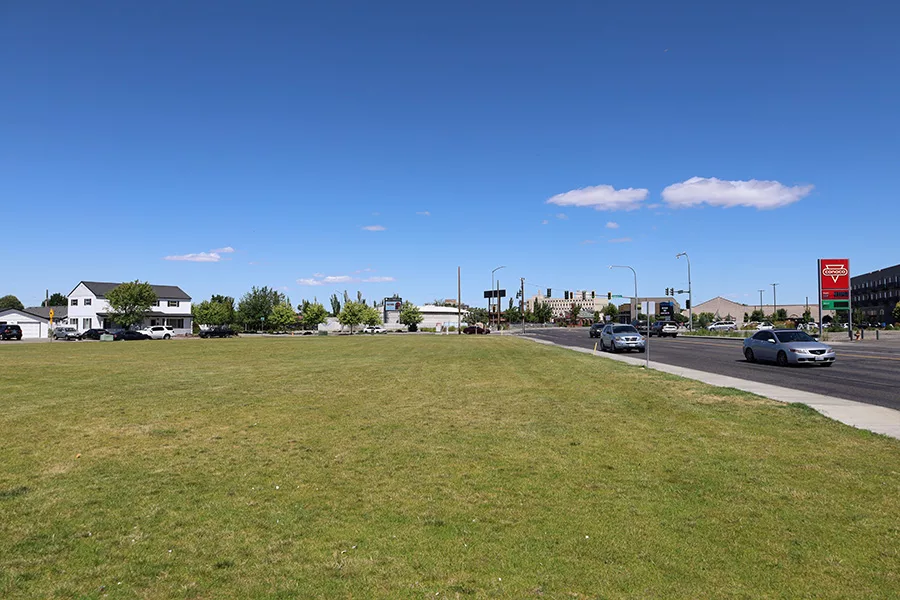
This grassy lot at the intersection of Jadwin Avenue and George Washington Way once held a blighted motel that was a drain on city resources. A federal grant provided the funds to start the process that led to the building's eventual demolition in 2023.
Photo by Nathan FinkeThe roughly triangular grassy lot next to where Jadwin Avenue connects with George Washington Way in Richland shows little indication of its past.
The only physical signs of a prior use are the matching curb cuts alongside George Washington Way. Otherwise you may not know it once had a blighted Economy Inn motel that was as unsightly as it was a drain on the city’s resources.
And part of the reason it’s no longer there is because the city, using funds from a 2021 federal grant, was able to have the property evaluated and assessed for contamination due to its status as a brownfield, paving the way for its demolition two years ago.
Brownfields is a term to describe tracts of land that have been developed, potentially polluted and then abandoned.
“Anytime you can turn a brownfield into a greenfield, it’s worth it,” Mandy Wallner, Richland’s business and economic development manager, told the Tri-Cities Area Journal of Business. “It’s better for the environment. It’s better for future development.”
Local government officials hope another $1.2 million federal grant will lead to the revitalization of similar vacant lots and dilapidated buildings in areas across the Mid-Columbia.
The money will be used to conduct environmental site assessments and regulated building materials surveys for properties ranging from former gas stations and dry cleaners to factories and vacant lots. Those assessments and surveys would then be used to develop site cleanup and reuse plans that support property sale or redevelopment activities for eligible sites.
“We want to make sure we’re using these dollars to drive future development,” Michelle Holt, the council’s executive director, told the Journal. “There can be a stigma to the idea of a property being a brownfield.”
The Benton-Franklin Council of Governments, along with a coalition of Mid-Columbia cities, Richland, Prosser and Connell, and nonprofit Habitat for Humanity were one of three entities in Washington state awarded a Brownfields Assessment Coalition Grant from the U.S. Environmental Protection Agency.
Holt noted that while the council and its coalition have been selected for a grant award, it has not been formally provided yet per EPA’s process.
It follows on an initial EPA grant for $600,000 the council and partnering cities received in 2021 that paid for projects such as the initial assessments and evaluation of Richland’s Economy Inn site and a dozen other brownfield properties in the region.
Brownfields may have environmental contamination ranging from underground fuel tanks of former gas stations to solvents from dry cleaners. But they can also be former orchards or homes built prior to 1970. Or a brownfield may not have any contamination at all, but the assumption they do stifles redevelopment.
“Brownfields are the ultimate fixer-uppers,” the state Department of Ecology wrote in a recent blog post. “If left languishing, they slam the door on hopes for more affordable housing, public services, businesses and public spaces for people to gather.”
And redevelopment can be successful.
Bellingham’s The Millworks, Seattle’s Mount Baker Properties affordable housing, Wenatchee’s public market and Spokane’s Riverfront Park are all on former brownfields.
Among the projects lined up for this next grant are assessments and evaluations of a former agricultural field for potential affordable housing, determinations of next steps for the site of the former Prosser City Hall that burned down several years ago and working with the owners of several properties along Connell’s Columbia Avenue, the small Franklin County city’s primary commercial area.
Holt said more projects could be added, if they are a good fit for the coalition’s goals.
“The nice thing about this grant is that we’re not limited to what we identified,” she said.
Most importantly, officials hope the projects demonstrate to other property owners the potential for redeveloping their own possible brownfields.
“There’s a stigma that it costs a lot and it’s not worth doing,” Wallner said. “It needs to be cleaned up but it’s not insurmountable.”