
Today’s children could prosper in tomorrow’s shortage of young workers
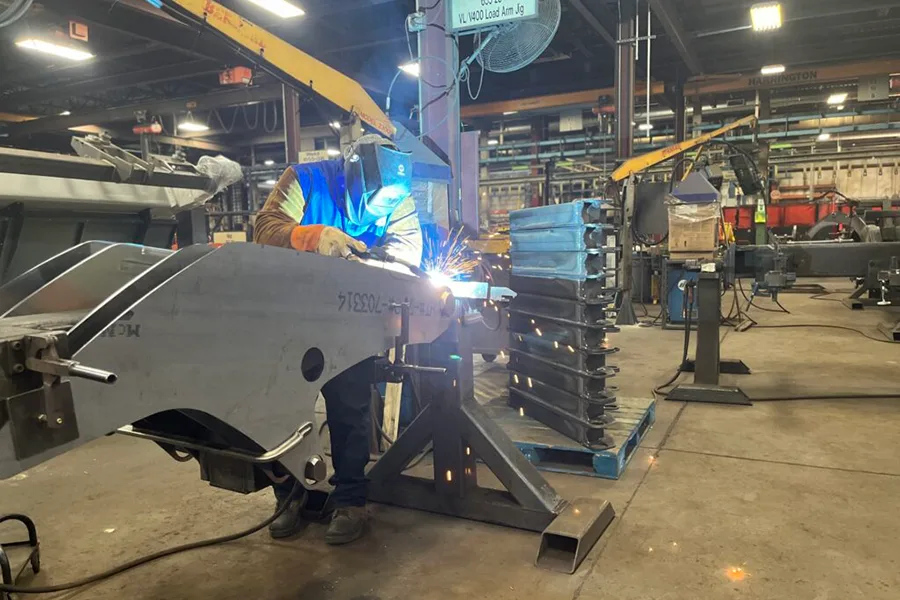
A welder works at a Manitou factory in June 2023 at Madison, South Dakota. Labor shortages in North Dakota and South Dakota could be harbingers of a shortage of young people in coming years.
Photo by Joshua Haiar/South Dakota SearchlightToday’s children could be the first generation since the 1970s to do better than their parents as young workers become more sought after and well paid. They may even see a surplus of housing to make their lives even easier after recent shortages.
An abundance of young workers will turn into an undersupply by 2040, with better pay and a surplus of housing, demographers predict. Immigration and artificial intelligence are wild cards, and young workers will still be saddled with taxes to support aging boomers for a while.
Some states are already seeing a shortage of young workers. North Dakota and South Dakota routinely have twice as many job openings as people looking for work, and those jobs often require physical labor that AI could never replace. Oil fracking in North Dakota, for instance, is hard, sweaty work, and truck drivers have to move the oil.
“Really a lot of the Midwest is still investigating things like autonomous systems but we’re not really there yet. So labor shortages are a thing and are an issue,” said David Flynn, an economics professor at the University of North Dakota.
Those issues will hit more states, including Washington and Nevada, where people looking for work still outnumber job openings by almost 2 to 1.
Today’s small children have a brighter future economically than any generation since the surge of Baby Boomers aged into adulthood in the early 1970s, swamping the job market and dampening pay for 20-somethings ever since, said Steven Ruggles, director of the Minnesota Population Center at the University of Minnesota.
“The second half of the boomers were particularly the victims of this,” Ruggles said. “They got here after things had been going great after World War II and wages had been going through the roof, and then all of a sudden the bottom falls out because there’s too many of them. ”
Ruggles in May published a paper, titled “The pig in the python,” about the slow progression of baby boomers through the national economy, maintaining that a coming shortage of young workers will give them more prosperity.
“We are on the verge of a radical reshaping of labor markets in which new workers will be in extremely short supply,” Ruggles wrote in the report. “We may finally see real (inflation-adjusted) wages of the young exceed the levels of the early 1970s. Americans born in the 2020s might be the first cohort in a half century that earns significantly more than their parents did.”
For the first time since at least 1910, people leaving the labor market will outnumber young newcomers by 2040, and rising pay may not be the only change. Housing could become more affordable too.
“If construction activity remains elevated, changing demographic trends could lead to a growing oversupply of housing in more markets,” the Mortgage Bankers of America concluded in a June white paper. “We expect that this will lead to falling prices for both single family and multifamily housing at the national level.”
The “potential for oversupply and falling prices” will affect house prices most in states such as Arizona, Florida and Texas because of fast construction — more than Massachusetts, New Jersey and New York, where building has been slowed by costs and restrictive zoning, the paper noted.
While the prospect of better pay and lower housing costs is something to look forward to, demographers caution that such a turnaround has been predicted before. Some “really smart economists” turned out to be “dreadfully wrong” in the 1990s when they predicated a housing market crash based on lower demand from aging boomers, said Richard Jackson, president of the Global Aging Institute, a Virginia-based research firm.
“The thesis was that the baby boom was moving beyond its household formation years and there’d be a collapse in housing prices. It never happened,” Jakson said. Labor supply was also unexpectedly boosted by women and immigrants, he noted, putting a lid on wages for the young.
Still, the future drop in the numbers of young people is fairly certain, he said.
“Most of the relevant demographics is already locked in. These people have already been born and so absent some Hollywood catastrophe like a colliding comet, we know how many 30-year-olds there are going to be 15 years from now,” Jackson said.
Immigration is also a wild card, with many recent arrivals drawn by the need for skilled young workers in construction and other trades.
“It definitely helped prolong the glut of labor,” Ruggles said. “Wages might have turned around a little quicker if there had been less of a boom in immigration, but to some extent the immigrant jobs were ones that didn’t directly compete with U.S. workers like farm labor.”
It’s hard to predict the effect of the Trump administration’s mass deportation agenda on future arrivals. Ruggles said his analysis holds across a wide range of possible immigration outcomes.
The population of young adults could grow “a bit” or shrink over the next 20 years depending on immigration policy, said Julia Gelatt, associate director of the U.S. Immigration Policy Program at the nonpartisan Migration Policy Institute.
Without immigrants and their children, the population of children and young adults would have shrunk by 5 million after the year 2000, according to a 2024 MPI report co-authored by Gelatt.
“Whether any of that translates to higher wages seems pretty uncertain to me,” Gelatt said. “With slower population growth, or population stagnation, labor demand is unlikely to keep growing at the pace it has been. There will not be the same growth in the number of people buying goods and services. And nobody is sure yet of how AI will affect labor markets.”
In North Dakota, companies have been willing to pay high wages for scarce workers, especially young men in jobs unlikely to see AI competition such as energy, construction and manufacturing, said Marcia Goetz Havens, manager of the state’s Labor Market Information Center.
“Companies were willing to pay big wages to attract labor to take oil and gas jobs resulting in a significant inflow of new workers from across the country,” she said. “Even within the state, high wages attracted younger, less educated workers from other parts of the state.”
The competition for young workers is making it hard to fill other jobs. Almost half the state’s unfilled job openings have been in health care, hospitality and retail, according to a state survey of employers last year. Nurses, cashiers and fast food counter workers are especially hard to find, employers reported.
North Dakota, second only to Nebraska for labor force participation with almost 70% of working-age people working or looking for work, doesn’t have a lot of options to find new workers, Flynn said
“We just don’t have the bodies,” Flynn said. At business roundtables, employers also complain that fewer young people are interested in manual labor.
“Construction company owners complain about not being able to find someone who can swing a hammer: They say, ‘We don’t even have people who are interested in doing that.’ Can you fault them if there are easier jobs at higher pay? So compensation for those types of jobs likely has to come up.”
This story was originally produced by Stateline, which is part of States Newsroom, a nonprofit news network which includes Washington State Standard, and is supported by grants and a coalition of donors as a 501c(3) public charity.