Report: Transmission system limitations will limit clean energy growth
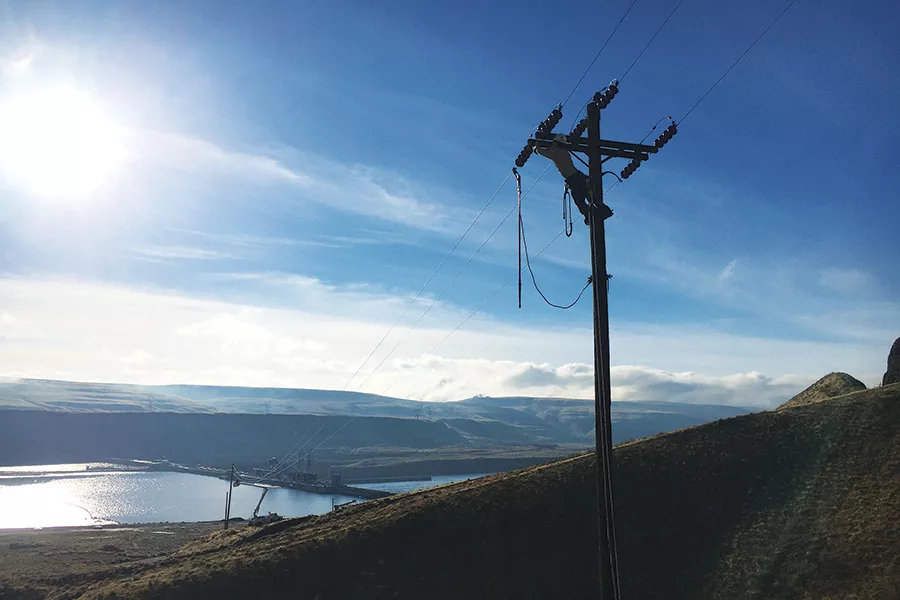
A lineman works on a transmission line above Lower Monumental Dam, which bridges Franklin and Walla Walla counties on the lower Snake River.
Courtesy Franklin PUDA recent report from a council of state agencies leading Washington’s transition to clean energy points to a growing concern beyond generating clean power: being able to move it around the state.
The development of new renewable energy projects remains critical to the state’s future, the interagency Clean Energy Siting Coordinating Council wrote in its 2025 annual report. And the shift in federal policy toward such projects threatens them and the state’s energy future, from the reliability of power to industry jobs.
But the limitations of the state’s current electrical transmission capacity mean those and future clean energy projects would face significant challenges in bringing their power to market. And the state needs to act to remove that hurdle via financial and regulatory actions.
“To support the growing demand for electrification and large load energy users, we must take action to rapidly build transmission and generate new renewable energy,” said Casey Sixkiller, director for state Department of Ecology, and Joe Nguyen, director for the state Department of Commerce, in a joint letter to Gov. Bob Ferguson.
“Without a coordinated state effort, we face a future of unreliable electricity, higher energy costs and climate impacts to our people and environment.”
The state’s electricity demand is expected to grow by 29 gigawatts by 2050, both from increased demand as well as state initiatives to reduce emissions and reliance on fossil fuels, according to the Clean Energy Transition Institute.
Part of that predicted growth in demand is expected to come from the proliferation of data centers to support artificial intelligence, or AI, technology. The Mid-Columbia has become a focal point for such facilities, with several entities proposing them at sites from West Richland to Wallula.
The region is also a hotbed for clean energy, with projects in various stages of development, such as the wind- and solar-powered Horse Heaven Hills Energy Complex and the Cascade Advanced Energy Facility, four nuclear-powered small modular reactors, or SMRs, being built as part of a collaboration between Energy Northwest, Amazon and X-energy.
But while those energy projects would be relatively close to the Tri-Cities, they would be far from the state’s main population centers west of the Cascades. The federal Bonneville Power Administration already has projects in the works to expand and upgrade its transmission infrastructure and is developing future plans.
“… but these plans alone do not address the pressing need to site and build transmission facilities. In the past, large transmission line projects have taken 10 to 20 years to complete siting, permitting and construction,” according to the council’s report.
Among the council’s recommendations to the governor and Legislature for addressing those barriers to transmission capacity:
- Establish a new state agency to finance and develop transmission projects and support those of other transmission developers.
- Facilitate coordinated siting and permitting for new transmission infrastructure through partnering with local, state and federal agencies, determining key transmission coordinators, streamlining processes for obtaining rights of way on state lands and other efficiencies.
- Improve existing transmission infrastructure via upgrades, offering incentives and resources for utilities to implement them and loosening state environmental exemptions for higher voltage transmission lines.
Getting those recommendations enacted could be tough. The state is facing significant budget challenges as it prepares to enter the short 2026 legislative session, with one of the Legislature’s primary budget writers already telling fellow lawmakers to not make any further spending requests.
The report also noted that while funding constraints are challenges, they don’t diminish the urgency of better connecting the state’s energy grid.
“While we look to near- and long-term solutions for the grid, there are actions we can take now to provide more options for clean energy development and improve awareness and understanding of their benefits and challenges,” the report said.