WA bills would allow locally designated ‘risk zones’ on dangerous roads
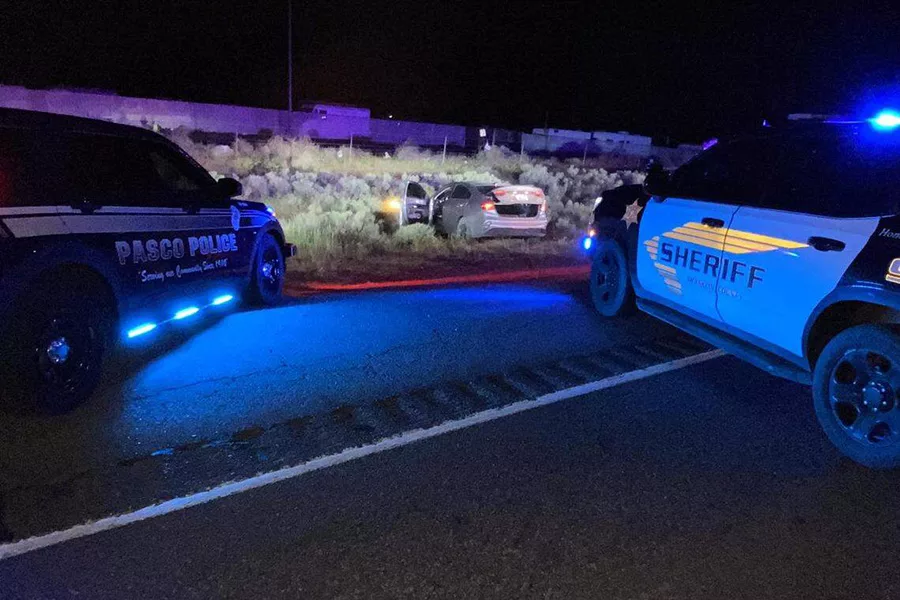
A crash scene on Highway 395 near Connell in 2024.
Franklin County Sheriff’s OfficeTwo bills introduced by Mid-Columbia state lawmakers would allow for locally designated zones along high-risk stretches of public roads where crashes are common and unsafe driving can have outsized consequences.
State Rep. Mark Klicker, R-Walla Walla, introduced House Bill 2174 in the House and state Sen. Nikki Torres, R-Pasco, introduced Senate Bill 6066. Both would let counties, cities, towns and the state Department of Transportation secretary treat dangerous sections of roadway similar to construction zones: Markers, such as lights and signage, would alert drivers to the zone – where fines would double for speed violations and for infractions that involve a crash – and law enforcement supervision would increase.
After an accident risk zone is established, either the municipality or the state transportation department would conduct engineering and traffic investigations of the public roads in the zone to identify safety improvements, including adjustments to the speed limits. The zones dissolve once permanent safety upgrades are in place.
HB 2174 includes language that fines would help fund the accident risk zone – perhaps the engineering and traffic investigation, signage, safety upgrades or law enforcement personnel, the bill says.
Two recent crashes in Klicker’s District 16 highlight the need for the legislation, he said at the House bill’s first hearing, in the House Local Government Committee on Jan. 21.
In November 2025, a Kahlotus City Council member died in a crash at the Vineyard Drive intersection of Highway 395 in Franklin County.
Then, on Christmas, a family of three – a mother, father and their infant – died in a crash on Highway 12 between Walla Walla and Wallula Junction.
Klicker said his bill would offer municipalities a “temporary short-term fix until we can get long-term solutions accomplished.”
On Highway 12, that solution will be the final phase of a project converting two lanes into four lanes between Walla Walla and Tri-Cities. Elsewhere, it might be frontage roads, overpasses or cloverleafs.
Torres’ bill was heard Jan. 15 by the Senate Local Government Committee and unanimously approved Jan. 22 and is now moving to the Senate Transportation Committee.
Torres said in a statement the state has a responsibility to act decisively when crash patterns are clear.
“If we know where collisions keep happening, we should treat those areas like the urgent safety priorities they are and respond with engineering, enforcement, and accountability,” she said.
Only supporters testified at the bill’s Jan. 21 House committee hearing.
Maria Serra, the city of Pasco’s public works director; Brad Tower, a lobbyist with Washington Counties Risk Pool, and Axel Swanson, managing director at the Washington State Association of County Engineers, suggested adding language to protect from liability the municipalities that establish the risk zones.
Tower said, “We do think that this (bill) is an excellent way for municipalities to identify problem spots and take measurable actions to make our roadways safer for folks. And, as we know, this is not just a matter of coming in and changing a lightbulb – I mean, traffic improvements take a long time. So it is appropriate to identify those spots and to require that users of this infrastructure … exercise more caution, slow down, et cetera.”
Serra said the Pasco area has two intersections – one on Highway 12, the other on Highway 395 – that see many collisions, some fatal. She said that, for the past three years, the city has asked the state Legislature for help in finding solutions to the Highway 12 intersection; at one point, the Legislature approved funding but it was vetoed.
“Texas” Larry Walker, volunteer state legislative affairs officer for A Brotherhood Against Totalitarian Enactments (ABATE) of Washington – a not-for-profit that advocates for motorcyclists’ freedom – praised the bill.
He expressed concern, though, that increased law enforcement could lead to targeted enforcement of motorcyclists. He said law enforcement might not recognize that a biker’s seemingly risky maneuver is actually safe and suggested that officers could be trained to tell the difference.
Also testifying in favor of HB 2174 was Michael Robitaille, the mayor of Kahlotus, who came before the committee, he said, as a private citizen.
It was his father, Kahlotus city councilman Perrie Robitaille, 77, who died in the crash at the Highway 395 intersection on Nov. 25.
He urged the committee to pass HB 2174 “in the hopes that other families don’t have to share the grief” that he has experienced.
As of Feb. 10, both bills remain alive but must pass out of their houses of origin by 5 p.m. on Feb. 17 to continue to be considered.
The Tri-Cities Area Journal of Business contributed to this report.
Erick Bengel, reporting on Eastern Washington issues during the 2026 state legislative session, is with the Murrow News Fellowship.
This story is republished from the Washington State Standard, a nonprofit, nonpartisan news outlet that provides original reporting, analysis and commentary on Washington state government and politics.