
Proposal would give WA agricultural workers more options to form a union
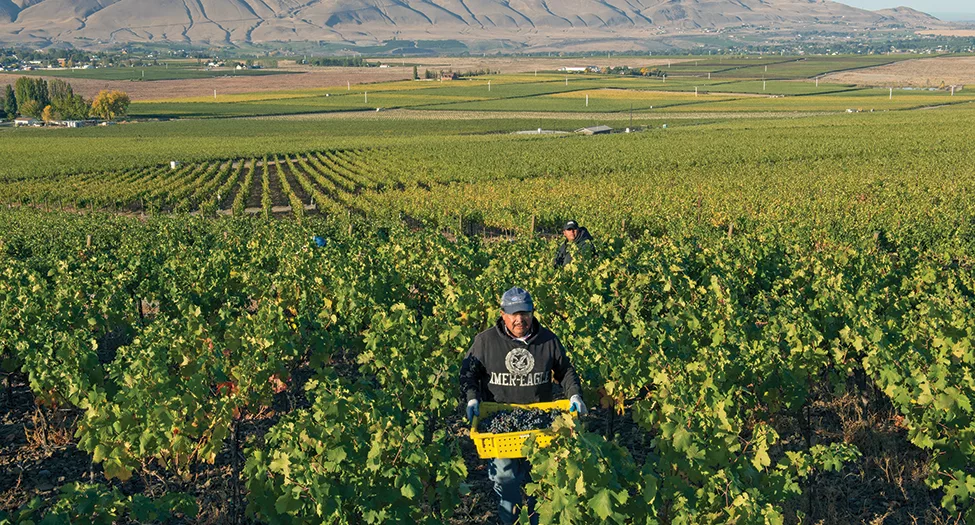
Washington is one of five states most dependent on H-2A workers in the country -- whose numbers have ballooned in the last decade to about 33,000.
Courtesy Andréa Johnson Photography/Washington State Wine CommissionA proposed law would give Washington’s agricultural workers a formal process to engage in collective bargaining with their employers, extending an advantage that many private-sector workers have.
But farm representatives worry that the change would burden an already struggling industry.
Senate Bill 6045 had its first hearing on Jan. 20 in the Senate Labor and Commerce Committee, which is chaired by the bill’s prime sponsor, Sen. Rebecca Saldana, D-Seattle.
The federal National Labor Relations Act, which grants collective bargaining rights to private-sector workers, does not cover agricultural workers. In Washington, agricultural workers can unionize, but the bill’s advocates point out that the law does not have a mechanism to enforce that ability.
SB 6045 would put agricultural workers’ collective bargaining under the purview of the state Public Employment Relations Commission, which already covers agricultural cannabis workers. The state commission, along with the courts, would enforce workers’ rights associated with forming a union, including certifying the union and establishing a contract, according to the bill summary.
Impassioned support
April Sims, president of the Washington State Labor Council, AFL-CIO, who testified in support of the bill, said the federal act left out agricultural work — “work historically performed by Black, Mexican or Filipino workers, and a century later that injustice still stands.”
“You have a chance to both empower the farm families who supply our food and to correct this historic injustice,” Sims said.
Andrea Schmitt, an attorney at Columbia Legal Services who supports the bill, said the fact that farmworkers don’t have an enforceable right to union elections, or to ensure their employers recognize those unions, remains a “gaping hole in the law.”
Several people who supported the bill are associated with Familias Unidas por la Justicia, a Washington farmworkers union that was born of strikes, boycotts and years of litigation, according to its political director, Edgar Franks.
He told the committee that such a contentious process “caused economic harm to both the employer and the employee. That’s something that we don’t want.”
SB 6045 “offers a remedy,” he said.
“Predictability, I know, is a big thing for employers and also for workers, so we feel that this bill does that,” he said. “It also offers fairness for workers.”
Tomas Ramon, vice president of FUJ, said through a translator, “Winning a union contract has changed my family’s life for the better in every way.
“We’re tired of hearing the excuse from the agricultural industry that giving farmworkers the same rights as everyone else will run farms out of business. It’s an insult to our humanity.”
Significant opposition
Of the people who signed into the meeting but did not testify, almost 500 favored the bill, and more than 600 opposed it.
Blaine Smith, an orchardist who opposes the bill, said he spoke for hundreds of small growers in the Wenatchee Valley when he said the agricultural industry faces financial difficulties right now.
“Nobody’s making an income,” he said, “and as much as we would like to pay higher wages, we just simply are broke.”
Enrique Gastelum testified on behalf of the Worker and Farm Labor Association, which opposes SB 6045. He said the bill “adds significant risk at a time when agriculture cannot absorb more.”
“Washington agriculture has been financially strained for years,” he said. “Farm numbers are falling, labor costs have surged, and many operations are hanging on by a thread. When farms close, workers are the first to lose income and the economic impact ripples across the entire community. Any new labor policy must be crafted with this fragile reality in mind.”
Gastelum and other critics share the concern that, by allowing workers to strike, the bill risks the crops that during harvest season must be picked within a narrow timeframe.
Others questioned whether a new law is needed given Washington’s worker protections, including the highest minimum wage among the states, overtime pay, employee safety and statutes against discrimination and retaliation.
Cory Anderson, director of agriculture operations and strategy at L&L Ag Production, asked what problem the bill seeks to solve.
“This bill doesn’t just claim to protect workers,” he said. “It builds a new labor system — a system of mandatory bargaining, lawyers and rigid rules. You don’t improve relationships by turning them into legal processes. … Collective bargaining agreements replace those relationships with paperwork and procedures. You cannot legislate trust, but you can absolutely destroy it.”
Saldana said the way agriculture operates is not working, in part, “because the fundamental way that we’ve structured this industry is based on a history of exploitation, and until we face that, it is causing harm to the farmer and to the farmworker.
“It is why we see a high rate of suicide and mental health challenges for both the producers and also the farmworkers.”
Calling her bill a “starting point” to correct the power imbalance, she said that although it is a short legislative session, “I am optimistic that the people that we have before us right now — the farmers we heard from, the association leaders that we heard from, the union representation we heard from — that we are the right people at the right time to take on a big challenge.”
A companion bill also had a hearing in the state House of Representatives.
Erick Bengel, reporting on Eastern Washington issues during the legislative session, is with the Murrow News Fellowship.
This story is republished from the Washington State Standard, a nonprofit, nonpartisan news outlet that provides original reporting, analysis and commentary on Washington state government and politics.