
Farmworkers sue over Trump’s low wages for foreign guest workers
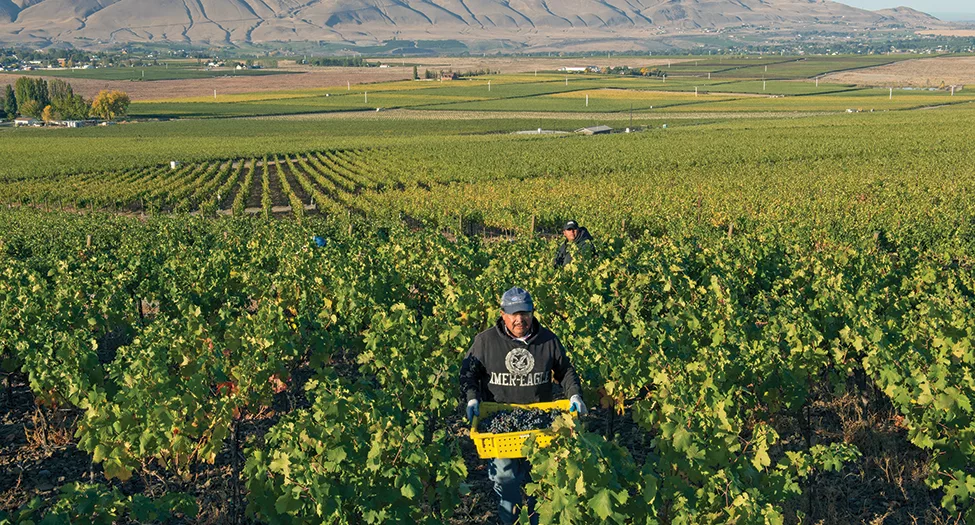
Washington is one of five states most dependent on H-2A workers in the country -- whose numbers have ballooned in the last decade to about 33,000.
Courtesy Andréa Johnson Photography/Washington State Wine CommissionA California union and a group of farmworkers from around the country — including one from Sunnyside and several others working in the state’s vineyards — are suing to stop new, lower-wage federal guidelines that save money for farmers but cut pay for temporary foreign agriculture workers, hurting local laborers as a result, the suit alleges.
In a lawsuit filed Nov. 21 in federal court, the United Farm Workers and 18 individual workers sued the U.S. Department of Labor over the October guidelines for laborers who are in the United States under temporary, H-2A visas. The new guidelines set lower wages — differentiating them by state — including pay cuts to account for the value of free housing provided by law to foreign workers.
“Farm workers, and the rural communities across America they sustain, need and deserve fair wages and job security, not a race to the bottom with an endless supply of cheap foreign labor,” Teresa Romero, president of the United Farm Workers, said in a statement announcing the lawsuit.
The new Trump administration rules are “drastically cutting the minimum wage that U.S. employers must pay foreign farmworkers, all while costs and wages in other sectors have sharply increased,” the lawsuit states, adding that the lower pay for foreign workers will also force cuts for American workers. The lawsuit asks a federal judge in California to halt implementation of the guidelines and recalculate wages.
The lawsuit also objects to first-time pay differentials based on the value of employer-provided housing. It alleges violations of laws requiring that foreign visas not affect wages of U.S. workers with similar jobs.
The cuts “will severely impact farmworkers — some of the most vulnerable members of our society and many of whom already live in poverty,” according to the lawsuit.
Cristano Serrano, a U.S. citizen farmworker in Sunnyside who has 45 years of experience in apples, cherries, asparagus, and tractor driving, said the cuts would reduce his most recent wage of $20 per hour to $16.53, according to court documents. The wage cuts would make it more difficult for him to cover basic necessities like food and medicine to treat his asthma, which he had developed from his agricultural work and exposure to chemicals from so many years in the industry.
Three other farmworkers with decades of experience in the state's vineyards claim in court documents that they would see their wages cut between more than $2 per hour up to as much as more than $4 per hour under the new federal rules. That would make it harder for them to make ends meet and makes them concerned that they will be edged out of their jobs by foreign laborers.
Other workers across the country made similar claims. One worker, not identified by name, works in Missouri with an H-2A foreign worker visa was formerly paid $17.83 an hour and will suffer a $4.08 pay cut, leaving him unable to afford food and essential protective clothing for his job helping with squash, eggplant and other vegetables, according to the lawsuit.
Irene Mendoza, a U.S. citizen, said in the lawsuit that her wages could be cut by $3.22 an hour, to $13.78, because of the guidelines, even though she doesn’t need a foreign worker visa, forcing her to get a second job to pay for food, housing and transportation between jobs in some of the states where she works. Mendoza said in the lawsuit that she works picking and packing green beans and potatoes in Michigan, Minnesota, Texas and Wisconsin.
The lower wage guidelines vary by state and are subject to state minimum wage laws that could make them higher in some states. In North Carolina, for instance, the new hourly wage is $11.09 for less-skilled workers, compared with $16.16 last year, and $12.27 for local workers who don’t need housing, according to a Cornell University analysis.
The Department of Labor referred a Stateline request for comment to the Department of Justice, which declined comment.
Some farmers and experts have hailed the new guidelines as lifesavers that will stave off bankruptcy as costs rise and some prices for their farm goods stay low.
Almost half the H-2A visas in the 2025 fiscal year were in a small group of states including Florida (60,000), Georgia (44,000), California (37,000), Washington state (36,000) and North Carolina (28,000). The government expects an additional 119,000 visas to be issued under the new rule, on top of the nearly 420,000 a year issued in recent years.
Public comments on the rule are open until Dec. 1.
The Tri-Cities Area Journal of Business contributed to this report.
This story was originally produced by Stateline, which is part of States Newsroom, a nonprofit news network which includes Washington State Standard, and is supported by grants and a coalition of donors as a 501c(3) public charity.