
Worker sues juice maker for rest break violations
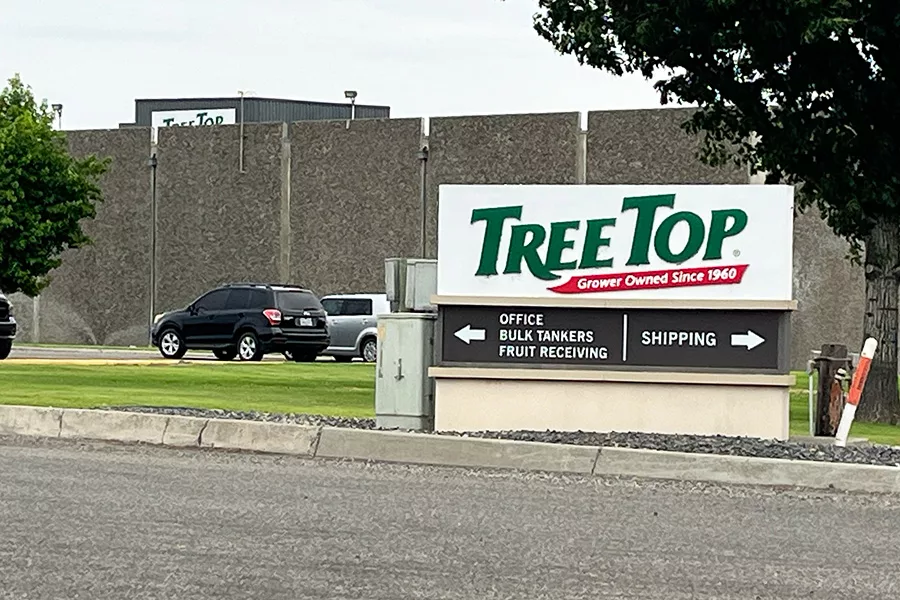
From time spent donning protective gear to regularly needing to respond to management needs while on meal or rest breaks, a former Tree Top employee says in a lawsuit the Selah-based juice maker failed to fully pay him or make sure he received legally required breaks while working.
Photo by Ty BeaverA former employee of Selah-based juice maker Tree Top is suing the company for allegedly failing to compensate him for overtime and work he was required to do off-the-clock and is hoping other former and current company workers will join him.
From time spent donning protective gear to regularly needing to respond to management needs while on meal or rest breaks, Braine Johnson says Tree Top failed to fully pay him or make sure he received legally required breaks while working for the juice maker.
He is seeking $75,000 in damages for himself but also is asking the U.S. District Court for the Eastern District of Washington to provide his claim class-action status so others who have worked for the company can pursue damages via his efforts.
The company is owned by roughly 1,000 growers in Washington, Oregon and Idaho, according to Good Fruit Grower. Tree Top operates at seven locations in Washington – including in Prosser – Oregon and California.
“If each individual … were required to file an individual lawsuit, (Tree Top) would necessarily gain an unconscionable advantage because (Tree Top) would be able to exploit and overwhelm the limited resources of each member … with (Tree Top’s) vastly superior financial and legal resources,” Johnson’s claim states.
Tree Top did not respond to a request for comment from the Tri-Cities Area Journal of Business, but the company did tell Good Fruit Grower that it takes these claims seriously and is committed to operating with integrity and in full compliance with all applicable labor laws, noting the case is one of many similar lawsuits filed across Washington state against employers in various industries.
According to the complaint, Johnson worked for Tree Top as a team lead for its processing facilities in Selah from Sept. 1, 2021, to July 7, 2023. His work required him to wear safety gear including arm guards, safety hats, plastic aprons, gloves, goggles and earplugs, and he typically worked between 50 to 60 hours a week.
His lawsuit claims that Tree Top had a “common course of wage-and-hour abuse” that violates state law as well as the Fair Labor Standards Act.
According to the claim, employees were required to put on and take off the personal protective equipment while off-the-clock. While on meal or rest breaks, Johnson said he and other workers were required to stay on site and respond to management work requests while clocked out as supervisors rarely scheduled sufficient staff to cover for those on breaks.
Tree Top also failed to pay overtime when he and others worked more than 40 hours in a week. Johnson said he and his co-workers are not agricultural employees and so overtime must be paid for time over 40 hours.
Only since Jan. 1, 2024, has state law required agricultural workers be paid overtime for working more than 40 hours in a week. An agricultural worker is defined by the state as someone who works for an agricultural employer who engages in agricultural activity such as growing, producing or harvesting of farm or nursery products.
With so many other employees subject to the same circumstances he faced, Johnson claims it only makes sense that his complaint be afforded class action status.
Johnson is represented by the firms of Emery Reddy, PLLC in Seattle and Schneider Wallace Cottrell Konecky LLP of Emeryville, California.
Tree Top’s counsel is Fisher & Phillips LLP of Portland.