
WSU researcher helps uncover hidden history of turkey domestication
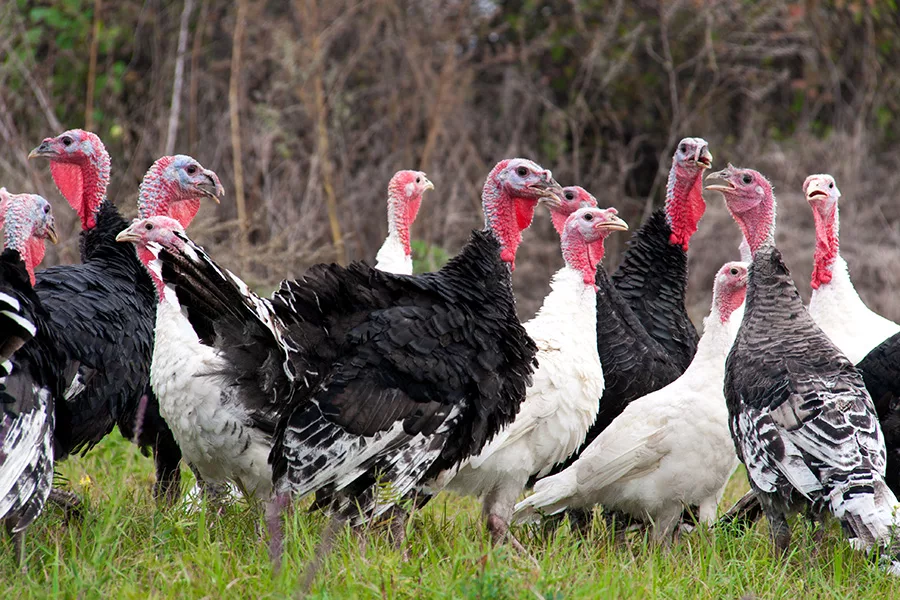
An associate professor of anthropology at Washington State University is on a mission to show the world how interesting turkey are.
“When I tell people I’m an archaeologist, they get really excited and they always ask me about my research,” Erin Thornton said in a WSU news release. “And as soon as I tell people that I’m studying turkeys, they look at me like I’m crazy.”
Thornton studies how New World societies like the ancient Maya and other cultures domesticated and managed turkeys for subsistence and ritual use. She contributed to and co-edited the recently published book, “Exploring the History of Turkey Management and Domestication: A Transatlantic Perspective,” which follows the evolution of turkeys from a New World livestock species to a globally-raised animal with cultural connotations in America, Europe and beyond.
“The turkey is the only vertebrate animal domesticated in North America during ancient times,” Thornton said. This contrasts with other global regions where a broader suite of animals were domesticated.
Her research has helped document the origins of turkey domestication in central Mexico, one of the two origin centers of turkey domestication along with the American Southwest. Evidence points to the domestication process occurring independently in each region, despite the existence of ancient cultural diffusion and exchange.
Thornton recently received a National Science Foundation grant to investigate turkey husbandry at Paquimé, an archaeological site in Chihuahua, Mexico.
Along with her graduate student collaborator, Caitlyn Ainsworth at the University of New Mexico, she is investigating whether the site’s inhabitants adopted domesticated turkeys from another region or independently experimented with the domestication process themselves. The international research efforts kicked off earlier this fall.
As a zooarcheologist, Thornton uses several techniques to analyze how turkey populations were affected by the domestication process. One particular method, stable isotope analysis, can be used by researchers to identify isotopic markers in bones and teeth, allowing them to reconstruct an animal’s diet.
Scientists can use the ratios of different carbon and nitrogen isotopes to estimate what the turkeys were eating. More wild plant material indicates a wild population of turkeys, but finding evidence of domesticated corn or maize indicates that the turkeys had lived in close proximity to human settlements.
“What we’re looking for is when turkey diet starts converging with human diet,” Thornton said. “That indicates when turkeys stop feeding on available wild resources and when they start being closer to humans, even being fed maize from humans themselves.”
Additional analytical techniques include studying the morphology of turkey bones recovered during archaeological excavations and comparing ancient turkey DNA with modern turkey DNA to trace lineages and subpopulations, reconstructing whether certain traits were being proactively selected.
“North America has been ignored in terms of animal domestication discussions,” Thornton said. “The core of my research is to really understand how the turkey domestication process in North America can be integrated into broader discussions of global animal domestication.”