Kennewick considers turning parking spots into dining spaces
Visitors to Seattle, Portland, Europe or Wenatchee may have noticed the popularity of a new type of urban, outdoor dining space: the streatery.
The transformation of parking spots into outdoor patios is coming next spring to Kennewick Avenue.
After dining at the McGlinn’s Public House streatery in Wenatchee, Rockabilly Roasting Co. owner Travis Jordan shared the streatery idea with Ann Steiger, owner of Roxy Theatre, where the Rockabilly is located. Steiger then brought the concept to the attention of city officials.
Emily Estes-Cross, economic development manager for the city of Kennewick, immediately recognized the concept’s alignment with what residents have expressed a need for in surveys over the past couple of years.
“The resounding answer was a desire for outdoor dining and community gathering space,” she said.
Out of 567 respondents, 78 percent said they wanted to see the development of more restaurant amenities. The current infrastructure—namely sidewalks—don’t support this vision well enough.
“The sidewalks simply aren’t wide enough to accommodate substantial outdoor dining space,” Estes-Cross said. However, “the scale of development in downtown Kennewick is very pedestrian-friendly,” she said.
“I think when it formulates and happens, we’re going to get a huge influx of people coming down here and I hope we can hold onto them,” Jordan said.
The new outdoor dining initiative fits in nicely with the city’s ongoing efforts to revitalize the downtown area and encourage residents and visitors to walk around and peruse. Expanded dining options will help facilitate this.
“We were looking at expansion anyway,” Jordan said. “Most mornings I walk in and the place is full. This way we won’t have to augment indoor space.”
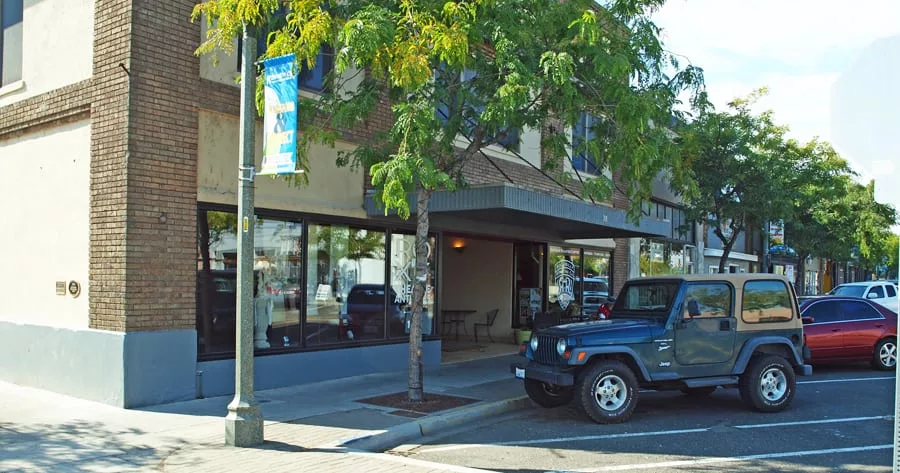
The current plan for Rockabilly’s streatery is to capitalize on its corner location at Kennewick Avenue and Auburn Street by leveraging the space from two motorcycle stalls in front of the café and part of the wedge-shaped street corner. A semi-permanent platform outfitted to withstand all seasons would be built flush with the curb to accommodate the disabled, and a sturdy barrier would separate diners from street traffic.
Another benefit of the streatery concept is they are relatively cheap to put in and don’t require extending sidewalks or expensively relocating and building new infrastructure. They can even serve as small, outdoor entertainment platforms.
Seattle launched its streatery program in 2014 and recently conducted a survey of businesses that host them and the people who use them.
Results revealed they are occupied about half the time and people stay an average of 40 minutes. Eighty-one percent think streateries contribute to a sense of neighborhood character and identity, and 60 percent of those respondents reported they are more likely to visit the street.
A majority of respondents visited them to socialize, either with friends or spontaneously with others sharing the space.
Sixty-seven percent of streatery operators reported increased sales because of the new outdoor space, and 83 percent reported an increase in foot traffic.
The most notable finding, however, was 29 percent of businesses neighboring streateries reported an increase in foot traffic, noting 25 percent more sales.
“This is an economic development tactic,” Estes-Cross said “It’s an affordable way to expand space to meet the marketplace need and create more jobs.”
Small building footprints need no longer limit growth as expanded space will provide businesses with increased opportunities for profit, which will lead to hiring more food service employees to meet demand.
Despite enthusiasm for the new development, some have questioned reductions of premium parking space to accommodate streateries.
However, Estes-Cross recalled how a gallery owner near the popular Foodie’s Brick and Mortar restaurant told her, “I watch people pass by my gallery on their way to Foodies, but I say bring more Foodies and don’t worry about the parking because after they’ve eaten, they walk through my gallery.”
“We received very few complaints when we surveyed people about driving to destination cities and having to walk further. They were willing to walk to an area that’s pedestrian-friendly and hang out because that area’s not full of cars, it’s full of people. Steateries are a way to ignite space with people,” Estes-Cross said.
Seattle survey respondents reported an uptick in customers walking, riding transit, or biking.
Jordan reported there is limited bike parking available on Kennewick Avenue. He said he hopes to incorporate aesthetically-pleasing bike racks into the design of his streatery to provide the many cyclists who frequent Rockabilly a safe place to park their bikes.
“Our goal is to generate vibrancy with engaging spaces and streetscapes that attract visitors, lengthen stays, and increase spending,” Estes-Cross said.
Over the course of winter 2017-18, streatery criteria will continue to be honed and developed, with the goal of beginning construction on the Rockabilly streatery in April or May. The Rockabilly pilot program aims to launch by Mother’s Day.
Though Estes-Cross said only one other business has inquired about applying to host a streatery, she is confident “there will be more interest once the requirements are established … we expect that these will be an asset for the community. Other people and businesses will see these and see how they can work in their neighborhood … anyone can apply—this is a city-wide initiative.”
Estes-Cross said the application process will generally entail interested businesses applying for a streatery location. “If it is deemed safe and meets the rest of the criteria … they would be issued a licensing agreement to be in the public right of way,” she said.
It would not be a permanent license, but revocable in case of unforeseen circumstances that would force removal. Businesses would retain ownership of the structures they build. Streateries would remain public spaces, but with the primary purpose of providing dining space. Additionally, the Washington State Liquor and Cannabis Board has approved service in streateries, as long as they are located within front window sight distance.
Preliminary criteria developed so far would require intended sites to be placed a certain distance from utility poles, hydrants and other infrastructural components and adjacent to the hosting business. Speed limits around the proposed streatery would have to be 30 mph or less, and an appropriate amount of parking would need to be available nearby.
Design standards will be based on existing Bridge-to-Bridge, River-to-Railroad food truck guidelines, with input from the Historic Downtown Kennewick Partnership.
Estes-Cross has applied for a Community Development Block Grant, whose advisory panel recommended that the city council contribute $50,000 to help pay for disability-accessible structures, bike racks and utility hookups. The hosting businesses would be expected to pay a percentage of this cost.
The development of streateries also will lay the groundwork for similar spaces in future urban developments, such as Vista Field, which already has outdoor dining space planned into its pedestrian-friendly framework.
“I think (streateries) are a huge step in the right direction, especially for our downtown,” Jordan said.
“We will be first out of the gate in the region,” Estes-Cross said.