Hanford advocates push back on proposed federal cleanup cuts
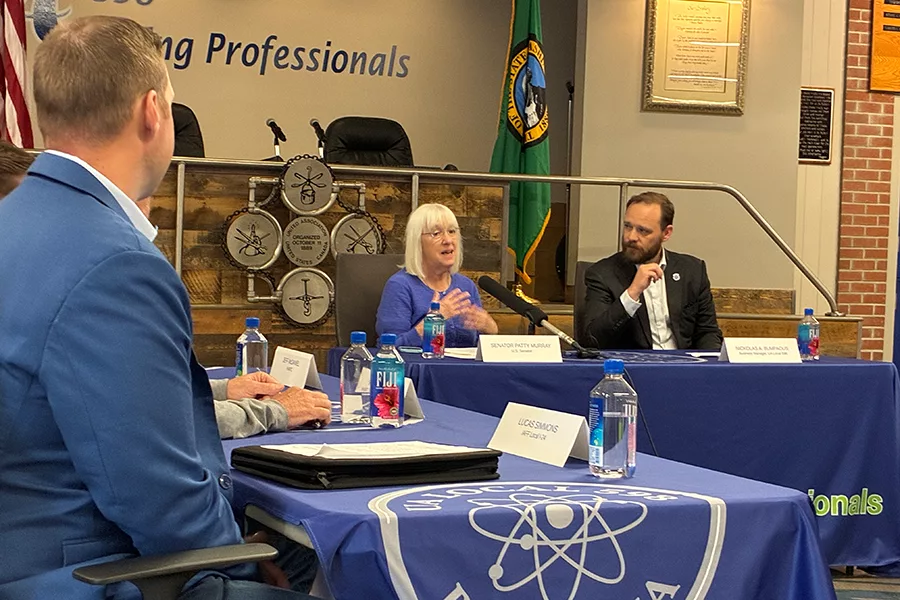
U.S. Sen. Patty Murray, D-Washington, speaks with Nick Bumpaous, business manager for UA Local 598 Plumbers & Steamfitters union and other Tri-City union and business leaders about President Donald Trump’s proposed fiscal year 2027 budget.
Photo by Ty BeaverThe Trump administration’s proposed cuts to Hanford cleanup funding is drawing backlash from Washington officials, unions and watchdog groups, despite DOE assurances that critical work will continue uninterrupted.
A U.S. Department of Energy official recently told Hanford community leaders that the proposed reductions are less severe than they appear and would not slow key work at the site’s Waste Treatment Plant.
Marianna Du Bosq, director of budget and planning for DOE’s Office of Environmental Management, acknowledged during a recent meeting in Pasco of leaders of cleanup sites that the White House’s proposed budget would lead to some work at Hanford being deferred, such as deactivation of the 324 Building.
However, any apparent cuts to funding for the High-Level Waste facility at the Waste Treatment Plant, commonly known as the vit plant, will not limit that project.
“We’re going to continue as is,” Du Bosq said. “We have more than enough in carry over.”
At least one member of the Hanford Advisory Board was not reassured by Du Bosq’s comments. Miya Burke, co-chair of the citizen-led board, said DOE has a legal obligation to meet cleanup deadlines. She asked how the proposed $400 million cut to Hanford’s budget would impact efforts such as the eventual shipment of the site’s transuranic waste to long-term storage in New Mexico.
“We’ll make sure to monitor our obligations,” Du Bosq said in response.
U.S. Sen. Patty Murray, D-Washington, said during a recent roundtable discussion with Tri-City business and union leaders she is “going to tear President Donald Trump’s budget up” and ensure the site’s cleanup remains a priority.
“He talks more about the (White House) ballroom than the investment we need to make here at Hanford and elsewhere around the country,” she said.
Congress set Hanford’s current fiscal year budget at a record $3.55 billion. Despite that, Washington state officials have noted that was still not sufficient to meet cleanup obligation timelines set out in a court order between the state’s Department of Ecology, the U.S. Environmental Protection Agency and DOE.
The Trump administration released its proposed fiscal year 2027 budget in April. It would fund DOE at nearly $54 billion, a nearly 10% increase over the current fiscal year. However, the Office of Environmental Management, which oversees Hanford, would see an overall cut of 5%, or about $386 million. The Hanford site’s cut is among the highest of any DOE EM site at 12%.
The White House specifically cited Hanford in its top line budget document, saying “reductions focus on operating the new Direct-Feed Low-Activity Waste facility to reduce liability rather than accumulating balances for partially-designed facilities.”
Union leaders representing thousands of Hanford site workers told Murray the proposed budget was “disrespectful” and “extremely irresponsible.” The recent milestones such as treated waste now being transformed into a glass form at the vit plant after decades of work and billions of dollars in investment show now is the wrong time to “take our foot off the gas.”
“We’re under legal obligation to clean this up, I don’t want another generation out there, it’s not necessary,” said Barry Shoemake, business agent for UA Local 598 and a third-generation Hanford site worker.
The union leaders added that inconsistent and unstable funding that leads to job reductions will ultimately cost taxpayers more money and slow cleanup.
“When you lay someone off, you can’t just bring them back. They’re going to go find another job tomorrow,” said Seth Worley of the Central Washington Building & Construction Trades Council.
“This isn’t plug-and-play labor, this is when continuity matters,” added TJ Carter of IBEW Local 112, noting that laid-off workers have to spend weeks or months being retrained if they are rehired.
Murray ascribed the proposed cuts to Trump’s demand to secure an additional $1.5 trillion for the federal defense budget and the ongoing conflict with Iran. She said she plans to use her role as vice chair of the Senate Appropriations Committee to ensure those proposed cuts don’t become permanent.
But the moral and legal obligations of the cleanup aren’t the only reason it needs to be completed.
“I know the more we get done, the more economic opportunity will come (to the Tri-Cities),” she said. “If we can’t clean up what we have, we can’t welcome new nuclear energy.”


Stay Informed. It’s Free.
Subscribe to our newsletters and get the latest news and insights delivered to your inbox.
We respect your privacy.
Unsubscribe anytime.
Thank you!
You’re subscribed. Keep an eye on your inbox for the latest updates.