Business Briefs — July 2026

TCCH nurses ratify new contract
Nurses at Tri-Cities Community Health will get wage increases as well additional pay for those moved to new worksites on short notice under a new contract.
The nurses, which are represented by UFCU 3000, reached a tentative agreement with TCCH earlier this month, according to a union release. They voted to accept it following a vote on June 26.
“Our member-led bargaining team feels proud to have negotiated a strong contract with fair wages that keep up with local clinics, which will help us recruit and retain more nurses so we can deliver the level of care our patients deserve,” said Sophia Rubalcava, a nurse and member of the union’s bargaining team, in a statement. “Personally, I’m putting my raise toward certifications I plan to get to help increase my skills on the job.”
Nurses and TCCH representatives began negotiating the new contract in early April. The former one lapsed in June and agreed upon wage increases in the new contract will be applied retroactively.
The new deal also provides temporary assignment pay to nurses who are moved to a different TCCH facility with less than two weeks’ notice.
TCCH operates seven clinics throughout the Tri-Cities staffed by 320 health care providers and employees. It was founded in 1982 by two women who saw the needs of migrant and farm workers in the community. It became a Federally Qualified Health Center in the 1990s.
WSU Tri-Cities, chamber to launch new business education network
Washington State University Tri-Cities and the Tri-City Regional Chamber of Commerce will launch a new entrepreneurial training initiative this fall and they want your input on shaping it.
The Resilient Business Builders Network will focus on providing training, networking opportunities and professional development for entrepreneurs, small business owners and nonprofit leaders, according to a release.
“Partnerships like the Resilient Business Builders Network are essential to the long-term economic vitality of the Tri-Cities,” said Austin Regimbal, vice president of the Tri-City Regional Chamber of Commerce, in a statement. “By joining forces with WSU Tri-Cities Cougar Tracks, the Chamber is advancing our mission to support small business growth and ensuring that high-quality workforce training is accessible to organizations of all sizes across our region.”
Future workshops led by Cougar Tracks, WSU Tri-Cities’ continuing education division, will center on topics such as practical AI adoption strategies for business and teams, leadership development and other workforce-related skills alongside networking opportunities.
In the meantime, organizers are gathering input through a regional survey and seeking applicants to be volunteer “Business Catalysts” who may serve as instructors, facilitators or panelists.
Go to: bit.ly/cougar-tracks.
Pasco seeks farmers market, specialty kitchen operator
The city of Pasco is seeking proposals for the management and operation of two city-owned programs and facilities.
Qualified organizations, nonprofits and individuals are invited to submit proposals to operate either the Pasco Farmers Market, Pasco Specialty Kitchen or both beginning in 2027.
“These programs have played an important role in the growth of downtown Pasco, and we’re excited to give community organizations and local leaders the opportunity to help shape what’s next,” said Harold Stewart, Pasco’s city manager, in a statement. “We’re looking for partners who share our vision of a vibrant downtown where people gather, support local businesses, and enjoy spending time.”
Located in Peanuts Park at 426 W. Lewis St. in historic downtown Pasco, the farmers market is open every Saturday from May to October and features locally-grown and produced fruit, vegetables, meat, baked goods and artisan products.
Just across South Fourth Avenue from the farmers market is the Pasco Specialty Kitchen, a certified commercial kitchen with multiple walk-up vendor windows at 110 S. Fourth Ave. It serves as an incubator space for small businesses, and over the years it has been a launchpad for several businesses, from Angel Brook Ice Cream to Aub’s Bananza Bread. It’s been in Pasco since 2003.
Proposals are due by Aug. 5. A request for proposals isn’t a commitment to purchase services or a contractual offer. The city will evaluate proposals based on the applicants’ ability to manage daily operations, support growth and innovation, maintain regulatory compliance and provide high-quality service.
Go to: bit.ly/pasco-bids.
Credit rating agency maintains high rating for RSD
A national credit rating agency recently announced it continues to rate Richland School District as a stable borrower for bonded debt.
Moody’s Ratings affirmed RSD’s A2 issuer and general obligation for unlimited tax (GOULT) ratings, according to a release. It also assigned an A2 underlying rating and Aaa enhanced rating to the district’s proposed $18 million Unlimited Tax General Obligation Refunding Bonds, 2026. The district has roughly $115 million in GOULT debt outstanding.
“The affirmation of the A2 reflects our expectation that available general fund reserves will improve over the next two years from a currently very narrow 0.6% of revenue in fiscal 2025 (year-end August 31),” Moody’s said in a statement. “Management projects an increase in available fund balance to over 2% in fiscal 2026, followed by a further increase to over 5% in fiscal 2027.”
Moody’s added that the Tri-Cities’ growing economy is also part of the basis for its A2 rating. Washington state’s pledge to guarantee debt service on qualified voter-approved school district general obligation bonds contributed to the Aaa enhanced rating.
AWB releases 2026 legislative endorsements
The state’s leading business advocacy organization has identified the current and hopeful state lawmakers for the Mid-Columbia it believes will best serve employers.
The Association of Washington Business identified an initial group of endorsed candidates by determining they aligned with AWB’s position on votes in the Legislature 80% of the time or more, according to a release.
For the Mid-Columbia, that included the following incumbents:
- State Reps. Stephanie Barnard and April Connors in the 8th legislative district
- State Reps. Gloria Mendoza and Deb Manjarrez in the 14th legislative district
- State Rep. Chris Corry in the 15th legislative district
- State Reps. Mark Klicker and Skyler Rude in the 16th legislative district
More recently, AWB made further endorsements following candidate interviews and member input. Those endorsements include:
- State Sen. Nikki Torres, who is vying for the seat being vacated by state Sen. Matt Boehnke in the 8th legislative district
- State. Rep. Jeremy Dufault, who is vying for the seat being vacated by Torres in the 15th legislative district.
“Washington employers are increasingly concerned about the direction of the state economy and the growing burden of taxes and regulations that leave our state out of step with much of the country,” said Morgan Irwin, AWB’s vice president for government affairs, in a statement. “That’s why it’s so important that we elect leaders who not only understand the serious challenges facing employers right now, but also work to promote a growth agenda and create jobs.”
Title company building becomes adult day care
A title company building in the Vista Field area of Kennewick is set to turn into an adult day care facility.
According to plans filed with the city of Kennewick, 6921 Crosswind Blvd. will undergo a change of use to become an adult day care facility. The two-story, 10,266-square-foot building was purchased by 6921 Crosswind Acquisition II LLC for $2.6 million in April.
6921 Crosswind Acquisition II LLC is a company registered in Delaware. It was first incorporated in March 2026 under a registered agent.
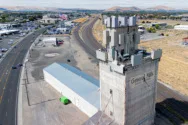
The distinctive two-story red-brick building has four white columns and a classical-style entrance.
The building was previously owned by Jay Carey and Hortensia Castillo-Carey, and Frontier Title & Escrow Company operated there.
According to a social media post from the Tri-City Association of Realtors, Frontier Title & Escrow Company has moved to 8121 W. Grandridge Blvd., Suite B, Kennewick.
Portland-based accounting firm joins CliftonLarsonAllen
An accounting firm with clients across Oregon and Washington state has joined one of the nation’s largest accounting firms, which also maintains an office in the Tri-Cities.
Perkins & Company officially joined CliftonLarsonAllen LLP (CLA) effective July 1, according to a release. The move is intended to strengthen CLA’s presence in the Pacific Northwest and broaden its support for clients through integrated audit, tax, consulting, outsourcing, digital and wealth advisory services.
“Perkins & Company brings a strong reputation in the Pacific Northwest, and a culture centered on relationships and community,” said Paul Bailey, chief growth officer at CLA, in a statement.
CLA has more than 120 accounting offices across the U.S. and also some global locations. It is the largest accounting firm in the Tri-Cities, with its office at 8101 W. Grandridge Blvd. in Kennewick employing more than 40 people, with nearly 20 of them as certified public accountants, or CPAs, according to the Tri-Cities Area Journal of Business’ 2025 Book of Lists.
Perkins & Company, founded in 1986, is ranked as a top 125 U.S. firm with more than 200 professionals and nearly $500 million in revenue.
Tri-Cities has more workers but also more people out of work
Unemployment in the Tri-Cities continued its regular seasonal decline in May and more people have jobs than a year ago, but the number of unemployed workers also has grown.
The Washington Employment Security Department reported that 146,587 people were actively employed in the Tri-Cities metropolitan statistical area in May 2026. That’s roughly 2,700 more than in April and a jump of 5,700 people compared to a year prior.
That was enough to drop April’s unemployment rate of 5.3% to 4.9% in May. However, with nearly 750 more people claiming unemployment benefits in the region compared to a year ago, the region saw an increase over the May 2025 unemployment rate of 4.6%
Washington as a whole gained a seasonally adjusted increase of 10,600 jobs in May, the department reported. Of those, 4,800 were in the leisure and hospitality industries, followed by manufacturing with 2,200 jobs and construction with 1,600. Public sector employment gained 1,600 jobs.
This marked the largest one-month surge since December, when 10,100 jobs were added, and last May, when the total reached 10,500 jobs, according to the Washington State Standard. However, even with last month’s surge, the number of jobs in Washington decreased by 7,700 jobs, or 0.2%, since May 2025.
In the meantime, a report issued June 15 by Washington’s chief economist, Dave Reich, says job growth has been weaker than expected since the release of the last revenue forecast in February. He noted initial claims for unemployment benefits were 5,972 in the week ending June 6, up from 5,006 in the prior week.
Gov. Bob Ferguson on June 25 signed an executive order creating a Governor’s Economic Development Council, which includes Columbia Basin College president Rebekah Woods. It comes in the wake of the weaker job growth, as well as recent announcements of Washington-based companies expanding outside the state following increased taxation on businesses by the Legislature.
Ecology seeks feedback on Hanford cleanup permit
The state Department of Ecology is seeking public comment on a draft renewal of the Hanford sitewide permit, which would cover 52 waste sites and facilities at the Hanford nuclear site.
The permit is enforceable and is one of the agency’s primary tools for overseeing the U.S. Department of Energy’s cleanup of Hanford and establishes standards for the storage, treatment and disposal of mixed hazardous and radioactive waste.
“This updated permit will ensure cleanup at Hanford progresses in a safe, efficient and environmentally protective manner,” said Stephanie Schleif, the agency’s nuclear waste program manager, in a statement. “Getting your input is vital in ensuring we produce a permit that reflects community values and priorities.”
The current permit covers 22 waste sites and facilities. The proposed renewal expands that to 52 unit groups and incorporates more than 5,000 comments submitted by the public, tribal nations and permittees during a 2012 comment period.
Ecology will accept comments through Oct. 27. They may be submitted online, by mail or hand delivery, or during public meetings.
Regional public hearings in Washington and Oregon are planned for late September and early October, with dates and locations to be announced.
Want to learn more? An informational meeting, offered in person and online, is scheduled for 6 p.m. July 15. A virtual Lunch & Learn series will run weekly from July 22 through Sept. 9.
The Hanford site produced more than 67 tons of plutonium during World War II and the Cold War. Ecology oversees the cleanup with the U.S. Environmental Protection Agency under the Tri-Party Agreement, a judicial consent decree and other permits.
Go to: ecology.wa.gov/waste-toxics/nuclear-waste/public-involvement.
Commerce awards $2.5M for renewable natural gas facility
A $70 million project to install an anaerobic digester to convert dairy cow manure to renewable natural gas at a Franklin County dairy got a financial boost from the state.
The Washington Department of Commerce has awarded $2.5 million to 5D RNG LLC for the construction of an anaerobic digester and nutrient recovery facility to reduce emissions and run-off. It was one of seven projects to receive $13.8 million in grants from the department’s Dairy Digester Program.
“These dairy projects cut emissions and boost the resiliency of rural communities,” said Sarah Clifthorne, interim director of the Department of Commerce. “They’re a smart, practical way to deliver cleaner air and water while creating new economic opportunities for Washington farmers.”
The project is for Five D Farms, located between Highway 395 and the Snake River in southern Franklin County. It maintains a herd of more than 8,000 head of dairy cattle. The farm began pursuing a project aimed at capturing methane from its herd’s manure three years ago, according to documents filed on the State Environmental Protection Act registry.
The farm currently uses open-air lagoons with no methane capture, resulting in methane emissions and significant nutrient management challenges, according to Commerce. The new facility will introduce not only emissions control and advanced wastewater treatment but also the sale of renewable natural gas by the farm.
5D RNG is affiliated with Stellar J Corp., a Woodland, Washington-based construction firm that specializes in renewable energy projects. It received a $2.5 million Clean Energy Grant from the state earlier this spring for the project.
Report: Columbia Basin water supply becoming more vulnerable
The latest long-range forecast of the Columbia River’s future water availability leaves the region high and dry within the next 20 years.
Climate change along with agricultural practice, groundwater use and growing communities are putting more pressure on the region’s water resources every year. As the region warms, rain rather than snow will fall and what snowpack does accumulate will run off earlier.
As a result, less water is expected to be available in summer and early fall by the 2040s, according to a draft forecast from the Washington Department of Ecology and the State of Washington Water Research Center at Washington State University.
“These pressures will grow as back-to-back droughts happen more often and for longer periods of time,” said Melissa Downes, projects section manager for Ecology’s Office of the Columbia River, in a statement. “That makes it even more important to understand the science and what challenges are coming our way. We use this framework to guide our decisions and help communities become more climate resilient.”
Ecology is accepting public comments on the draft Columbia Basin Long-Term Water Supply and Demand Forecast through July 31. After reviewing comments, the agency will send a final report to the Legislature in November.
To learn more, including in-person and virtual meetings on the forecast, go to: bit.ly/columbia-water-supply.
New horse arena opens, just in time for the fair
Volunteers have completed construction of a new arena for 4-H youth and equestrians at the Benton County Fairgrounds.
Spearheaded by the Benton-Franklin Fair Association, the $45,000 project replaces a prior facility built by the Benton-Franklin Mounted Sheriff’s Posse decades ago, according to a release. The project was paid for by the fair association, as well as a $12,500 grant from the Wildhorse Foundation.
“The Benton Franklin Fair exists to create opportunities for youth and strengthen our community,” said Lori Lancaster, the fair association’s executive director, in a statement. “We’re incredibly grateful to the Wildhorse Foundation for helping make this project possible. Their support, combined with the dedication of our volunteers, has created a lasting resource that will benefit generations of 4-H members and the community.”
Volunteers demolished the former arena before installing a new livestock barrier from Noble Panels in Milton-Freewater and leveling the arena footing.
Big D’s Construction is supporting the project with equipment and expertise.
The arena is used for horse clinics, barrel races and other equestrian events for 4-H youth and the community.
WA ecology officials laud Kennewick affordable housing project
An affordable housing project in east Kennewick is among a handful state ecology officials are lifting up as an example of the good that comes from redeveloping formerly contaminated land.
The city of Kennewick received more than $60,000 from the state Department of Ecology’s Brownfields Program to evaluate redevelopment opportunities for the city’s former maintenance yard. Brownfields are abandoned or underused properties that may have environmental contamination.
Now the Hammer Lofts, being built by Kennewick Housing Authority in partnership with nonprofit Community Frameworks, are set to be completed in 2027.
Construction of Hammer Lofts, previously known as the Bubble on Gum project, began in 2025 on 13th Avenue between Gum Street and Date Place. It will have 58 units of one- and two-story buildings intended for households making between 30% and 50% of the area’s median income, or roughly more than $25,000 to just under $43,000 a year, as well as those with disabilities and veterans.
The Hammer Lofts initially faced opposition from some residents, who voiced concerns about how increased housing density could worsen traffic and parking challenges along with worries a housing project serving those with low incomes would drive up crime.
The housing agency did modify the housing development after a public comment period to give it a more residential feel so that it would fit in better with the neighborhood’s existing homes.
Overtime thresholds to change Jan. 1
Sitting down to start drafting your business’s budget for next year? You’ll want to make sure to account for coming changes to the state’s overtime salary threshold.
The minimum salary required for certain overtime-exempt employees is scheduled to increase on Jan. 1, according to a release from the Washington Retail Association.
Washington’s overtime exemption salary threshold is tied to the state minimum wage and is calculated as a multiplier of a 40-hour workweek. Employees must generally meet both the salary threshold and applicable duties tests to qualify as exempt from overtime.
For 2027, the projected salary thresholds are:
- Small employers, 1-50 employees: $1,583 per week, or $82,321 annually.
- Large employers, 51 or more employees: $1,759 per week, or $91,468 annually.