
In the red
Hospitals report years of financial strain
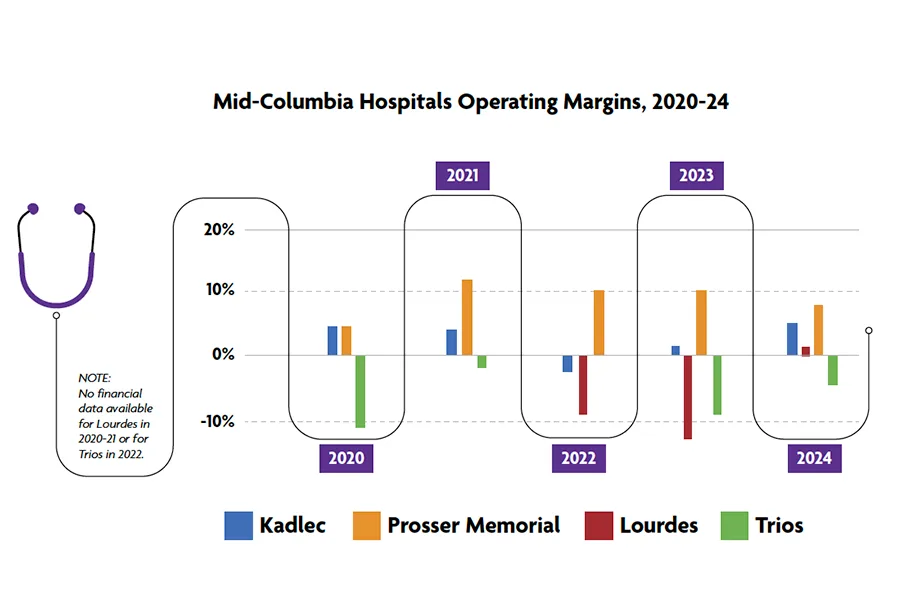
Source: Washington Department of Health
Graphic by Vanessa GuzmánWhen the healthcare company now known as LifePoint Health acquired Trios Health, one member of Kennewick Public Hospital District’s board called it a hero for taking on the bankruptcy-beleaguered hospital.
Some current hospital district officials don’t use that same term, but they say LifePoint’s acquisition of Trios is the only reason the Southridge hospital has continued to operate.
“If we’d lost 122 beds (in the community), it would have been disastrous,” said Lee Kerr, superintendent of the hospital district.
But it has been far from smooth sailing for Trios since it was acquired by LifePoint, which is owned by private equity firm Apollo Global Management.
The hospital has operated with negative days of cash on hand since 2019, according to reports filed with the Washington Department of Health. It has faced an average annual operating loss of $15.2 million since 2018. Dozens of healthcare providers have departed in the past year alone, according to the Journal’s Book of Lists data.
Pasco’s Lourdes Health, which LifePoint acquired weeks after Trios, has faced similar circumstances, with programs being cut and staff having to pressure leadership to follow through on pay increases.
David Elgarico, LifePoint’s market president and CEO for the region, said in a statement to the Journal that Trios and Lourdes, like many hospitals, are navigating difficult times for the healthcare industry that do have budget implications.
Indeed, 70% of hospitals and healthcare systems in the state operated at a loss between 2021-24, accumulating $4.9 billion in losses, according to the Washington State Hospital Association. Many across the healthcare industry have decried federal cuts to Medicaid and elimination of insurance subsidies that patients relied on to pay for their care and healthcare providers relied on to cover their budgets.
Elgarico challenged the notion that either hospital is on life support.
“While publicly available financial reports provide an important snapshot of hospital operations, they do not always reflect the full picture of the investments being made to support patient care, workforce development, and long-term sustainability,” he said in a statement.
Yet private equity-backed healthcare providers such as LifePoint are facing increased scrutiny as they continue to report profits while their hospitals struggle and outcomes for patients worsen.
“We’ve filed 16 grievances over pay and benefit issues since 2023, and we’ve seen an uptick in those sorts of problems in the last 18 months,” said Rich Smith, communications director for UFCW 3000, the union representing many Trios and Lourdes workers, in a statement to the Journal. “We see similar issues manifest whenever far-flung private equity firms take over community institutions and attempt to squeeze them for profits.”
Post-bankruptcy
Trios Health, formerly known as Kennewick General Hospital, filed for Chapter 9 bankruptcy protection in June 2017 to restructure $221 million in debt.
The hospital had failed to cover operating expenses for five years, and the filing came only a few years after the public hospital district pushed through construction of Southridge hospital, with lease payments making up roughly half of its debt.
That September, the hospital district announced it was in talks with UW Medicine and RegionalCare Hospital Partners, or RCCH, about a possible acquisition. RCCH was already in the process of acquiring Lourdes at the time – the only reason it considered Trios at all, said Mark Brault, current president of the KPHD board.
“Trios at that time would not have been seen as an attractive option,” Brault said.
RCCH’s purchase of Trios closed in August 2018, about a month before it took ownership of Lourdes.
Not long after, RCCH – already owned by private equity firm Apollo Global Management – merged with LifePoint, forming a company with hospitals across the country, mostly in the Sun Belt.
The first few years after the acquisition were rocky, Brault and Kerr said. The first two CEOs LifePoint brought in had the directive to right the ship, which led to more layoffs and clashes with staff.
Elgarico, who arrived just over three years ago, has provided needed leadership alongside deep knowledge of the healthcare industry, Kerr and Brault said.
Financial data
But Trios’ financial position does not appear to have improved, at least not on paper.
In 2024, the most recent year financial data is available from the state, Trios showed a loss of nearly $9 million, or a -4% operating margin. It also had -4 days of cash on hand, which meant that on paper at least the hospital had no available cash reserves to pay for operating expenses.
That’s at least the fifth year since 2019 that Trios has operated at a loss with negative cash on hand. DOH does not have any financial data for Trios for the 2022 fiscal year.
More recently, between 2024-25, Trios shed nearly 50 doctors and nurses, according to data provided for the Journal’s annual Book of Lists.
Lourdes has had similar financial struggles since it was acquired by LifePoint. It had a negative operating margin for two of the past three years, eking out $1.2 million in net revenue in 2024. But it’s also had -3 to -4 days of cash on hand the past three years, after having about two and a half days of cash on hand, or about $585,000, in 2018.
DOH has no financial data on the Pasco healthcare provider for the years 2019-21.
Kadlec Regional Medical Center in Richland, owned and operated by Renton-based nonprofit Providence Health & Services, had three unprofitable years between 2012 and 2024, the most recent being in 2022. Its average profit margin during those years was $20.9 million, or 2.2%. Its days of cash on hand dropped as low as 8 in 2019 but has stayed around 90 or higher ever since.
The state does not have financial data on Prosser Memorial Health for the 2014 and 2017 fiscal years, but for all other years between 2012 and 2024, the hospital was in the black and always had at least a month’s worth of cash on hand.
Kadlec officials echoed Elgarico’s point that state-reported numbers don’t capture the full financial picture.
For example, nearly a third of Kadlec’s $423.8 million in net working capital in 2024 was locked up as yet-to-be-collected invoices.
“What we earn is reinvested directly back into caring for our patients, maintaining essential services, supporting our caregivers, and meeting the needs of our community and region,” said Spencer Harris, chief financial officer for Providence’s Southeast WA service area, in a statement.
 Trios Southridge Hospital in Kennewick.
 Continued investment
Brault and Kerr said they have seen the same finance reports and have had their concerns about the state of services and programs at Trios. They meet regularly with hospital administrators for updates but acknowledge there is information they are not provided and LifePoint is not obligated to provide.
“There’s no visibility on what happens between the hospital and the mothership,” Brault said, referencing LifePoint’s corporate office. “We don’t know how capital flows back and forth.”
They also noted Trios doesn’t have some of the advantages of other regional hospitals: Kadlec controls 80% of the region’s healthcare market, giving it the benefit of scale, while Lourdes and Prosser’s hospitals are considered Critical Access Hospitals by federal health officials, giving them higher Medicare and Medicaid reimbursement rates.
Trios provides more charity care compared to its revenue – nearly 3%, or $18.4 million in 2024 – than either Lourdes or Kadlec, which give 2% or less. Additionally, Kerr and Brault assert that Trios’ staff turnover is comparable to that of other hospitals.
Elgarico noted that Trios and Lourdes have recruited new physicians and specialists in a number of specialties, expanded treatment capabilities with its new aquablation therapy, enhanced rehabilitation programs and increased access to outpatient care.
“We have also continued to invest in our facilities, technology, and infrastructure, with more than $5.6 million in recent and planned capital improvements across the market,” he said in his statement.
Those capital improvements include $1.5 million for new patient monitoring equipment at Trios and $4.2 million for a new and expanded central sterile processing space at Lourdes.
Nichole Arnzen and Taylor Dougherty, mental health counselors at Lourdes Behavioral Health, said they aren’t seeing those investments in either programs or staff.
Dougherty said the high-stress nature of their work already makes staff retention a challenge. However, newly hired staff have left in recent months when their pay did not end up being what was communicated to them. A change in management in recent months has led to less support when short-staffed and difficulty securing time off to prevent burnout.
“I love my job and I love my patients,” Dougherty said. “I don’t love having to deal with management.”
Programs such as the children’s day program, a patient job training effort known as Wilson House, and a program providing mental health training for first responders have fallen by the wayside since LifePoint took over operations, Arnzen said. Patients in the behavioral health unit no longer have regular access to a recreational therapist, nutritionist or chaplain.
“We’re crisis stabilization now,” Arnzen said. “We’ve seen patients come back because they’re not getting the support they need to be successful. They end up being hospitalized more often.”
Kadlec also has had tension with its employees, as evidenced by a recent settlement with its nurses over unfair labor practices. In May, the Washington Attorney General’s Office sued Providence for allegedly failing to accommodate pregnant and nursing employees at many of its hospitals.
Private equity interests
Nearly 500 U.S. hospitals are owned or operated by private equity firms, and a quarter of those, including Trios and Lourdes, serve rural populations, according to the Private Equity Stakeholder Project (PESP), a nonprofit watchdog.
Critics say private equity’s push to recoup investments quickly puts them at odds with patients’ and providers’ interests. LifePoint has drawn scrutiny for its hospital management: A bipartisan U.S. Senate Budget Committee investigation last year found LifePoint’s underinvestment in a rural Iowa hospital led to deteriorating conditions and worsening patient care even as Apollo investors profited.
A 2024 PESP report found LifePoint and fellow Apollo-owned ScionHealth tend to cut services and staff, achieve poor care ratings and draw regulatory scrutiny – but also carry heavy debt. Lifepoint’s debt-to-EBITDA factor was 7.9 in September 2023, according to Moody’s Investors Service, meaning the company owed nearly eight times more than its income could cover.
“The high debt ratio in part reflects new debt taken on in September 2023 – including $1 billion secured notes and a $2 billion backed senior secured term loan – which together increase LifePoint’s annual interest expense by about $37.5 million,” the report said.
LifePoint collected $700 million in 2019 after it sold real estate for 10 of its hospitals around the country, with those facilities now having to pay rent. However, that isn’t an option at Trios; Trios Southridge is under a lease agreement with the company that built the facility through 2031.
Future confidence
That lease agreement provides a possible sunset on LifePoint’s operation of Trios: its contract is tied to the life of the hospital’s current lease.
Brault said it’s possible LifePoint could choose to sell its interest in the hospital to another healthcare provider. Kerr, on the other hand, said he would be surprised if LifePoint “cut and run,” given its operation of nearby Lourdes and the recent sale of ScionHealth’s St. Joseph Regional Medical Center in Lewiston, Idaho, to LifePoint earlier this year.
Trios officials say their intention is to remain at the facility beyond the current lease terms.
“We remain confident in the future of Trios Health and Lourdes Health and are committed to building on the progress already underway, strengthening our hospitals, investing in our people, and expanding access to care so we can continue serving this community for generations to come,” Elgarico said in his statement.
There will still be challenges. Federal cuts and eligibility requirements for Medicaid are now in full force and expected to impact all healthcare providers. Brault added that new caps on federal college loans will likely further bottleneck the pipeline for the healthcare workforce, which is already insufficient.
LifePoint also could see increased scrutiny from the state. Washington was one of seven states to pass laws in 2025 requiring more oversight over private equity acquisitions in health care, according to Stateline. Specifically, state lawmakers passed a transparency law creating a registry of all health care entities.
Ultimately, Kerr and Brault said, the situation demonstrates the dire straits the healthcare industry is in.
“There have to be significant changes in the whole provision of healthcare,” Brault said.