
Albertsons must pay $900M for role in WA opioid crisis, judge rules
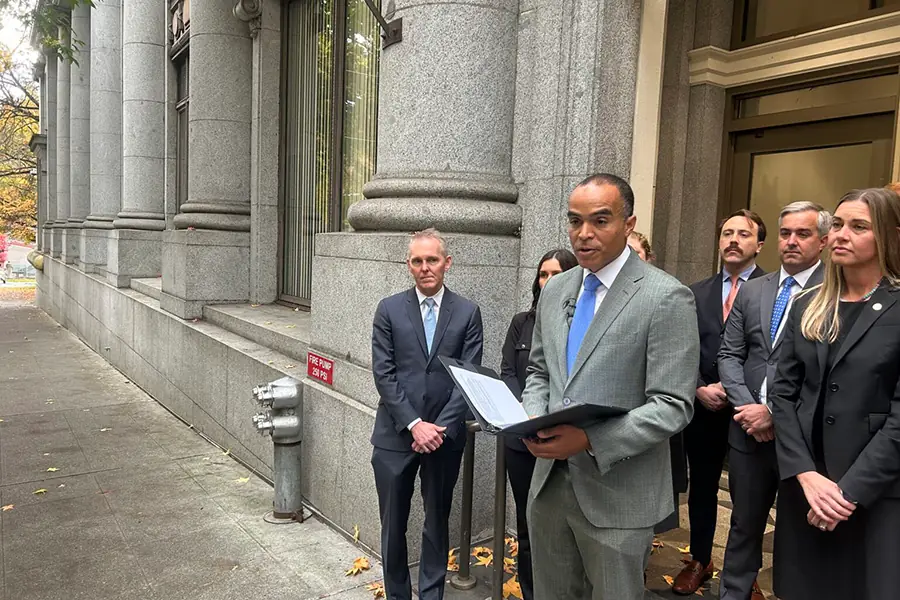
Washington state Attorney General Nick, alongside attorneys from his office, speaks to reporters outside the King County Courthouse after a $900 million verdict against Albertsons for its role in fueling the opioid crisis on Thursday, Nov. 5, 2026, in Seattle.
Photo by Jake Goldstein-Street/Washington State StandardGrocery giant Albertsons must pay Washington state $900 million for its pharmacies’ role in fueling the opioid epidemic, a judge ruled on Nov. 5.
Washington Attorney General Nick Brown said this is believed to be the largest verdict in state history. It came after a 9-week trial before King County Superior Court Judge Janet Helson.
Washington has now won nearly $2.2 billion for state and local governments in numerous cases against drug manufacturers and distributors in recent years. The money goes toward resources to prevent drug abuse and overdoses. But it’ll take a while for the $900 million to reach Washington, as Albertsons can appeal Helson’s verdict.
The state alleged Albertsons, which owns Safeway and Haggen and runs more than 200 pharmacies in Washington, dispensed 641 million opioid pills between 2006 and 2022. Many of those prescriptions had red flags that should’ve been investigated, not ignored, before distributing the pills, according to Brown’s office.
“This is a victory for the people of the state of Washington,” Brown told reporters after the verdict. “It is a victory that affirms that when corporations put safety measures at risk, when they do not prioritize their customers, when they are focused not on safety, that they will be held accountable.”
Albertsons filled prescriptions more than 6.5 million times without showing that pharmacists had confirmed doctors wrote them for legitimate medical purposes, according to the state.
This led to them being diverted for illicit use as an epidemic roared across Washington, and the nation. Here, opioid overdoses have claimed tens of thousands of lives.
In a statement, Albertsons said it was “disappointed by the court’s ruling and respectfully disagrees with its conclusions.”
“We are reviewing the decision closely and will evaluate all available options, including appeal,” the company said. “We are proud of our pharmacists and their dedication to the patients and communities they serve, and we will continue to support our customers and communities across Washington through responsible pharmacy operations.”
At trial, the company’s lawyers argued doctors were responsible for prescribing the dangerous opioids more aggressively to treat pain.
Albertsons has been defending against similar claims across the country. In April, the grocery chain agreed to pay $774 million to settle numerous other lawsuits. Washington didn’t sign on to receive a piece of that money.
“We thought the liability and the accountability that we needed to achieve against Albertsons was greater than the efforts that we were seeing elsewhere,” Brown said. “And to have a $900 million verdict that we proved before a judge, I think that really is confirmation of the approach that we took.”
Money from past opioid-related legal settlements has been held in the state treasury to be transferred out to cities and counties.
‘Mistakes can easily be made’
Pharmacists are legally required to identify drug diversion and report suspicious orders to the U.S. Drug Enforcement Administration, according to the state. Brown said company policies “actively discouraged” pharmacists from doing their due diligence.
As examples of this diversion, the state cited cases of Albertsons pharmacies dispensing thousands of pills to single customers. In one month, a customer at a Kent pharmacy got over 5,000 opioid pills, for example.
At one store, a family medicine doctor accounted for 60% of all the oxycodone dispensed, an attorney for the state said at trial. The company, in some cases, didn’t allow pharmacists to decline to fill prescriptions from these “pill mill” doctors, unlike other pharmacies. One store reportedly filled prescriptions for someone known to sell his drugs.
Store employees also stole pills, according to the state. A Safeway employee in North Bend reportedly swiped more than 70,000 opioid pills over two years before getting caught. The store agreed in 2017 to temporarily suspend filling controlled substance prescriptions after an investigation found the store hadn’t notified the DEA of the missing hydrocodone tablets until months after Safeway learned of the pilfering. The inquiry found a widespread practice of Safeway failing to report missing or stolen pills. Safeway agreed to pay $3 million in that case.
Other thefts include 12,000 pills from a Leavenworth pharmacy and 19,000 in Olympia. This was due to lackluster tracking of its inventory of controlled substances, Brown argued.
Stores were chronically understaffed, leading to overworked pharmacy employees. This made it “impossible” to review prescriptions to ensure they were above board, according to evidence presented during the lengthy trial. One pharmacist warned the company that, due to these conditions, “mistakes can easily be made to put someone’s life at risk,” according to the attorney general’s office.
All of this, Brown argues, points to Albertsons putting profit over patient safety during the epidemic.
The case started under now-Gov. Bob Ferguson during his tenure as attorney general. Under Ferguson, the state sued Albertsons, along with other major grocery chains. Kroger in 2024 agreed to pay Washington $47.5 million. The state has also signed onto opioid-related settlements, bringing in millions of dollars from Walmart, Walgreens and CVS, among others.
“Going after the companies responsible for fueling the opioid crisis in our state was a top priority for me as Attorney General,” Ferguson wrote on social media on Nov. 5. “I was proud to file this case, and proud to see the Attorney General’s Office bring it to trial and win.”
This story is republished from the Washington State Standard, a nonprofit, nonpartisan news outlet that provides original reporting, analysis and commentary on Washington state government and politics.

Stay Informed. It’s Free.
Subscribe to our newsletters and get the latest news and insights delivered to your inbox.
We respect your privacy.
Unsubscribe anytime.
Thank you!
You’re subscribed. Keep an eye on your inbox for the latest updates.