
New BPA power purchase agreements aim to improve rate stability
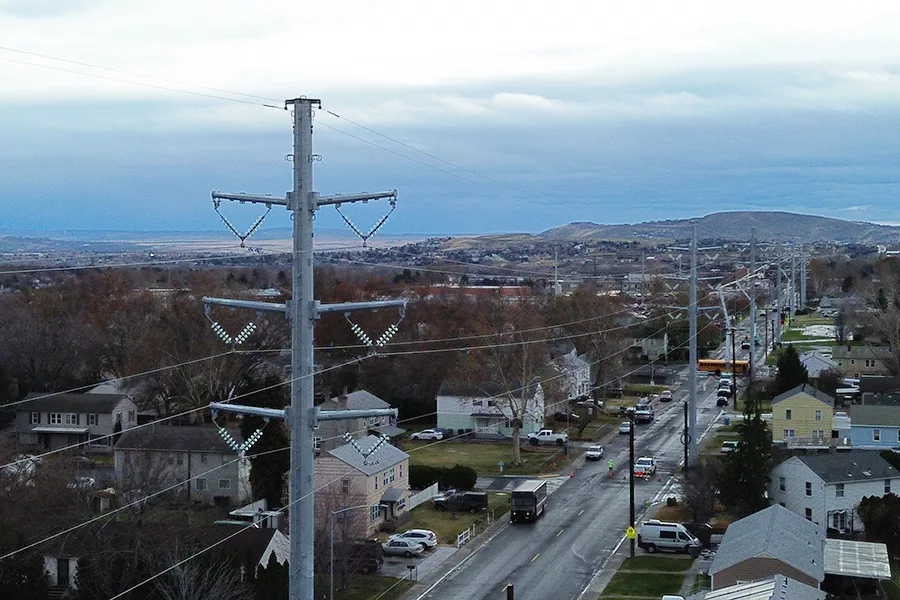
This photo of new larger transmission lines installed by Bonneville Power Administration through the heart of Richland illustrated the story "Residents bristle at new lines needed for growing energy needs," one of several pieces cited by judges in awarding the Tri-Cities Area Journal of Business four awards during the 2026 Editorial Excellence Awards of the Alliance of Area Business Publishers.
Photo by Nathan FinkeAll three of the public electric utilities serving the Tri-Cities have signed new long-term power purchase agreements with Bonneville Power Administration, a move the utilities say will provide some certainty for their operations and their customers’ future energy bills.
Roughly four years after beginning the process, BPA finalized contracts with more than 130 public utilities in the Pacific Northwest this fall, according to a release. The agencies include the Benton and Franklin public utility districts, or PUDs, and Benton Rural Electric Association.
The contracts, part of the agency’s Provider of Choice initiative, are intended to provide BPA’s power customers with cost and rate stability, while providing the federal power and transmission services provider with more financial security into the future.
“This is a watershed moment for BPA and our ratepayers,” said John Hairston, BPA’s administrator and CEO, in a statement. “With these contracts in hand, we have the continuity and certainty necessary to continue building and expanding the value of the federal power and transmission systems that deliver vital, low-cost and reliable electricity to millions of residential, commercial and industrial consumers and serves as a cornerstone of the Pacific Northwest's economy.”
The Benton and Franklin PUDs and Benton REA depend on BPA and its network of hydroelectric dams for much of the power they provide to their customers.
The contracts will take effect beginning in 2028 and be in place for 16 years. Once in place, BPA will use a new public rate design methodology, developed over negotiations with utilities and other stakeholders, to establish rates. The first rate case under that framework is expected to begin in fall 2027.
Josh Lozano, Benton REA’s director of energy policy and communications manager, told the Tri-Cities Area Journal of Business the new long-term contracts provide certainty around the wholesale power supply, which eases operational planning, load forecasting and capital planning for infrastructure and reliability investments.
Franklin PUD is still going over the specific details of how it will transition to the contract over the new few years, said Rosario Viera, the utility’s public information officer. However, the new contract provides additional capacity and is designed to help the Pasco-based utility integrate other power resources to meet future load growth and demand.
“Resource adequacy is an anticipated challenge for us, as well as for many utilities,” Viera said in an email to the Journal. “Overall, this agreement provides a foundation for us to continue providing reliable power to our customers as the region grows.”
The new rate methodology will put more emphasis on capacity costs in rate design by increasing capacity-based rate components, most notably demand charges, said Jon Meyer, Benton PUD’s senior director of finance and executive administration.
“It is estimated that these changes will increase Benton PUD’s wholesale power costs from BPA, as compared to the current rate setting methodology, by about 2% in 2028 gradually moving to about 5% by the end of the 16-year contract,” Meyer said.
And the contracts only cover a part of the costs of doing business with BPA. Transmission charges and other regional rate cases and cost recovery for the system will continue to be X factors to some degree.
“This means we continue to closely monitor and participate in BPA rate proceedings, as those decisions can directly affect our cost of power and, in turn, the retail rates paid by our members,” Lozano said in an email.
One need only look to the most recent year to see how costs to BPA’s utility customers can increase even when the agency is doing well financially. BPA ended the 2025 fiscal year in the black with net revenues of $74 million, $4 million above its target and a far cry from the -$44 million projected a year ago.
But the agency will still increase power rates due to drained financial reserves. Its Power Services division ended the year with 50 days of cash on hand, which is lower than its mandated 60-day threshold, according to a release. As a result, it will seek to collect up to $40 million via a surcharge on power provided to the various community power providers across the Pacific Northwest.


Stay Informed. It’s Free.
Subscribe to our newsletters and get the latest news and insights delivered to your inbox.
We respect your privacy.
Unsubscribe anytime.
Thank you!
You’re subscribed. Keep an eye on your inbox for the latest updates.