New $30M plant taps growing pipe market
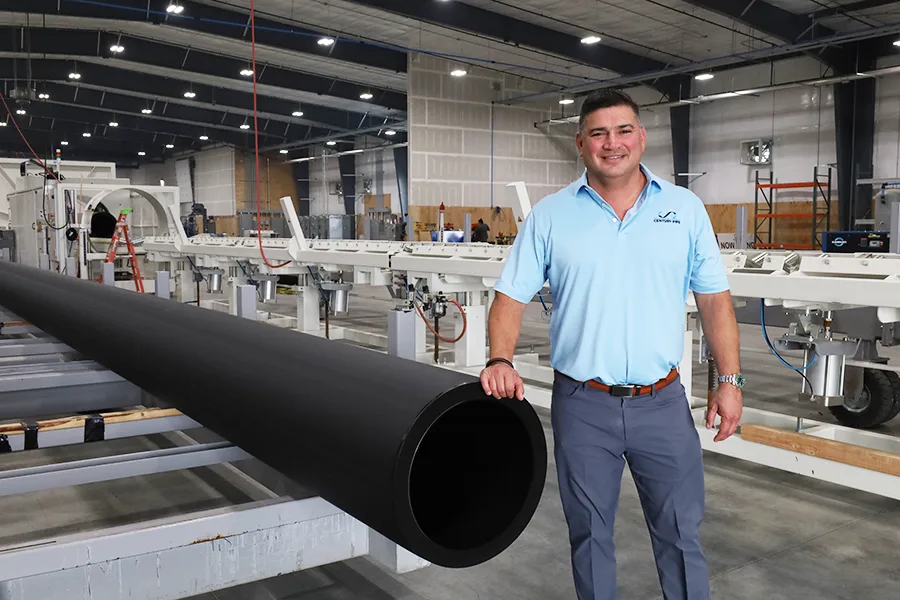
René Collin, president of Century Pipe LLC, stands by one of the pipes produced by the startup company’s newly opened manufacturing facility near Burbank.
Photo by Rachel VisickFive years ago, longtime plastics salesman René Collin was approached to start a business making high-density polyethylene pipes. Today, the concept is more than just a pipe dream: Texas-based Century Pipe LLC’s first manufacturing facility has opened its doors near Burbank.
The company says HDPE pipe is a growing market used to support municipal and industrial water and gas distribution, like irrigation, sewer and mining projects.
Before trying to start a business of his own, Collin, now Century Pipe’s president, had spent 25 years as a salesman in the industry, most recently working for the manufacturer of the pigment that’s used to make plastic pipes black.
Knowing that money wouldn’t matter if he didn’t have someone who knew how to build a plant, he worked to secure the right talent for the job, bringing on Bryan Eeles, vice president of operations and a pipe maker with more than 40 years of experience.
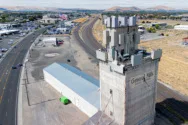
An investor joined the endeavor as well, and by the time the company was fully funded in May 2025, it took little time to start building their first production plant at 1811 Railex Road in the Port of Walla Walla’s Dodd Road Industrial Park.
Texas to Tri-Cities
The new plant was a $30 million investment, Collin said. FCF Holdings LLC bought the 16-acre property from the port in April 2025 for just under $1.1 million. The 52,762-square-foot building is valued at $9.9 million, according to a Walla Walla County permit.
The manufacturing facility became operational around June, with three lines of pipe production up and running. About 50,000 square feet make up the manufacturing space, with the other 3,000 square feet used as office space.
Collin said they are commonly asked how they ended up in Walla Walla County with two Texans and a Canadian as the top management team. With an expensive plant to build, Collin said they didn’t want to go up against the major players in the industry right from the start.
While other Texas-based companies might shy away from the Pacific Northwest due to the distance and cultural differences, “what they saw as a pain, we saw as an opportunity,” Collin said. “We knew that there was plenty of business out here to be had.”
Locating near the Tri-Cities offered some other advantages: There was a need for a regional pipe manufacturer and there was a large enough population in the area to easily staff the plant.
The facility employs 30 full-time workers to run the operation around the clock. Collin said that between WorkSource Walla Walla and Tri-Cities, they had a wealth of quality candidates to choose from. The port also helped advocate for the company and point them in the right direction.
The Walla Walla and Tri-Cities communities have been welcoming, Collin said. “We’re very very happy with the decision we made to come to Tri-Cities.”
Plastic processes
The HDPE pipes Century Pipe produces are engineered to last 100 years, which is how the company chose its name, Collin said.
Century Pipe mainly sells through distributors, who will call up for a quote for a specific job. If Century Pipe gets the work, it will specifically manufacture the pipe needed for that project.
The machinery can create pipes ranging between 2 inches and 36 inches in diameter, and more than 90% of the pipes Century Pipe makes are custom-made for a particular project, Collin said.
At full capacity, Century Pipe’s facility will be able to manufacture more than 160,000 pounds a day, 365 days a year. Its site off Highway 12 includes a rail spur where supplies roll in from the Gulf Coast area.
Once the resin pellets arrive by train, they’re pumped into three of Century Pipe’s five siloes. The other two siloes store the pipes’ coloring and recycled material.
The material is dried, mixed and fed into equipment and dyed. Then it goes to the individual lines, where it’s extruded and formed into a pipe. Sprayers in long tanks cool down the plastic once it’s formed, and then the pipe is cut into segments. It ends up out in Century Pipe’s 7-acre laydown yard before being loaded onto trucks.
Quality control happens at several different points in the process: when the material is first brought in, as pipes are being produced and before they’re shipped out.
Collin said that one of the highlights of their operation is the way Century Pipe recycles and reuses its materials.
Only about 20 gallons of water are used each day to cool the pipes down, and since it’s a closed-loop system, the water goes back into a water pit to be reused. Only a little water is lost to evaporation, Collin said.
Material is also reused. When a pipe comes off the line between size changes or when it’s not up to standards, it will be shredded and worked back into the system later on.
“It’s not a single-use plastic product,” Collin said.
Planning for growth
Collin said that HDPE pipe is a growing market, and there’s a need for new manufacturers to help bolster U.S. infrastructure.
“One of our suppliers said the need for pipe is going to be more in the next 25 years than it was in the previous 25 years,” he said.
Century Pipe has plenty of room to do some growing of its own. Though three lines are operational in its current facility, the space was designed to house five lines. It plans to build out the additional lines once it gets established.
There are also 10 additional acres adjacent to the facility that Century Pipe has the right of refusal on if it chooses to build a second plant there.
“We built this to grow, and ideally, we’d like to grow intelligently, and eventually open up a second plant somewhere in another part of the United States,” he said.