
Framatome eyes expansion, advanced fuel plans to meet demand
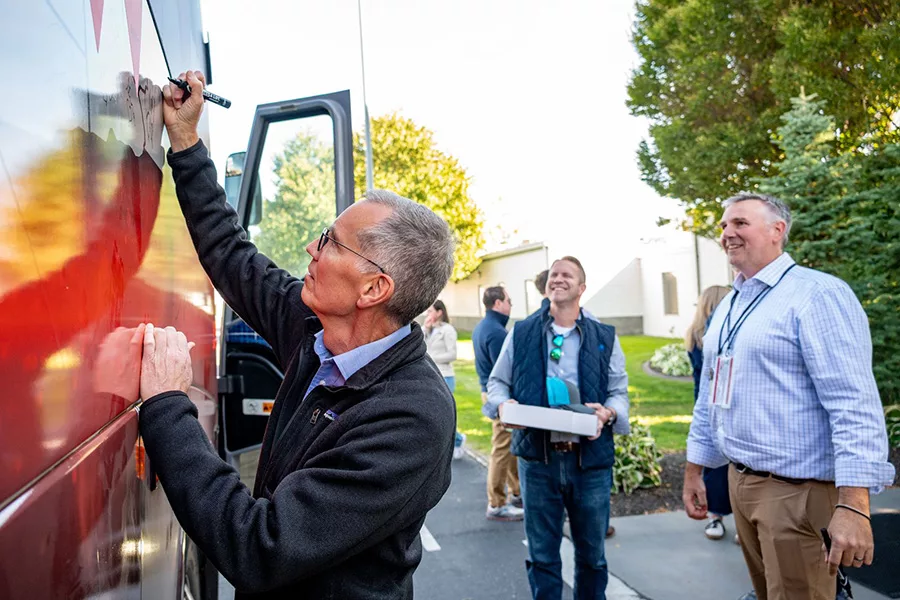
Brian Vance, site leader for Framatome’s nuclear fuel manufacturing facility in Richland, signs the side of the Association of Washington Business Manufacturing Week bus on Oct. 6. The bus was crisscrossing the state to highlight manufacturers. “The support for the nuclear industry and the need for power has never been greater,” the company said.
Courtesy Association of Washington BusinessAn increasingly busy future is taking shape at Framatome’s nuclear fuel production facility north of Richland.
The France-based company kicked off construction of a $7 million expansion for fuel assembly storage in July. When complete, it will have enough space to store as many as 200 fuel assemblies for commercial reactors, a must as demand for nuclear energy continues to grow.
But there’s an even bigger transformation in the making: Framatome recently announced it is pursuing a joint venture with the United States’ only independent developer of TRISO fuel, made for the next generation of nuclear reactors. And the companies plan to manufacture that fuel in Richland.
Framatome has already initiated the process to amend its facility license through the Nuclear Regulatory Commission so it can produce fuel with a higher uranium content. If approved, that would facilitate the manufacture of Standard Nuclear’s proprietary advanced reactor fuel. It would also set the Richland plant up for eventual production of high-assay low-enriched uranium, or HALEU, fuel, which will be needed for many advanced nuclear reactors currently in development.
Both companies say they expect the license amendment process to finish in the spring of 2026, with fuel manufacturing beginning in 2027, pending regulatory approvals.
Specific details on what the new fuel production line will look like when it comes to infrastructure and logistics were not disclosed, though it will be housed within current structures at the Richland plant.
A Framatome spokesperson told the Tri-Cities Area Journal of Business that “the facility repurposing and equipment required to produce TRISO is significant. We expect to hire employees to run our processes and grow our team around market demand.”
Framatome produces uranium dioxide powder, pellets, fuel rods and fuel assemblies for commercial nuclear power plants worldwide. Five percent of the electricity produced in the U.S. comes from fuel manufactured in Richland.
Framatome employs 580 in Richland.
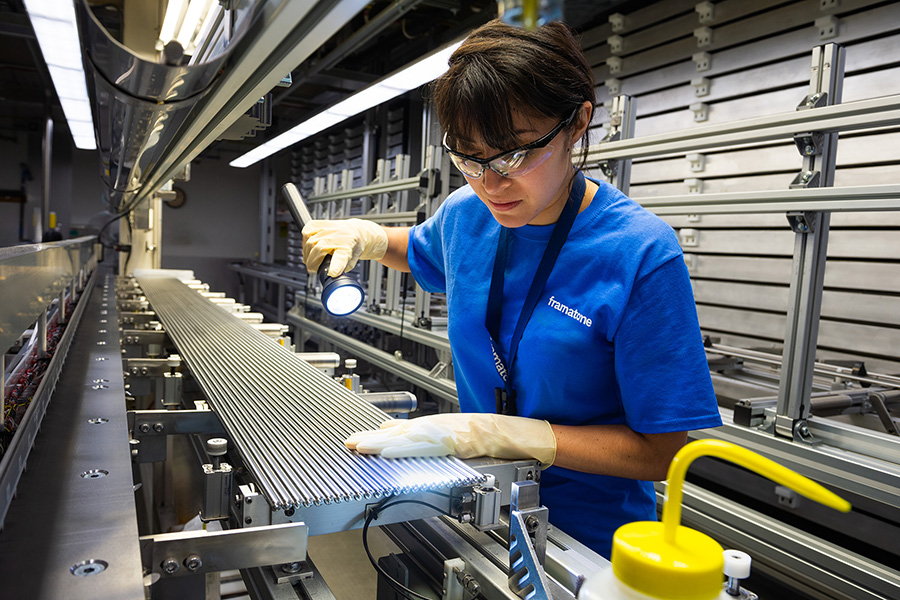
Framatome’s team of experts at the Richland fuel fabrication facility produce advanced nuclear fuel designs and related products for nuclear power plants around the world.
| Courtesy FramatomeMeeting energy demand
Nuclear energy has seen renewed interest in recent years as the demand for energy strains existing power grids and generation facilities. In the Mid-Columbia, Energy Northwest has teamed up with Amazon to bring small modular reactors, or SMRs, online near its current nuclear power plant. It also has partnered with Bonneville Power Administration to increase the generating capacity of that power plant.
Framatome officials have said the Richland facility has fuel contracts for the next six years and that they expect to see more demand. Running 24 hours a day, the fuel production plant produces 90 million uranium oxide pellets per year, which are inserted into rods and then placed in fuel arrays.
The new two-story storage facility will be more than 3,200 square feet, according to the project’s building permit. It also will have equipment necessary to hold and move the fuel arrays safely and securely. Meier Architecture Engineering is the architect for the project and Fowler Construction is the contractor.
Federal policy toward nuclear power has gone into overdrive, with the U.S. Department of Energy pushing to support development of new reactor designs and securing domestic supply chains for reactor components and fuel.
Both Framatome and Standard Nuclear have benefited from DOE’s efforts. In 2023, Framatome was one of six companies that received a 10-year contract from the agency to produce HALEU fuel.
That contract – which specifically allows the companies to bid for work to deconvert HALEU as uranium hexafluoride gas to various chemical forms used to fabricate fuels required by many advanced reactor developers – will provide each producer a minimum of $2 million with up to $800 million available.
More recently, Standard Nuclear was the first U.S. company to be accepted into DOE’s Fuel Line Pilot Program. Federal officials established that program, which provides companies a fast-tracked commercial licensing process for facilities, to address the lack of a domestic nuclear fuel supply chain for advanced reactors.
TRISO fuel
Standard Nuclear, based in Oak Ridge, Tennessee, is known for its tri-structural isotopic particle, or TRISO, fuel. Made from uranium particles wrapped in protective ceramic and carbon layers, it has enhanced safety and durability at extreme temperatures.
The companies announced they plan to pursue manufacturing “reactor agnostic” products by combining Framatome’s fuel cycle expertise and infrastructure assets with Standard Nuclear’s technical manufacturing capabilities and fuel production expertise.
“Pairing Standard Nuclear’s pioneering technology and full-scale pilot facility with our deep-rooted manufacturing expertise and scalable capacity has ignited a shared momentum,” said Tony Robinson, CEO of Framatome Inc., in a statement. “This isn’t just collaboration – it’s a shared vision and capability for the future of our industry to develop advanced reactor fuel on a commercial scale to support advanced reactor developers.”
Specifically, the joint venture, which will form a new company called Standard Nuclear-Framatome, aims to produce 2 metric tons of TRISO fuel annually, a substantial increase in domestic supply of advanced reactor fuel.
“This strategic partnership with Framatome marks a pivotal moment in establishing a robust, domestic TRISO fuel supply chain,” said Kurt Terrani, CEO of Standard Nuclear in a statement. “This joint venture reinforces our commitment to serving as America’s leading advanced nuclear fuel supplier while strengthening the western world’s energy security through reliable, reactor-agnostic fuel production.”
Framatome officials stressed that TRISO particle production is independent of uranium enrichment levels necessary for HALEU fuel. However, the equipment and process required for TRISO production are the same as for HALEU fuel.
“We plan our first operation to be at an elevated enrichment of 10% as a step forward to HALEU enrichment (20%) until commercial quantities of HALEU become available,” a Framatome spokesperson said.
Framatome has indicated it’s been waiting for the right partner to come along so it could move into HALEU fuel production.
Earlier this year, company officials told Tri-City business leaders there were plans to double the size of the Richland facility by constructing a new building adjacent to its campus. That facility would be specifically for HALEU-derived fuel products and require about 200 new salaried employees to operate.
But the project has a hefty price tag at an estimated $300 million to $400 million, necessitating some level of partnership as well as commercial demand for the new fuel.