Veteran in nuclear industry optimistic about Richland plant’s future
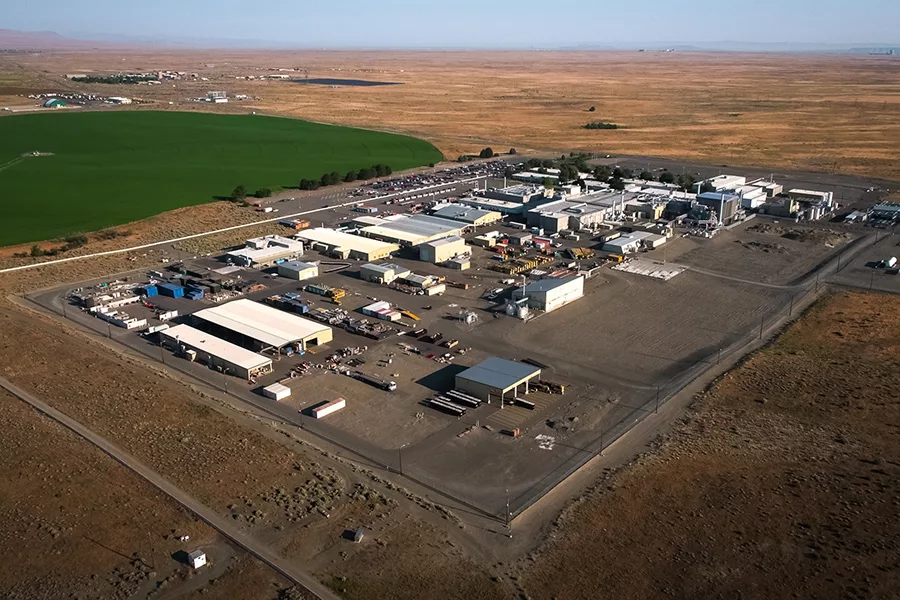
Framatome, 2101 Horn Rapids Road, Richland.
Courtesy FramatomeLeaving the Hanford site before the vitrification plant began full operations was a tough decision for Brian Vance.
He had spent his tenure as the U.S. Department of Energy’s top Hanford official shepherding the construction and testing to turn the millions of gallons of waste stored on the nuclear reservation into a stable glass form.
It was only a month after Vance retired from his role that workers began introducing chemicals akin to tank waste into the facility’s melter in the latest step to test its systems ahead of full-scale operations.

Brian Vance
“There were certainly some decisions that contributed to my departure, but I hope they are successful,” Vance told the Tri-Cities Area Journal of Business.
But now the veteran nuclear professional finds himself part of yet another watershed moment in the industry as the new site leader for Framatome’s nuclear fuel manufacturing facility, located not far from the Hanford site.
The Richland plant is likely to play a key role in the nuclear industry’s future with growing interest in nuclear to address the soaring demand for reliable energy, particularly via small modular reactors, or SMRs. Framatome has plans to build a new facility next to its Richland campus to produce the fuel used by SMRs.
Vance said he is still getting the feel for his new role and forging relationships with the hundreds of workers who produce fuel for nuclear power plants around the country. But he sees a bright future for the industry and the abundant, carbon-free power it helps produce.
“I’m incredibly optimistic about the future here,” Vance said. “We have a talented team, an important product. If you want to come to a place with a great future, this is one of those places.”
Vance was pursuing a number of other roles around the country when Framatome contacted him about a potential new leadership position they were establishing at the Richland site.
Vance was no stranger to Framatome. He had worked for the company when it was called Areva during his 30-year career in the nuclear industry. He also had a 25-year career in the U.S. Navy as a nuclear-trained submarine officer, retiring as a captain in 2009.
Vance was named the new site leader in early July, succeeding Lance Stephens who will retire in October after more than 30 years with Framatome.
“With years of extensive industry and leadership experience, Brian has built a strong track record in the nuclear and energy sectors,” Tony Robinson, CEO of Framatome North America, said in a statement. “Under Brian’s leadership I am confident he will maintain the standard of excellence that has been established at the Richland site, while rapidly expanding our operations to support the tremendous growth opportunities in the nuclear industry.”
After years of downsizing, Framatome’s Richland facility entered recruitment mode in 2023 and now has about 600 workers. The company has fuel contracts for the next six years and the Japanese nuclear energy market is reviving alongside growing consideration stateside.
Framatome intends to be part of the supply chain for the next generation of nuclear reactors by doubling the size of its Richland facility to produce high-assay low-enriched uranium, or HALEU, fuel. The project is estimated to cost $300 million to $400 million and create 200 jobs.
When that project breaks ground is dependent on factors largely outside Framatome’s control, Vance said. Framatome was one of six companies that received a 10-year contract from the U.S. Department of Energy to produce HALEU fuel. The company is otherwise at the mercy of those operating nuclear power plants seeking out the fuel.
Vance said he intends to guide the Richland facility toward sustainable growth so it can be ready to move on HALEU when demand is there. And Framatome being a company versus a government agency means pivots can happen more quickly.
“The nuclear industry has a very long approach to business,” he said.
And he’ll need that long approach. Even with his decades of experience, Vance said he is not a fuels expert and is learning more about it every day. Alongside that effort, he’s working to get to know his staff.
Since taking on his leadership role, he’s held more than a dozen hourlong sessions for staff to meet him, ask questions and voice their concerns. They have told him about areas they want to see improvement, such as around safety culture at the facility and better communication within and between teams.
“I’ve already met with the managers and supervisors three times in the last two weeks to build that up,” Vance said of communication channels.
His experience dealing with unions at the Hanford site also will come in handy. More than 200 Framatome workers recently voted nearly 2-to-1 in favor of being represented by International Brotherhood of Electrical Workers (IBEW) Local 77.
“In just a short time, these workers came together with incredible energy and determination to be heard. They are eager to make things better around the plant, share their ideas for how the company can improve production, and partner with Framatome to return it to its status as the workplace of choice in the Tri-Cities,” said Jason Locke, an electrician at Framatome and one of the leaders of the campaign for IBEW representation, in a statement.
The union already represented 45 workers at the facility who are covered under two separate collective bargaining agreements.
“At the end of the day, they’re still my teammates, whether they’re represented or not, and we have to find a way to work together,” Vance said, saying they are “part of the fabric of Framatome.”
He’s excited to be a part of it, too, saying he’s glad he could remain in the Tri-Cities after his time at Hanford. Beyond being the place where he’s lived the longest since he was in college, it has the right people and technology that the nuclear industry needs as well as the support of the community. And all that is crucial if nuclear is to fulfill its promise as the abundant, carbon-free energy of the future.
“We need nuclear as part of our energy portfolio,” Vance said. “I’ve told our team we’re not just part of the nuclear industry, we’re environmentalists.”