
Home-like features for the workplace can help to lure workers back
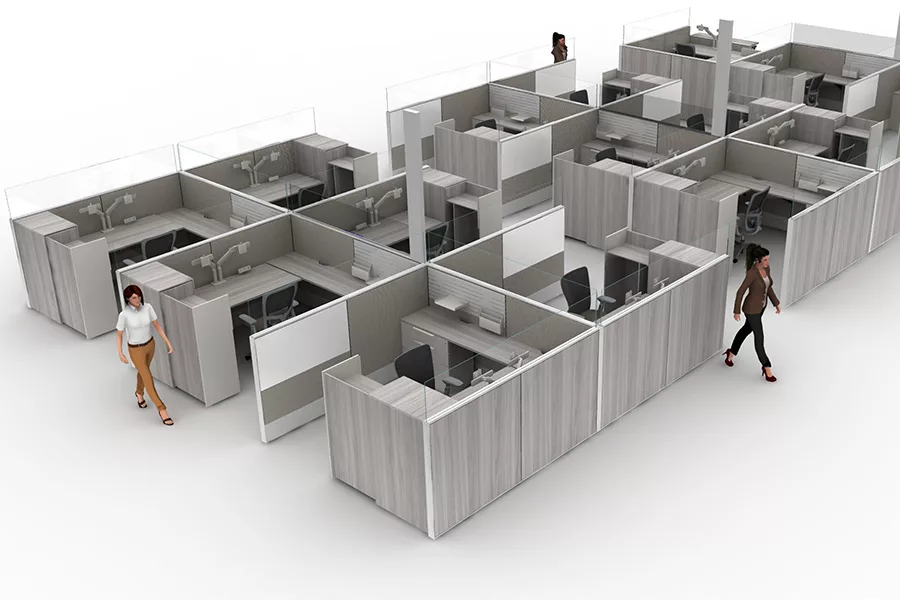
A rendering of one of the examples of work stations developed by Freeform for Umatilla Electric Cooperative’s newly renovated headquarters building in Hermiston
Courtesy FreeformUmatilla Electric Cooperative’s renovation of its long-standing administrative building is about the future.
Part of that future is making sure staff, which is expected to double in the next five to 10 years, can all fit under one roof, Jodie Thomas, the utility’s public relations supervisor, recently told the Tri-Cities Area Journal of Business.
But the Hermiston utility’s leaders also want their office to be a place where current and future employees want to be and that means more than just providing workstations.
They aim to achieve this through amenities like standing desks, personal pantry closets, and a breakroom designed to feel like a cozy living room.
“Ten-, 11-, 12-hour days aren’t unusual for us, so we want everyone to be more comfortable,” Thomas said.
It’s a vision that office designer Freeform, which has a showroom and offices in Tri-Cities, has helped Umatilla Electric achieve. And it’s one that Spokane-based Freeform’s CEO, Fernando Jauretche, says is the direction businesses need to head if they plan to keep people coming into the office post-pandemic.
“The old idea of putting as many people in a space as possible is gone,” Jauretche told the Journal. “(Workers) want to go into a space where they know their employer shows they care for their health and wellness.”
Office-based jobs shifting to remote work was one of the touchstones of the Covid-19 pandemic as companies sought to keep operating amid social distancing and quarantine requirements.
And it’s one aspect of the pandemic that a lot of workers have fought to hold onto. An estimated 22% of the U.S. labor force works remotely today, according to Forbes magazine, compared to 4% immediately prior to the pandemic. Companies have instituted a variety of measures to bring people back to the office, including return-to-office mandates, but researchers have found that often leads to increased employee dissatisfaction and not much improvement in productivity.
Jauretche said making the workplace feel more like a home is how employers can make coming to the office commute-worthy, both for workers and companies alike.
This can be partly achieved with softer, more residential-style furniture, a warmer color palette and natural materials like stone and wood on walls and surfaces. Even potted plants to break up the environment, he said.
But it also requires rethinking workspaces like cubicles and private offices, with glass partitions that provide some privacy but still a sense of openness. Replacing a filing cabinet with a personal wardrobe or other storage space in workstations provides somewhere for workers to hang their coat or place their office supplies but also store and display personal items important to them.
And the age-old fight to make workstations ergonomically friendly is also part of the movement, Jauretche said. Most people don’t just sit while at home but are up and about taking care of tasks. Providing standing desks replicates that behavior while also improving comfort and productivity.
“What I think most people don’t realize is that it also provides equity for people of different heights,” he said.
Thomas said that Umatilla Electric’s staff is eager to all be back together, and features such as the coffee bar in its breakroom-employee engagement space contribute to this enthusiasm.
But there are other aspects of the renovation that many, including Thomas, look forward to and see as making the building more homelike, from increasing natural light with banks of new windows, to the dedicated room with a sink and fridge for nursing mothers or employees needing privacy during the workday.
“Those little touches make a big difference,” Thomas said.