$126M incentive program for zero-emission trucks nears launch in WA
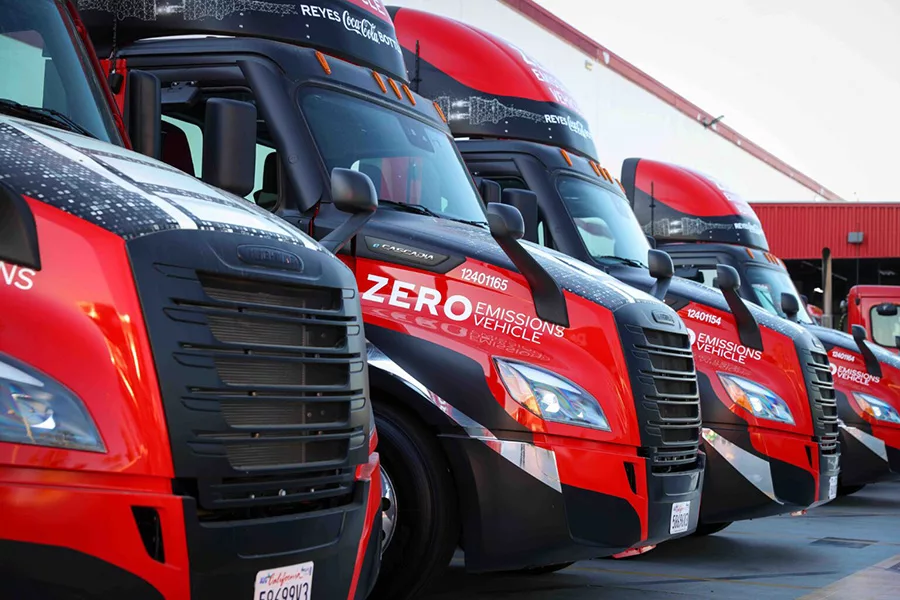
Freightliner eCascadia electric trucks used in a Coca-Cola Bottling fleet are pictured in 2023.
Courtesy Daimler Truck AG / Washington State StandardWashington is close to opening a new incentive program for commercial fleet operators to transition trucks and other vehicles to models that run on electric or hydrogen power.
Industry groups and climate advocates anxiously await the $126 million initiative. But the state lawmakers who championed it say it’s taken far too long to come online.
The transportation sector is the biggest driver of Washington’s carbon emissions. Exhaust from big trucks and buses makes up a disproportionate share of those emissions, and diesel air pollution can be especially unhealthy.
To help combat this, the Washington Zero-Emission Incentive Program, or WAZIP, is expected to launch in the spring.
“We are very eager for WAZIP to launch as soon as possible,” said Leah Missik, the Washington legislative director for environmental advocacy group Climate Solutions, which is part of a group that receives money as a subcontractor on the WAZIP program, though that work is separate from Missik’s role.
“We know from the experience in other states and even from the experience of people who’ve been able to get clean trucks here in Washington that this program will help drivers and businesses save money, and it will benefit communities,” Missik added.
Washington has already made some progress.
In 2024, nearly one in five new medium- and heavy-duty vehicles sold in Washington ran on zero-emission technology, according to the state Department of Ecology. Though the adoption rate varies depending on the type. Heavier trucks are harder to come by than, for example, electric delivery vans. Think of Amazon’s ubiquitous Rivian vans.
Heavy trucks, on the other hand, remain prohibitively expensive for many companies, while lacking public charging infrastructure, industry groups say. And they can’t go nearly as far on a charge as their diesel-fueled counterparts, not to mention they’re much heavier.
The city of Seattle has tried its own incentive program offering up to $180,000 for Class 8 heavy-duty trucks to serve the Port of Seattle. But even with that sweetener, operators found the transition still unfeasible financially.
Instead, the city in October partnered with a company called Zeem Solutions to distribute $1.5 million to drayage operators. It follows more than $5 million that the Northwest Seaport Alliance gave the company over the summer for a commercial fleet charging depot in the city of SeaTac.
But while Washington state moves ahead, the federal government has looked to slow the transition.
Washington has been following the lead of California in its push toward zero-emission vehicles. California has a unique ability to set emission rules that go further than federal guidelines, and other states can pick between the two. Washington has been following California’s stricter standards.
But Congress this year repealed California’s opportunity to set those standards. States, including Washington, have sued the federal government over the move.
One of those rules pushes manufacturers to up their sales of zero-emission medium- and heavy-duty trucks over time. The move by Congress and approved by President Donald Trump offers a “slight ease of pressure” on the trucking industry, said Sheri Call, president and CEO of the Washington Trucking Associations.
“But it also doesn’t mean that we don’t want to continue the conversation about what industry can do today,” Call continued, “because we do have members who are motivated to reduce their carbon footprint. They just need workable solutions to do so.”
The local trucking industry is also grappling with the Trump administration’s cancellation of federal money meant to fuel a hub of hydrogen development in the region, which aimed to help develop cleaner semitrucks, among other things. Call said this is “very promising technology for the industry, especially in the heavy truck space.”
How will it work?
The WAZIP program is funded by proceeds from the state’s carbon auctions under the Climate Commitment Act.
It’ll offer $82 million in vouchers for on-road vehicles, $20 million for off-road equipment, like forklifts and farm equipment. It’ll also have $10 million reserved for small businesses.
For example, buyers of a zero-emission Class 4 medium-duty truck weighing between 14,001 pounds and 16,000 pounds could get $60,000 off at the point of sale, though the final voucher amounts aren’t yet finalized. The vouchers, which increase based on weight, cover electric and hydrogen fuel cell technology.
For reference, a Class 4 diesel truck costs around $60,000 while the electric version is roughly $160,000, according to John Barnes, of TEC Equipment. Diesel Class 8 trucks cost $160,000 compared to $600,000 for electrics.
Voucher applicants can also ask for more money to install charging infrastructure, a major barrier to transitioning to zero-emission vehicles for both businesses and individuals.
The hope is that trucking companies can get assistance with upfront costs to transition toward electric, then reap the benefits of reduced fuel costs over time.
“I cannot understate the importance of it in terms of hitting our climate targets, but also helping people save money over the long run,” Missik said.
Some businesses will be eligible for even more savings. They include those with under $10 million in annual revenue and those certified as an emerging or rising business by the state’s Office of Women and Minority Owned Business Enterprises. Drayage operators, veteran-owned businesses, nonprofits and public agencies also qualify.
In the Class 4 example, these purchasers could get an extra $10,000 off.
Businesses can also buy converted or used vehicles with vouchers of reduced value.
The initiative is modeled on similar efforts in California, where a truck incentive program has given out roughly 15,000 vouchers totaling over $1.6 billion in savings in the past 15 years.
Call and Missik both expect WAZIP to be very popular.
What’s taking so long?
But those leading the charge for WAZIP’s creation think it should already be up and running.
State House Transportation Committee Chair Jake Fey, D-Tacoma, said it should’ve started up at least six months ago. His counterpart in the Senate agrees.
“The governor’s office and the Department of Transportation know that I’m not satisfied by how long it’s taken to get this done,” Fey said. “It’s beyond the point now that my patience is about done with this.”
In response, the state Department of Transportation noted “this is a complex program that WSDOT needs to ensure is developed and administered properly, because significant state resources are involved.”
“This work includes custom software to meet Washington’s unique needs,” spokesperson Barbara LaBoe said in an email. “WSDOT is working diligently to deliver the program as quickly as possible, while maintaining the high standards for compliance and usability that are required.”
The agency doesn’t have a date set for the launch.
This story has been updated to note Climate Solutions’ involvement in the WAZIP program.
This story is republished from the Washington State Standard, a nonprofit, nonpartisan news outlet that provides original reporting, analysis and commentary on Washington state government and politics.