This respected Pasco leader led with faith, grace
Katie Barton was born into a life of discrimination.
For Blacks like Barton, born into and raised in a former Confederate state in the 1920s, ’30s and ’40s, prejudice was a given.
But, to her surprise when she arrived in the Tri-Cities as a 30-year-old housewife in 1948, she discovered conditions even less tolerant for Blacks. Relations between Blacks and whites, she found, were more contentious than she experienced growing up in Gonzales, Texas.
Be out of Kennewick by sundown. Live on your side of the train tracks in Pasco. These and other social barriers were in place for African Americans.
From her childhood in Texas to her younger adult years in the Tri-Cities, she found the color of her skin often dictated what she could or could not do.
She would endure it and overcome it to become an important and respected Pasco leader.
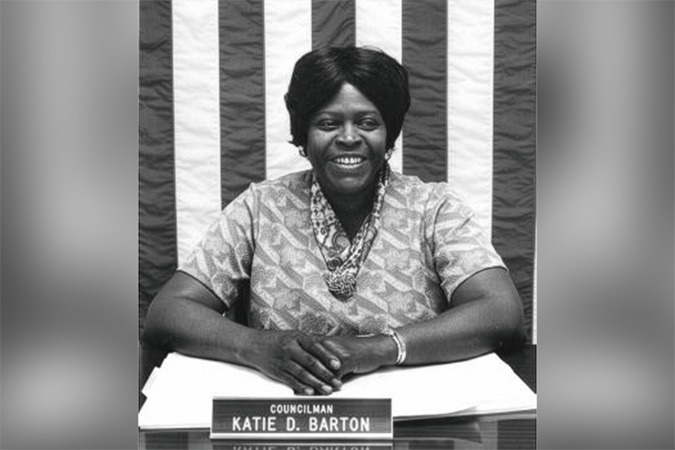
Katie Barton
For many of her early years in the Tri-Cities, Blacks often were refused service by many businesses and were forced to live in squalid surroundings.
Conditions were best described as appalling in the east Pasco neighborhood they were forced to live in by being unofficially blacklisted from many neighborhoods. Houses were in disrepair. Unpaved dirt streets swirled up in a cloud of dust when cars passed. Fresh water did not always run, and sewage disposal often failed. Garbage collected on the streets because of unreliable pickup service. Neighborhood lighting was nonexistent.
Barton never surrendered her gracious personality while bringing positive change to the city she called home for 62 years, her friends said. Bitterness didn’t fit her personality; determination did. She used it to bring down racial barriers.
Her efforts altered attitudes of racism and discrimination and helped renovate that same appalling east Pasco neighborhood into respectable living conditions. She helped influence integrated schools and neighborhoods, ownership of businesses by Blacks, and elected leaders of color.
Honors came to her for her efforts. She took the oath of office as the first African American woman to serve on the Pasco City Council, breaking a barrier that had existed for 80 years since Pasco was incorporated in 1891.
She replaced Art Fletcher, who was the first Black man to serve on the council. He later served an assistant secretary of labor in President Nixon’s administration, and headed the nation’s Civil Rights Commission for both President George H.W. Bush and President Bill Clinton.
Barton, who died in 2010 at the age of 92, was honored as the inaugural recipient of the Martin Luther King Jr. Spirit Award.
Annually, the award goes to a Tri-Citian who best exemplifies King’s philosophy and spirit.
She received the Juneteenth Volunteer Award and the Senior Citizen Volunteer Award, and in 2002 she was named Grand Marshal of Pasco’s annual Fourth of July Parade.
Her hand was instrumental in the building of Kurtzman Park in east Pasco, just a short distance from the Elm Street home she lived in until her life’s end. Her handprint is on the Martin Luther King Center at Kurtzman.
She was a member of the NAACP, the nation’s oldest civil rights organization, the Pasco Civil Service Commission and the Citizens Advisory Council for the Pasco Senior Citizens. She served on the Community Action Council and was president of the East Pasco Neighborhood Council.
All the while, she was raising two children, a daughter, Carolyn, and a son, Keith, and had significant roles in her churches as faith played a central role in her life.
She was closely associated with two east Pasco churches, beginning with the New Hope Missionary Baptist Church in 1953, and then the Morning Star Baptist Church beginning in 2005. She was a church clerk and a Sunday School teacher at New Hope and received Mother of the Church honors at both.
She was employed for 24 years by the U.S. Army Corps of Engineers. In retirement, she volunteered as a senior companion.
When memorial services were held for Barton in the sprawling Faith Assembly Church in Pasco eight days after her death, people of all colors sat shoulder to shoulder to honor and remember her.
Gale Metcalf of Kennewick is a lifelong Tri-Citian, retired Tri-City Herald employee and volunteer for the East Benton County Historical Museum. He writes the monthly history column.