How early boat races anchored a Tri-Cities summer tradition
The first thunder on the Columbia echoing from the piston-fed energy of boats roaring across the surface waters of the Tri-Cities didn’t come from the inaugural race of Unlimited hydroplanes competing here 60 years ago.
For the Tri-Cities, Unlimited racing began with the Atomic Cup on July 24, 1966. The 61st running of Unlimiteds kicks off here on July 26 in what is officially known as the Apollo Columbia Cup.
It is the signature event of boat race weekend, which runs July 24-26, and includes the STCU Over-the-River Air Show, along with other festivities as part of Tri-Cities Water Follies.
Tri-Cities fans’ love for racing on the Columbia dates much further back than the historic first Unlimited competition 60 years ago.
Racing in the 1940s set the tempo and awakened the venue for future hydroplane racing that began with that first Atomic Cup. A 1948 race was a major feature of the first Pasco Water Follies.
Racing in the 1940s featured limited class inboard and outboard piston-driven craft racing off Sacajawea State Park in Pasco. Limited class boats are much smaller and less powerful than Unlimiteds.
One of those early-day competitors and a big booster of boat racing here once told this writer that a featured competitor he raced against near Sacajawea was famed band leader Guy Lombardo.
With his orchestra, Guy Lombardo and the Royal Canadians, he became known as Mr. New Year’s Eve for “setting the definitive musical template for welcoming the new year from 1929 to 1976,” first on radio and then television.
In racing circles, he was known for his love of speed on the water with any class of boat and was owner and driver of the Tempo VI that won the 1946 Gold Cup on the Detroit River.
The prized trophy offered here in the 60 years of racing on the Columbia River has most frequently been the Columbia Cup, often co-presented or co-sponsored under local naming rights like this year’s Apollo Columbia Cup. But it began with the Atomic Cup, which also has been the featured prize identified for many races on the Columbia.
Gold Cup
Six times the Tri-Cities also has hosted what is considered the Super Bowl of hydroplane racing, the Gold Cup. It was the regatta prize in 1973, 1975, 1977, 1984, 2015 and 2025.
The Gold Cup in boat racing originated in 1904 and is annually the biggest prize in boat racing. There have been few cancellations of the Gold Cup in its more than 120 years, primarily yielding only to the two World Wars, the Covid-19 pandemic and dangerous water conditions.
In American motorsports, the Gold Cup is the oldest active trophy.
On that Sunday 60 years ago this month with the first unlimited race here, a late-day wind turned the river choppy and tainted the sky with the brownish grit of dust as the drivers maneuvered their boats in the finals for one last run on the two-and-a-half-mile Columbia River course.
Most decorated boat
Bernie Little’s Miss Budweiser would win that first-ever race here, piloted by Bill Brow. It was also the first ever win for Little’s boat. It came on his 30th try in Unlimited competition. It would not be his last win.
In 42 years of competing, from 1963 to 2004, Miss Budweiser would become the most successful boat in the history of Unlimited racing. Entering some 354 events, it won at least 134, and some accounts say as many as 141. It finished in the top three more than 200 times, it won 26 season championships and 14 Gold Cups.
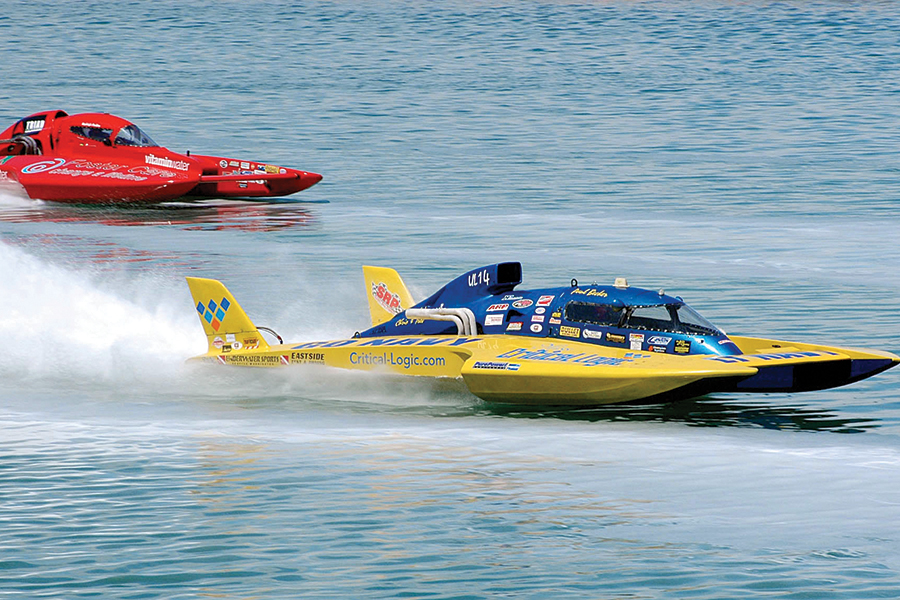 Courtesy Water Follies
As many as 50,000 viewers saw that historic first, most lining along a 4-mile stretch of the Columbia River in Columbia Park, with others viewing from the dike on the Pasco side of the river.
Others used a vantage point then existing for parked cars along Canal Drive above Columbia Park or from the front lawns of their homes along the drive.
Miss Tri-Cities, the U-37 driven by Bob Miller, was a competitor to Miss Budweiser and 10 other boats in the 1966 inaugural year of Miss Tri-Cities competing on the hydroplane circuit.
With time trials on Friday and Saturday before the Sunday finals, all 12 boats qualified to compete in Sunday heats for a shot at the championship finals. Mechanical problems, however, kept Dollar Bill, piloted by Bill Manchu, from competing on Sunday.
The three Sunday heats were won by Bill Sterrett, piloting Miss Chrysler Crew, Brow driving Miss Budweiser, and Mira Slovak behind the wheel of Tahoe Miss.
The top two finishers in each of the Sunday heats competed in the finals. Joining the three heat winners in the championship run were Smirnoff, Savair’s Probe, and Wayfarers Club Lady, piloted respectively by Bill Cantrell, Red Loomis and Bob Fendler.
The wind’s increasing momentum stirred up the air and made the surface of the water more treacherous for the boats, but it didn’t keep Miss Budweiser from plowing its way to victory in the first Atomic Cup at 4 p.m., averaging more than 92 miles per hour.
Miss Budweiser received $4,500 of the $25,000 in prize money for winning the race. Second place received $3,200, and the remainder was distributed based on placing. Heat winners received an additional $500.
This year’s racing action starts Friday, July 24, with the Dash for Cash, with the top four teams competing for a cash prize following a day of qualifying, according to the Water Follies website. Racing continues the following day with two sets of heats and concludes July 26. The winner not only takes home the hardware, but they win the coveted parking spot under Little’s tree for the following year’s race.
Gale Metcalf of Kennewick is a lifelong Tri-Citian, retired Tri-City Herald employee and volunteer for the East Benton County Historical Museum. He writes the monthly history column.