This small town refuses to disappear
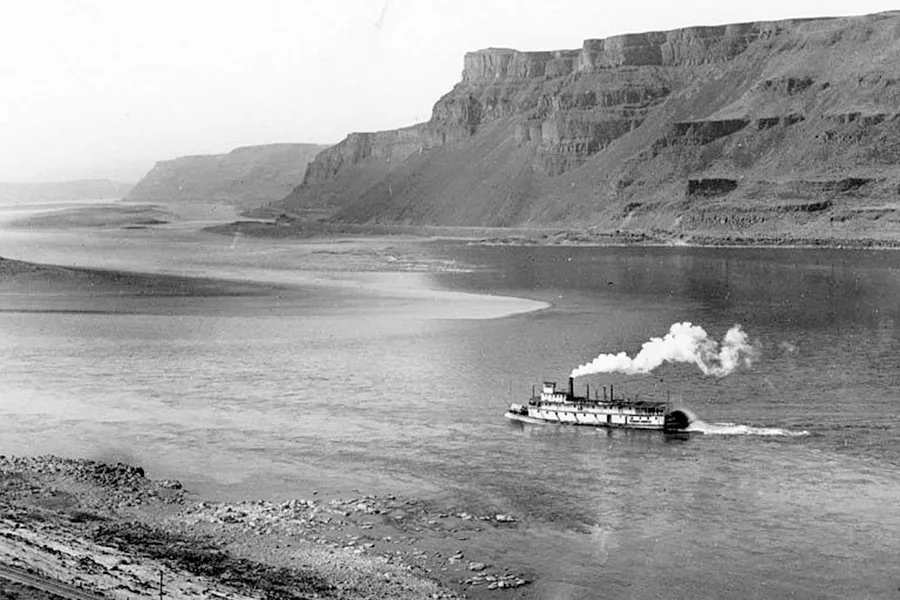
This 1915 photo was taken along the upper Columbia River looking southwest toward Oregon. It shows a sternwheel steamboat and the basalt cliffs in the Wallula Gap.
Courtesy University of Washington Libraries, Special Collections, Asahel Curtis, photographer, CUR1290In 1862, J.M. Vansyckle and S.W. Tatem founded a town not far from today’s Tri-Cities that is still around – but only because Wallula has refused to die at least twice.
They called it Wallula City when platting the townsite near the confluence of the Columbia and the Walla Walla rivers, and it grew into a thriving community long before Pasco, Kennewick or Richland saw daylight.
Today, it is simply known as Wallula and it celebrates its 164th birthday this spring, perched above Highway 12 about 15 or so miles east of Pasco en route to Walla Walla.
The scenic area near Wallula is home to the McNary National Wildlife Refuge, as well as major industrial employers in the region, including Packaging Corporation of America and Tyson Foods.
The area also soon will welcome other big industrial facilities, including a plant that makes stone-derived insulation, a sustainable aviation fuel facility and an Amazon data center campus.
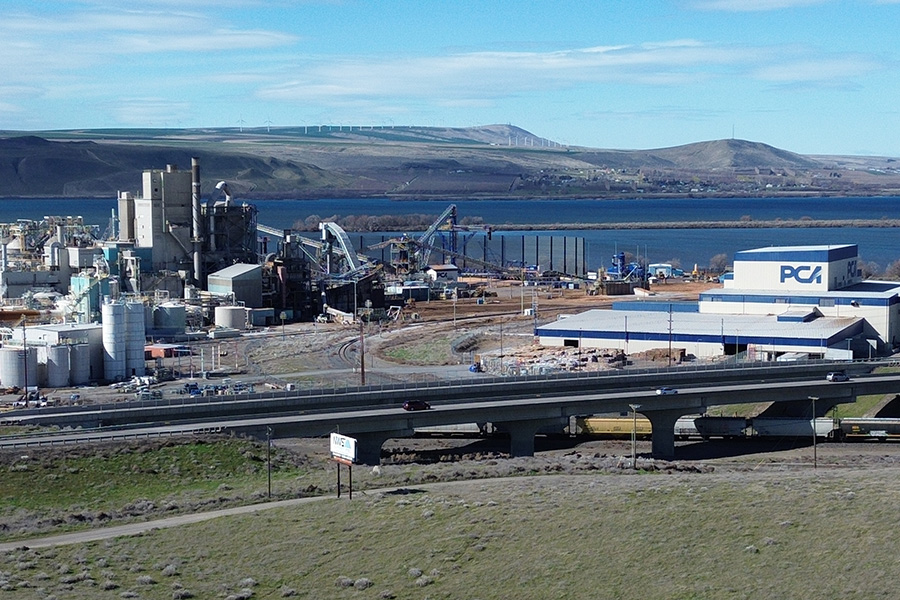
The town of Wallula celebrates its 164th birthday this spring. The Packaging Corporation of America is located near the small unincorporated town.
| Photo by Nathan FinkeOriginal site under water
The original site of Wallula now lies below the surface waters of the Columbia River behind McNary Dam in what is officially known as Lake Wallula. Also below the surface is the site of the second Wallula.
Wallula arose near the site of one of the first military posts established in the Pacific Northwest, founded by Donald MacKenzie and Alexander Ross of the North West Company on July 11, 1818. Although named Fort Nez Perce for the tribe, it was on the traditional lands of the Walla Walla tribe.
In 1821, it was renamed Fort Walla Walla after a merger of the North West and the Hudson Bay companies, originally competitors for the fur trade in the Pacific Northwest.
Fort Walla Walla continued to function near the mouth of the Walla Walla River for another 34 years, a fur trading post interacting with local tribes. A major fire in 1841 destroyed the wooden fort, but it was rebuilt with adobe.
It was abandoned in 1855.
A new original Fort Walla Walla was established in 1856 where today is the Jonathan M. Wainwright Veterans Administration Medical Center in Walla Walla, with many original historical Fort Walla Walla buildings still in use.
Wallula received its first mail by a steamer from The Dalles, and stagecoaches linked Walla Walla and Wallula.
The first railroad leaving Walla Walla linking to the Columbia River did so at Wallula. Construction of the 30-mile line began in 1871 and was completed on Oct. 23, 1875. The Walla Walla and Columbia River Railroad used the line.
The Northern Pacific Railroad in the early 1880s completed a line connecting St. Paul, Minnesota, with Wallula and extended it to the south side of the Columbia River by building a bridge where it connected to the tracks of the Oregon Railway and Navigation Company.
The town provided supplies for farmers and trappers and was the last port of entry for gold seekers heading for mines in Idaho.
Contributing to the decline of the original Wallula was the Northern Pacific's arrival some two miles to the northeast on higher ground, with flooding by river waters contributing. Businesses moved to be nearer the railroad and soon were followed by homeowners.
The second Wallula
The second Wallula boomed as a railroad town, thriving with restaurants, beer parlors, a train depot, churches and a residential district comprising up to 42 homes. Tidewater Oil Company had tanks in Wallula, and an ice plant and grocery store operated.
In those days, Wallula also boasted of having the Wallula Hotel, a general merchandise store, Chinese restaurant, a blacksmith shop, dance hall, a warehouse and a shipping yard for livestock.
As the years progressed, youngsters from first through the eighth grade attended a red brick four-room schoolhouse, while high school students in the early years of the 20th century attended high school just upriver toward today’s Burbank. Its foundation still exists in a wooded area along the river.
When it became obvious the second Wallula was endangered by the backwaters being formed by the construction of McNary Dam between 1947-54, with dedication by President Eisenhower in September 1954, a third Wallula location was needed.
Two miles away on higher ground was some 640 acres owned by the U.S. Bureau of Land Management. The BLM said it would permit those in Wallula interested to acquire homesites, and a 160-acre townsite was created. Walla Walla County Engineer Ed Watson drew up the plat.
Lots were drawn. Wallula residents could buy a lot for their new home for $10, but at 32-by-120 feet, they were too narrow for a residence, so husbands and wives were allowed to buy three lots and a single person could buy two.
Some 17 families stepped up to buy, followed by the BLM offering surplus lots at a public auction. Some sold for up to $1,000 apiece.
It is a quiet community of residential neighbors today with a 2020 census of about 140 residents in the 0.12-square-mile community. A few short miles down the highway is an all-purpose store with gas pumps that can meet immediate needs. A short distance the other way in the direction of Walla Walla is Wallula Junction and Madame Dorion Park.
Marie Dorion was only the second woman to reach the Pacific Ocean by land after Sacajawea with the Lewis and Clark Expedition and is referred to by some as the Madonna of the Old Oregon Trail. In 1814 she survived a harrowing winter refuged along the Walla Walla River after her husband, a guide and interpreter, was killed. She died in St. Louis, Oregon, in 1850.
The U.S. Post Office still operates at Wallula, and at one time was a stop for Greyhound bus riders.
A schoolhouse was built in the third Wallula but was used by students only for about six months. Youth now living in Wallula attend school in nearby Burbank a dozen or so miles away. The town’s cemetery is maintained through a cemetery district and kept up by volunteers. Remains of the town’s pioneer residents from the previous Wallulas were removed and reinterned in today’s cemetery.
Gale Metcalf of Kennewick is a lifelong Tri-Citian, retired Tri-City Herald employee and volunteer for the East Benton County Historical Museum. He writes the monthly history column.