Reading, writing and arithmetic around a potbellied stove

When Glenna Kinkaid walked into school in the dead of winter, she wasn’t greeted by a warm, inviting classroom with central heating.
Shivering in the cold stillness of an empty classroom, she struggled to heat a potbellied coal-burning stove to warm the space for her young pupils when they arrived two hours later.
Outside, chilling winds whipped off the barren, snow-covered Horse Heaven Hills and bit through Kinkaid’s winter garments.
This was school in rural Benton County in 1928, with the first sunlight barely peeking over the ridges of the snow-capped Blue Mountains to the east.
Kinkaid was the lone 19-year-old teacher at the small one-room schoolhouse.
The wood-framed Triple Springs School was located on what was then a dusty path through the Horse Heavens that is now Clodfelter Road.
“The teacher was the janitor, the fireman,” said Kinkaid some 35 years ago describing her early days as an educator here.
It was the start of her 45-year career as a teacher, including 34 years in Finley.
She taught at Triple Springs when Calvin Coolidge was president of the United States and attended her first eight grades there when Woodrow Wilson was president.
She grew up in the Horse Heavens with her parents, Pat and Minnie Kinkaid.
“There was a cloak room and a wash room but no indoor plumbing,” she said. “We pumped our water from a cistern outside.”
Kids who rode to school on horseback sheltered their horses in a small, shack-like barn. The remainder of the school comprised two outhouses, a shed for kindling and coal, and a flagpole out front.
After Triple Spring, Kinkaid went on to Kennewick High School, graduating with the class of 1926. She then spent two years at the State Normal School in Cheney, now Eastern Washington University, where she earned her teaching degree.
She returned home to teach at Triple Springs, where in her first year she taught children who had been in the first grade when she left the school.
While winters were bitterly cold, late summer days could be just the opposite.
“You always prayed that by the time school started, it had cooled off,” Kinkaid said. Even with the windows open, the sweltering heat was nearly intolerable, she said. In winter, the stove centered in the classroom “warmed the room very satisfactorily.”
While winter never stranded the children in the school overnight, some storms did keep students home for days. When a student became ill at school, another rode off on horseback to the nearest farm with a phone to call the child’s parents.
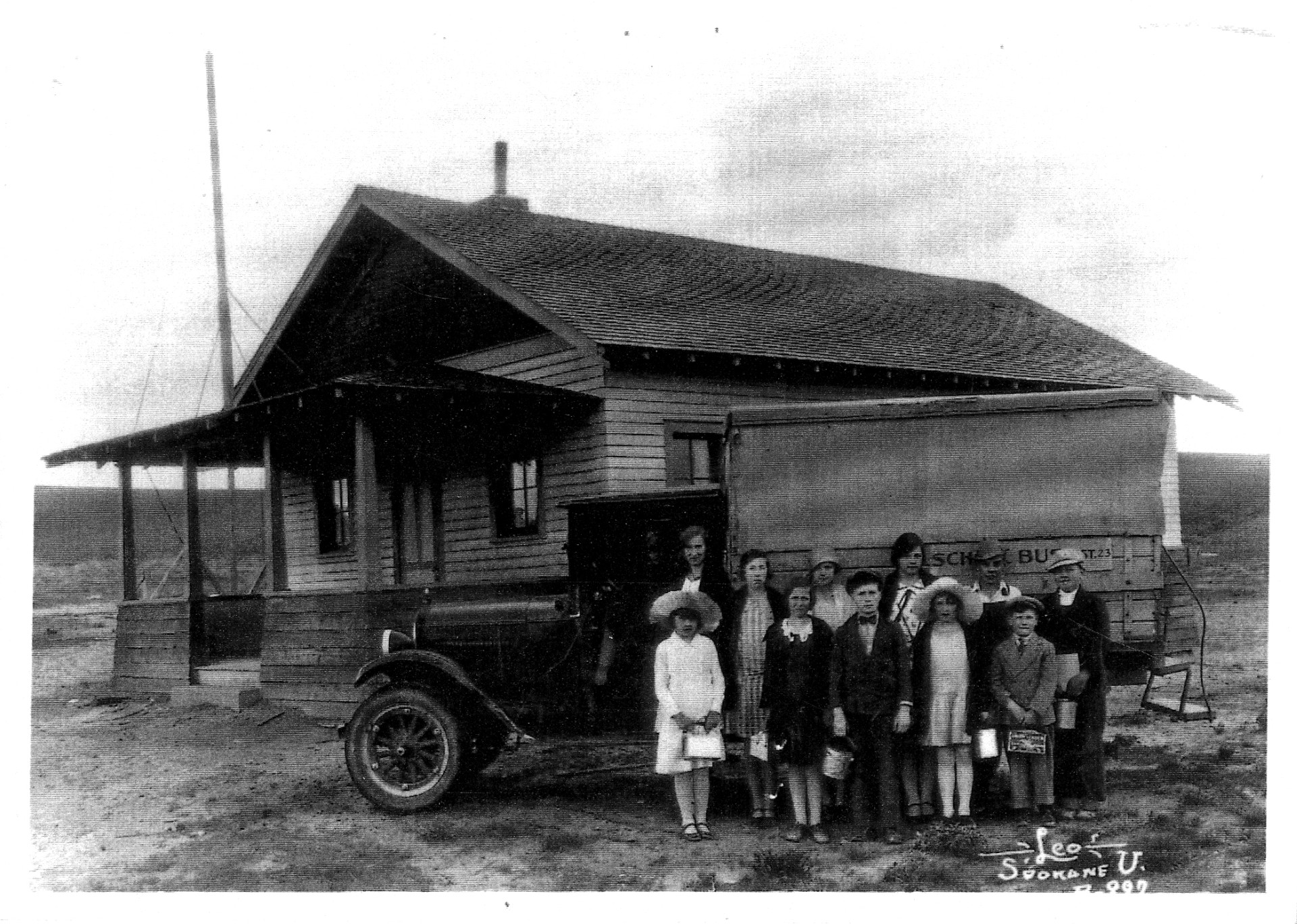
Triple Springs School with students, bus driver May Smith Safford and teacher Miss Glenna Kinkaid in 1929.
| Courtesy East Benton County Historical MuseumAs a student and teacher, Kinkaid appreciated some aspects of the one-room schoolhouse.
“One of the advantages ... was that the little kids listened to the recitals of older students,” she explained, giving the younger students a step up in learning to recite poetry and even the Gettysburg Address, thanks to observing their older peers.
“We always had a lot of reading and we had music,” Kinkaid said. A pump organ supplied the tunes and portraits of George Washington and Abraham Lincoln decorated the walls. A globe brought geography into the small classroom.
At Triple Springs, eight to 10 students were the most Kinkaid taught at any one time, and it was thrilling having visitors stop by the school.
“Olaf Strandwold, the county (school) superintendent from Prosser, would drop by twice a year for a visit,” she said.
Once a year, students from the Triple Springs and Locust Groves schools came together for a picnic. Locust Grove was the nearest of perhaps 10 or 12 one-room schools in rural Benton County at the time, Kinkaid said. Over time, they began to vanish as school districts consolidated.
At Christmas, Triple Springs students put on a holiday show illuminated by the glow of kerosene lamps. Parents arrived by buggy, wagon or car to take it in.
After two years at Triple Springs, Kinkaid went to teach grade school in Kennewick for three years. She then left to teach at an isolated mountain school in Benton County, Oregon, walking or riding horseback six miles each day to reach the school.
In 1939, she started teaching at Finley schools, beginning with Finley Grade School before moving on to Finley’s River View High School. She remained until retiring in 1973.
Kinkaid, who later became Glenna Taylor after marrying her husband Leonard, was named Kennewick Woman of the Year in 1959 in recognition of her various volunteer efforts. In retirement, she was an active volunteer for more than 25 years with the Tri-City Chaplaincy and with the local Red Cross Blood Bank, according to her obituary. She died at age 94 in 2003.
Gale Metcalf of Kennewick is a lifelong Tri-Citian, retired Tri-City Herald employee and volunteer for the East Benton County Historical Museum. He writes the monthly history column.

Stay Informed. It’s Free.
Subscribe to our newsletters and get the latest news and insights delivered to your inbox.
We respect your privacy.
Unsubscribe anytime.
Thank you!
You’re subscribed. Keep an eye on your inbox for the latest updates.