Remembering a pro-nuclear art movement
New exhibit at Washington State University Tri-Cities runs through February 2026
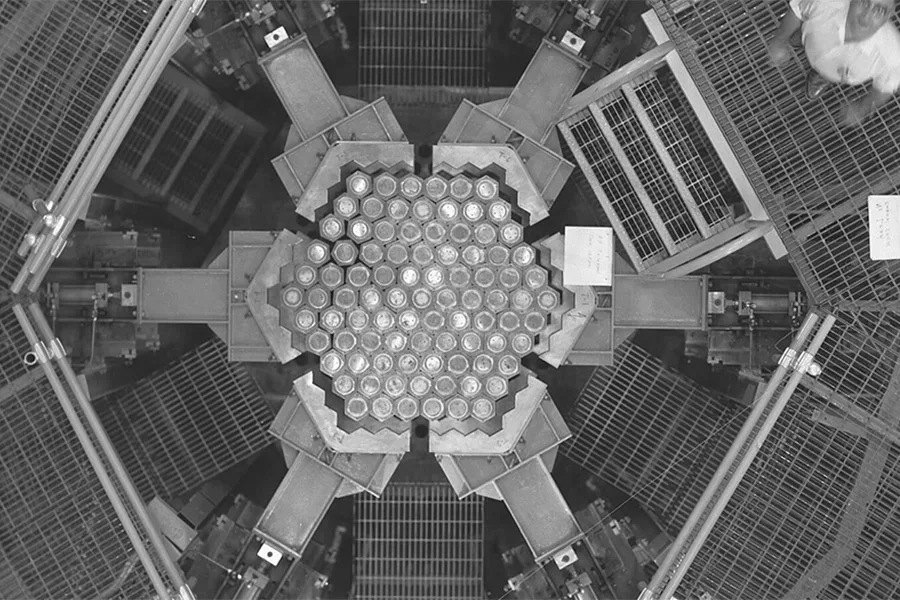
A photograph showing a top-down view of the reactor fuel core from a project at the Hanford site that was the focus of advocacy by a group of Seattle artists in the 1990s.
Courtesy WSU Tri-Cities Hanford History ProjectIt may be hard to believe, but there was a time when Seattle-based artists rallied to support the development of nuclear energy at the Hanford site.
In the early 1990s, sculptor James Acord moved from Seattle to the Tri-Cities and immersed himself in Hanford’s nuclear community.
Acord’s influence led a group of Seattle artists – calling themselves “YIMBYs” (Yes In My Backyard) – to advocate for the Fast Flux Test Facility (FFTF), a prototype breeder reactor located at Hanford. That resulted in a series of performances called “Load the Reactor” at Seattle’s Fremont Fine Arts Foundry that brought together artists, scientists and the public to discuss the future of nuclear energy.
Now a new exhibit opening Sept. 4 at the Arts Center in the Consolidated Information Center at Washington State University Tri-Cities will revisit that surprising moment when Seattle artists and nuclear proponents were unified.
“The idea of pro-nuclear Seattle artists might seem counterintuitive,” said Brian Freer, co-curator of the exhibit “Load the Reactor: A Study for the New Nuclear” and research fellow at the Hanford History Project. “But the collaboration that unfolded was visionary – an early example of how artists can help shape conversations around energy, technology and policy.”

“FFTF Hydraulic Core Mockup’’ is a drawing that shows that the FFTF reactor using several Hanford testing areas in its early design planning. This photo shows a testing system for the FFTF design at the 300 Area. The project was the focus of advocacy by a group of Seattle artists in the 1990s.
| Courtesy WSU Tri-Cities Hanford History ProjectThe exhibit features works by Acord as well as artists Arthur S. Aubry, Warren Dykeman, Joe Feddersen, Etsuko Ichikawa, Paul Korsmo and Jay Needham. Through a range of multimedia installations, visitors will be able to explore themes including past, present and future reactor technologies, public engagement with nuclear energy, the role of artificial intelligence and data centers and the evolving relationship between art and science.
“Our goal is to create a forum for exploration, reflection and dialogue,” Freer said. “With renewed interest in nuclear energy driven by the need to decarbonize and power a growing digital economy, this exhibit invites the public to consider what a ‘new nuclear’ future might look like – and how art can help us get there.”
A free public opening will be held at 5:30 p.m. Sept. 4 in the Arts Center and will feature talks by curator Rachel Allen of the Museum of Arts and Culture; Bruce Hevly, professor of history at the University of Washington; and Jay Needham, artist and professor at Southern Illinois University Carbondale.
Freer said additional programming will accompany the exhibit, including a roundtable discussion and community events focused on today’s energy challenges.
The exhibit runs through Feb. 27, 2026, and is sponsored by the WSU Tri-Cities Hanford History Project.
Stay Informed. It’s Free.
Subscribe to our newsletters and get the latest news and insights delivered to your inbox.
We respect your privacy.
Unsubscribe anytime.
Thank you!
You’re subscribed. Keep an eye on your inbox for the latest updates.