
Help wanted
Staffing shortages push providers to get creative with hiring tactics
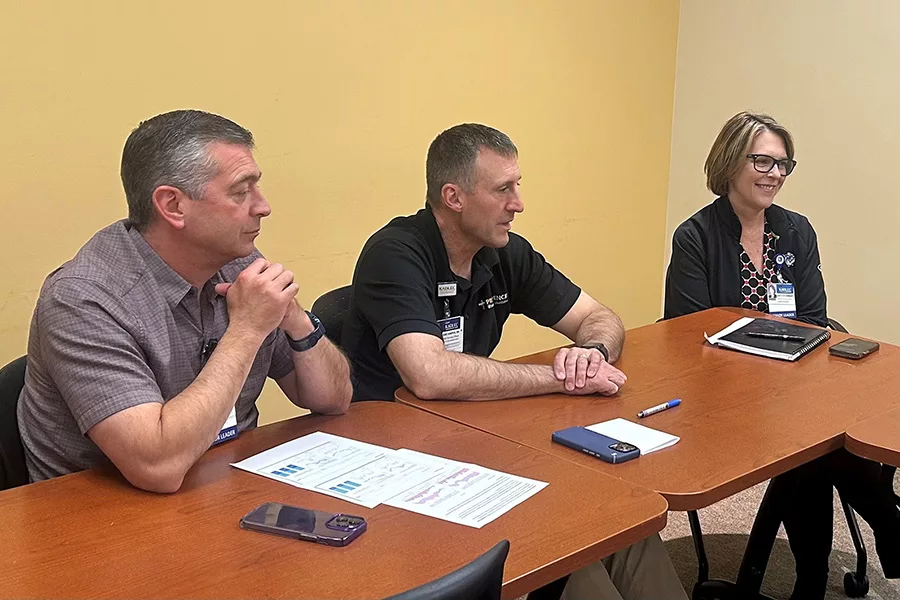
From left, Kadlec’s chief medical officer Dr. Rich Meadows; Kirk Harper, chief nursing officer and Katy O’Connor, chief human resources officer, share how the Richland hospital system has recruited and retained staff in recent years and what the labor pool will be like in the future.
Courtesy Kadlec Regional Medical CenterKadlec Regional Medical Center in Richland welcomed one of its largest cohorts of new nurses this summer.
Out of 100 applicants to a dedicated hiring effort earlier in the year, two-thirds were offered and accepted roles at the hospital. Kadlec officials credit a streamlined hiring process and the opportunity for candidates to meet one-on-one with managers from multiple departments to find the best fit as reasons for the successful hires.
And yet, as of early August, there were still more than 30 nursing positions open at Kadlec, among the more than 80 open roles overall.
“That’s actually a lot less than last summer,” Katy O’Conner, Providence's chief human resources officer for Southeast Washington & Inland Northwest Washington, recently told the Tri-Cities Area Journal of Business.
Employee recruitment and retention has become a constant effort for the area’s health care providers, as the Tri-Cities and its surrounding communities grow and retirements outpace the onboarding of new workers.
Between the hospitals in the Tri-Cities and Prosser there were more than 300 openings for positions ranging from physicians to medical assistants across operations, including emergency rooms and primary care clinics.
Hospital HR departments are pulling out all the stops to keep up, from large scale hiring events and maintaining multiple pipelines with training and educational programs to internal advancement opportunities for staff and using artificial intelligence, or AI.
The health care workforce has been strained for years, particularly after the stresses of the Covid-19 pandemic led to burnout.
The need for health workers is great as the health care workforce makes up the second-largest job sector in the Tri-Cities region, according to Benton-Franklin Trends data.
The federal Health Resources and Services Administration estimated in 2024 the state had a shortage of 13,000 registered nurses, which is expected to grow to 22,000 by 2036. The Washington State Medical Association (WSMA) in 2023 wrote in a special report that nearly 800 primary care providers were needed to adequately meet the needs of the state’s population.
That doesn’t account for the countless other roles in hospitals and clinics that aren’t as well-known but also in demand, from physical therapists and technologists to front desk staff and specialist nurses.
“Frontline staff are often overlooked,” said Tim Reed, chief financial officer at Prosser Memorial Health. “Yes, they are entry level, but they are the face of an organization.”
Enter more novel approaches to not only find staff but ensure that they stick around.
Lourdes Health, in early August, hosted an open interview day for medical assistants. With multiple openings for those roles spread across its system, hospital officials said they were striving to find the best fit for qualified candidates.
“This event, in addition to our traditional recruitment efforts, offers a valuable opportunity for prospective candidates to engage with us directly, ask questions and get a taste of our culture by meeting potential colleagues,” said Lourdes spokeswoman Tina Baumgartner in a statement to the Journal.
At Kadlec, new medical assistants are provided the opportunity to try out a placement for a couple of weeks and rotate to another if it’s not a good fit.
“It’s not just, ‘I hope this works,’” said Dr. Rich Meadows, chief medical officer for Providence Clinical Network and Providence's Southeast Washington service area. “I think this is what’s helped us with retention.”
Prosser Memorial Health has put a lot of effort toward making sure all its staff, whether a physician or a clerical worker, feel supported and valued and are also a good fit for the organization. It’s what has allowed the rural hospital to grow from a staff of 300 to 800 over the past seven years.
“If you make the wrong hire, it can tip the whole department over real fast,” said Shannon Hitchcock, Prosser Memorial’s chief communications officer.
And while working to find quality new employees, the necessity of finding efficiencies has become critical. Kadlec has adopted AI tools in some limited settings, specifically for writing patient chart notes and other paperwork. Meadows stressed that AI is intended to augment and not replace providers, saving a physician an hour a day via voice recognition software and transcription.
But even good staff retention can’t mitigate the wave of retirements of baby boomer health care providers and workers. And that trend is exacerbated by increasing difficulty in enticing people to pursue health care careers, especially for entry level roles.
According to the WSMA report, in the 2019 reporting period, the Washington Workforce Training and Education Coordinating Board tracked 30,000 program completions across a range of health care professions. Two years later, in 2021, that number decreased to 22,487, or 11.4%.
O’Connor recalled a member of upper management in the Providence Health system, which owns and operates Kadlec, noting that hospitals will likely never have as many nurses as they do now.
“We’re going to have to have different models of care,” she said.