
Trump proposal to streamline jobs program funding would cut funding to states
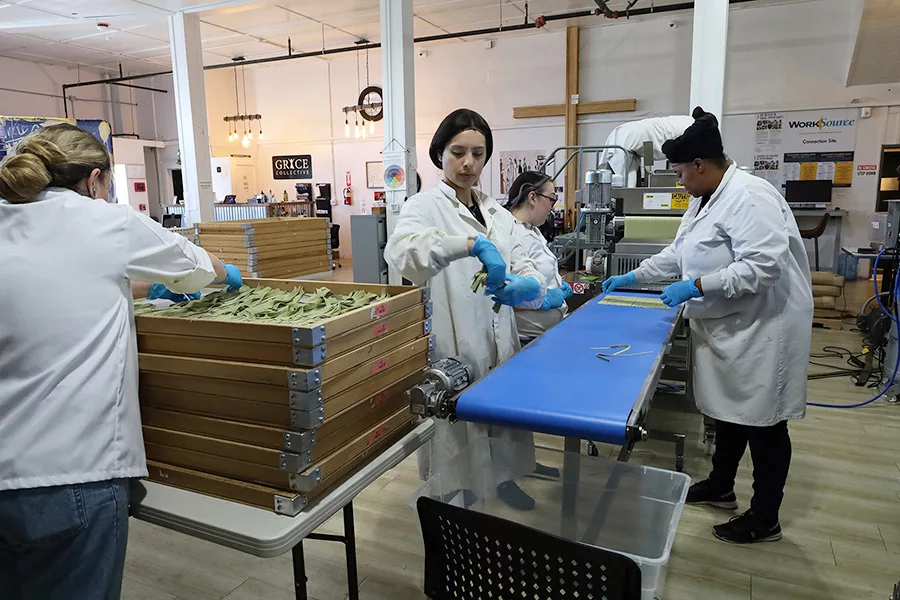
A Pasco nonprofit gives impoverished and exploited women a place to work and gain experience, from making pasta to taking computer classes. Grace Collective offers an 18-month training program, and its programs are expanding to serve more women.
Photo by Rachel VisickTucked into President Donald Trump’s new budget request is a plan that could dramatically change — and, critics say, slash — how much money and help states provide to people needing jobs and training.
Trump’s latest budget proposes a federal “Make America Skilled Again’’ grant that would combine a dozen current programs and provide $3.4 billion in spending for certain employment and training programs, down from $4.65 billion anticipated this fiscal year.
The president’s plan would fund block, or general, grants to states, which could then tailor the spending to employment and training needs.
There’s no formula in the budget proposal detailing how or where the money would be distributed, other than a requirement that at least 10% be spent on an apprenticeship program and 3% on innovations. The secretary of the Department of Labor could also reserve up to 0.75% on “program accountability” and technical support.
Congressional Republicans are moving ahead with other ways to fund, and in some cases revamp, federal job programs, though they showed little interest in Trump’s MASA proposal that was also in his budget request last year.
The Trump plan
The MASA effort is another in a series of administration initiatives aimed at streamlining job training programs’ administrative costs and making them more responsive to changes in the workplace.
The Labor Department referred questions about the plan to the Office of Management and Budget, which did not respond to questions.
At the National Skills Coalition, an advocacy organization for skills-based training, Megan Evans saw the MASA effort as a way of making deep cuts that ultimately hurt workers and employers, she said in an interview.
“The administration says it’s trying to streamline,” said Evans, the coalition’s senior government affairs manager. “But in reality it’s combining deep cuts with risky consolidations and rollbacks.”
The White House last year issued a detailed report and a video on its strategy, outlining how “workforce programs are fragmented across agencies, stifled by red tape, and too often misaligned with the skills employers need.”
These issues, it said, “pose particular risks as the United States advances toward a bold reindustrialization agenda and navigates the transformational impact of AI (artificial intelligence) on the workforce.”
In the budget released this month, the administration called the program “a key part of the administration’s strategy to fill the growing demand for skilled trades and other occupations,” along with some other programs, including the tax cuts enacted last year.
Changes in getting money and help
While MASA aims to reduce administrative costs, a long-sought goal of administrators across the country, popular programs would be consolidated under the block grant, including several with strong constituencies.
Among them are programs for adult training and employment, youth training and employment, the Labor Department’s Re-integration of Ex-Offenders program, Native American programs and others.
The National Skills Coalition saw trouble in folding these programs into a single grant.
“These programs weren’t created in a vacuum,” it said in a blog post last year. “They each serve distinct populations.”
Merging them would be “making it harder for people to access training that fits their lives and needs,” the group said.
It also had doubts about whether block grants would in fact be more efficient.
“By combining multiple workforce programs into a single grant, it becomes significantly harder to track program outcomes, monitor equity and assess whether specific populations–such as veterans, youth, people with disabilities, or former incarcerated people–are being effectively served,” the coalition said.
Some state and local officials share the concern.
“Washington state is already facing significant budget shortfalls, and this proposal would further widen that gap,” said Marisol Tapia Hopper, director of strategic partnerships & funding at the Workforce Development Council of Seattle-King County.
She said combining the programs into a block grant “functions as a reduction in workforce investment, applying a one-size-fits-all approach to a system that is already chronically underfunded.”
The National Governors Association, a bipartisan group comprising all the nation’s governors, has taken no position on the proposal.
“Workforce training is a huge bipartisan priority for governors,” said Jack Porter, NGA program director for workforce development & economic policy.
“Federal support is critical to standing up effective workforce programs, but the federally funded workforce system as it stands now comes with a lot of red tape that shifts time and focus away from the goal, which is (to) provide workers with training,” he said.
Congressional reluctance
Congress has shown little enthusiasm for the administration’s consolidation.
Earlier this month, the Republican-led U.S. House Education and Workforce Committee proposed a comprehensive job training blueprint.
Among its ideas: providing funding for on-the-job learning and strengthening the system that holds state and local workforce boards responsible “for delivering positive outcomes for workers and job seekers.”
The bill would have adult education programs governed by the Labor Department. The aim would be to “connect adult education to apprenticeships, sector partnerships, and employer-led training especially as artificial intelligence reshapes skill demands.”
Included in the legislation, which a committee spokeswoman says is clearly “in line with the broad goals proposed in the president’s budget,” is a Make America Skilled Again pilot program.
It would permit states to apply to combine different workforce funding streams and then spend them on programs that best suit their needs.
The bill, said committee Chairman Tim Walberg, R-Mich., in a statement, “modernizes a struggling and underutilized workforce development system, delivering reforms that strengthen participant outcomes and ensure greater accountability for taxpayer dollars.”
In the U.S. Senate, Republicans began pushing changes that will help people get access to current programs.
The Senate Health, Education, Labor and Pensions Committee Republicans’ aim is to “increase Americans’ access to job opportunities by eliminating red tape, increasing flexibility, and modernizing the workforce system.”
The goal is to create one-stop centers where people can get information about jobs and training. The measure would “help Nebraskans find great jobs more efficiently,” said Sen. Pete Ricketts, a Nebraska Republican who co-sponsored the bill.
Spending bill season
At the moment, Democrats and Republicans appear deadlocked on how to proceed. The House Appropriations Committee plans to write labor spending legislation in June. The Senate has not announced a schedule.
The partisan lines are forming.
The Trump labor budget “attacks workers and small businesses by undermining workforce development programs at the Department of Labor,” said Rep. Bobby Scott, D-Va., top Democrat on the House workforce panel, in a statement.
Without the specific programs, he said, “many workers will struggle to provide for their families.”
Walberg sees a need for big change.
“The workforce is evolving rapidly, and legislation designed over a decade ago is no longer meeting today’s demands,” he said.
This story is republished from the Washington State Standard, a nonprofit, nonpartisan news outlet that provides original reporting, analysis and commentary on Washington state government and politics.
Stay Informed. It’s Free.
Subscribe to our newsletters and get the latest news and insights delivered to your inbox.
We respect your privacy.
Unsubscribe anytime.
Thank you!
You’re subscribed. Keep an eye on your inbox for the latest updates.