
WA hospitals anticipate losing billions in revenue from Medicaid cuts
New work requirements take effect Jan. 1. Healthcare leaders say this will affect all patients, not just those on Medicaid
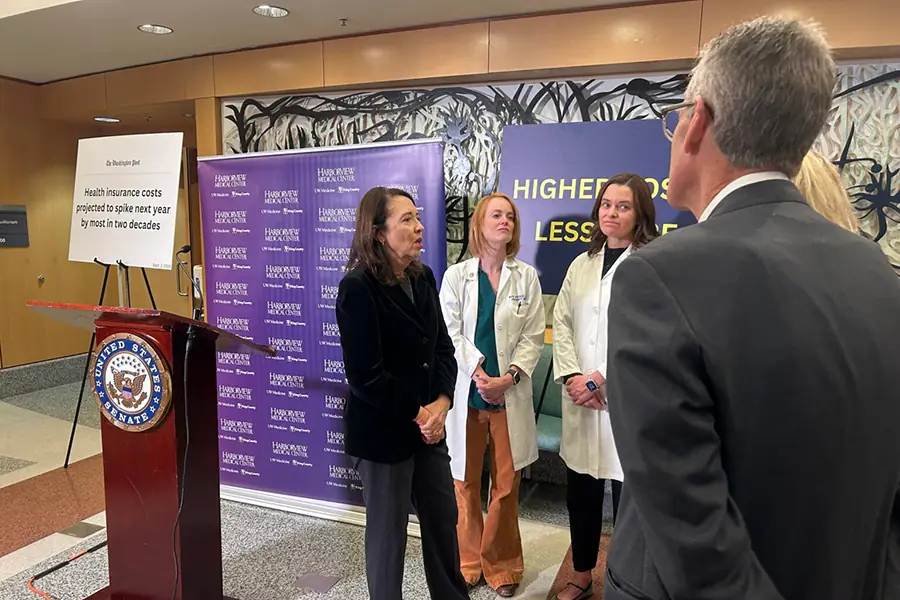
U.S. Sen. Maria Cantwell, left, talks to doctors and healthcare leaders after a press conference on Oct. 20, 2026, at Harborview Medical Center in Seattle.
Photo by Jake Goldstein-Street/Washington State StandardWashington’s hospitals anticipate losing nearly $6 billion in revenue through 2033 due to steep Medicaid cuts in the coming months.
That’s according to a new report from the state hospital and community health associations. It comes as Democrats play up high healthcare costs and coverage losses in the runup to next month’s midterm elections. Voting has already begun.
Democratic U.S. Sen. Maria Cantwell and local healthcare leaders discussed the expected woes for hospitals in an Oct. 20 news conference at Harborview Medical Center in Seattle. They emphasized that the hefty drop in federal funding for the insurance program serving low-income Americans from the tax break and spending cut bill congressional Republicans approved last year will affect all patients, as wait times in emergency rooms rise and premiums for those still insured increase to account for the lost revenue. Staff could be cut and clinics face closure.
Fewer people enrolled in Medicaid means more people going to ERs for care instead of being able to access primary care, and more costs that hospitals have to cover without being reimbursed, advocates say. Hospitals are required to serve patients in emergency departments whether they’ll be paid or not.
“When you drive down the cost of uncompensated care, you help keep healthcare costs in check,” Cantwell said. “When you don’t do that, you are literally driving up the cost on all of us.”
Republicans believe the funding cuts, amounting to over $900 billion over the next decade across the country, were necessary to protect the program from waste, fraud and abuse.
Around 200,000 Washingtonians are expected to lose coverage by the end of next year due to the cuts. Many could meet newly enacted work requirements but won’t be able to surpass constant new paperwork barriers to maintain their insurance, officials expect. About 600,000 enrollees are expected to be subject to these requirements.
The work requirements, which begin Jan. 1, will require enrollees to prove every six months that they’re working, volunteering or attending classes at least 80 hours per month or show they qualify for an exemption. The mandate would apply to healthy adults up to age 64 without dependent children under 13 years old.
Roughly 10,000 in Washington have already lost coverage on Oct. 1, as the law stripped Medicaid coverage for refugees, asylees and other lawfully present immigrants, including people who fled the war in Ukraine and trafficking victims, for example.
Tens of thousands of people have also dropped the health plans they had through the Affordable Care Act when insurance became less affordable as federal subsidies expired. The debate over this issue in Congress led to a lengthy federal government shutdown last year. Coverage through the state’s exchange will cost an average of 22.2% more in 2027.
Rural healthcare
Medicaid cuts will hit hospitals hardest in some of Washington’s more rural areas, like in the 6th Congressional District on the Olympic Peninsula, projected to lose $1 billion. The 2nd Congressional District in northwest Washington and the 5th Congressional District in eastern Washington are next on the list.
Jefferson Healthcare in Port Townsend is bracing for millions in lost revenue and over $1 million in new uncompensated care to account for. CEO Mike Glenn says many rural hospitals are considering layoffs, clinic closures and other service reductions.
“Small rural hospitals will be harmed disproportionately because rural communities tend to be older and poorer than urban communities, and more dependent on public payers like Medicare and Medicaid,” Glenn said.
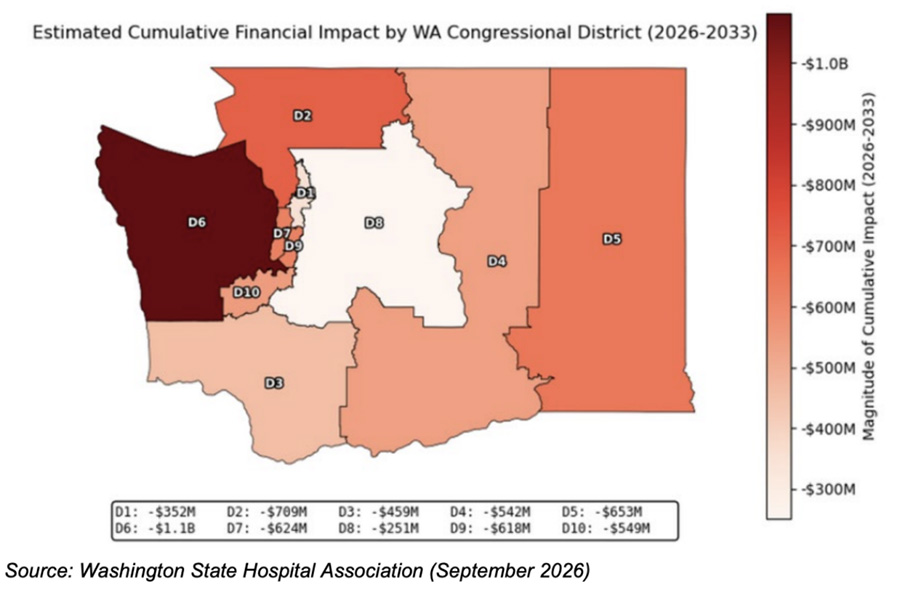
This map shows the impact on hospitals in each congressional district from federal Medicaid cuts, according to the Washington State Hospital Association.
| Graphic courtesy of U.S. Sen. Maria Cantwell’s office.Republicans in Congress embedded $50 billion in the bill for rural healthcare. From this, Washington is expected to get hundreds of millions of dollars over the next five years for an array of initiatives to boost health systems in less populous areas.
The lost revenue for Washington hospitals is projected to get worse each year, starting with $339 million in 2027 to $1 billion per year in the 2030s.
“When you take hundreds of millions of dollars away from safety-net hospitals like Harborview, you are not just putting care for Medicaid patients and uninsured patients at risk,” said hospital CEO Sommer Kleweno Walley. “You are putting Harborview’s ability to serve our entire community at risk.”
Meanwhile, clinics across Washington that primarily serve low-income patients anticipate losing between $98 million and $118 million in Medicaid reimbursements next year, according to the report. These federally qualified health centers serve as the safety net in many communities since they don’t turn away residents without insurance. The clinics estimate at least 82,000 of their patients across the state will lose health coverage, leading to over 200,000 fewer visits per year.
Consequences in the ER
Doctors laid bare the consequences for patients of the Medicaid cuts to come.
Dr. Lauren Whiteside recently cared for a homeless young man at Harborview’s ER after he overdosed on fentanyl. It was his second overdose in a week, she said. She connected him to an outpatient treatment program based at Harborview, and he was stable on medication a month later. Six months later, he was no longer homeless.
“This is what access to care can do,” Whiteside said. “The decisions we make about Medicaid and healthcare access are not abstract policy decisions. They shape when and how people get treatment, and they shape what kind of healthcare system we want for our community.”
Facilities are already seeing the effects of more people seeking care in emergency rooms.
Dr. Marie Vrablik, the medical director of the emergency department at the University of Washington Medical Center’s Montlake campus, told the story of a man on a medication drip in the ER. He was waiting for a bed when his drip ran out. He went into shock. They were able to rush him into a room to save his life.
“But because of crowding and folks waiting for care that, in a better situation, they could have gotten in primary care offices, we couldn’t get him in in a timely manner,” Vrablik told reporters Oct. 20. “And as a physician, I worry that we will only see these situations increase.”
This story is republished from the Washington State Standard, a nonprofit, nonpartisan news outlet that provides original reporting, analysis and commentary on Washington state government and politics.

Stay Informed. It’s Free.
Subscribe to our newsletters and get the latest news and insights delivered to your inbox.
We respect your privacy.
Unsubscribe anytime.
Thank you!
You’re subscribed. Keep an eye on your inbox for the latest updates.