Longtime Hanford Communities leader to retire
The first and only leader of the Hanford Communities group plans to retire in May 2020, ending 25 years of support and advocacy on behalf of those who live in the shadow of the Hanford site and its long-running cleanup efforts.
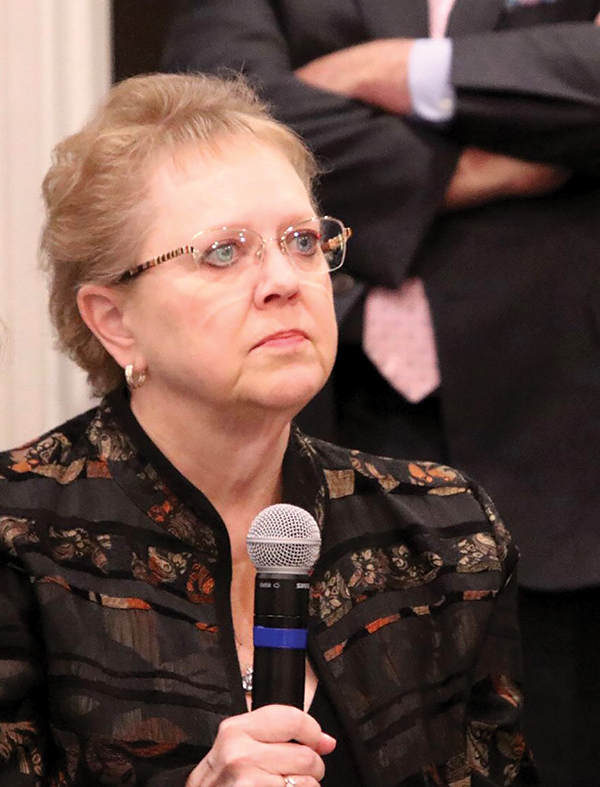
It’s a role Pamela Larsen didn’t expect to fill, let alone serve in for decades, when she first applied for an economic development position while living in western Washington.
“They called me and said, ‘We’ve been looking at your résumé and there’s this other job open that we think you’d be great at.’ They told me what it was, and I said, ‘Oh, I don’t think so,’ ” Larsen recalled.
“There wasn’t a lot of information about Hanford at the time, plus business development and nuclear waste are pretty far apart on the spectrum. I came (here) thinking it would be two years. I missed the trees for a while but decided I liked the sun.”
As the executive director since 1994, Larsen also served on the Hanford Advisory Board for that same duration, vastly expanding her knowledge on the processes, accomplishments and goals for cleanup of the Hanford site.
Former Richland City Manager Joe King created the Hanford position when he saw the need for a coordinated effort to manage information that was just starting to trickle in from the U.S. Department of Energy, which was under pressure from the state of Washington to be more transparent about its work at Hanford.
Information about contamination wasn’t public. But the new disclosures helped lead to the Tri-Party Agreement, which governs the cleanup.
“They were sharing information that hadn’t been shared before, and people in the community were much more nervous about jobs and what was going to be happening, so there was a lot of interest. King had a passion to engage the communities on what was going on,” she said.
Hanford Communities was created as an intergovernmental organization under Washington state law, with the city of Richland as the administrator.
The Tri-Cities was the only DOE community with an association of government at first. Today, DOE communities in Los Alamos, New Mexico and at Oak Ridge, Tennessee, have followed suit.
Larsen added that while Hanford Communities is no longer the only community to have this representation, it’s the only one that consistently agrees on its positions.
“We are very collaborative. We have never had a major difference of opinion between the jurisdictions, whereas the communities around Los Alamos, New Mexico, have very different opinions,” she said.
Larsen recently shared some of this collaborative vision with agencies in Fukushima, Japan, the site of a 2011 nuclear accident. Leaders there wanted to learn how Hanford Communities worked to have a voice in waste cleanup.
Larsen said the organization’s role has evolved over the past 25 years, shifting from policy analysis to advocacy.
“As we became more knowledgeable about the issues and the depth, we’ve been able to be much more vocal, especially in Washington, D.C.,” she said.
She pointed to strong local representation for helping keep Hanford a priority in the federal budget. She praised efforts from U.S. senators who represent Washington state in key roles.
Sen. Patty Murray serves on the Senate Appropriations Committee, and Sen. Maria Cantwell has served as ranking member for Energy and Natural Resources.
The Washington Democrats and their staffs work on Hanford issues daily.
“We’re very, very fortunate that we have those folks looking out for us,” Larsen said.
While acknowledging the most recent success of Hanford receiving more money for cleanup efforts than requested for the current year, Larsen anticipates a struggle ahead.
“We’re in defense appropriation, which means the weapons program competes with waste cleanup for funding. This administration wants to put more money into weapons, so that will be hard to sustain, but a lot is going to get done this year and we have incredible leadership at the Department of Energy in Brian Vance.”
Larsen recognizes the local community’s ability to leverage future success in new avenues with the growth of nuclear energy at the Columbia Generating Station, operated by Energy Northwest.
Proximity to the commercial nuclear plant has led to a comfort level because engineers and other workers live in the community.
“If you live in Seattle, you probably don’t know a nuclear engineer, let alone live next door to one,” she said.
She also points to the supporting industries and small businesses that have cropped up around the site that have a future interest in the success of nuclear energy.
Reflecting on the last 25 years since becoming the first employee of Hanford Communities, Larsen remembers the collaborative effort around safety and stabilization of the PUREX tunnels, once used to transport items out of the Hanford site.
“The Department of Energy and the state were progressing along, but we had a strong sense of urgency. The DOE site manager met with the four mayors and talked of the potential collapse of the tunnel, so they wrote a very strong letter to the state, ‘Please issue the permit,’ so the DOE could get it done. And the grouting got done before that nasty winter we had last year. They’ve been given a lot of credit for moving that along a lot faster.”
Still, Larsen wishes some projects were further along, such as treating tank waste.
The original goal was 2007.
“We need to get waste out of the tank,” Larsen said. “The problem has been, the Defense Nuclear Safety Board kept coming up with safety questions.”
The cleanup of the Columbia River corridor is a point of pride for Larsen’s past quarter of a century of work.
“When I first started, and Congressman (Doc) Hastings first came to office, he went to see C Reactor and it was snowing inside the building,” Larsen said.
Today, the river corridor is almost done. Sludge is removed from K Basin, contamination plumes have shrunk and the pump-and-treat systems along the Central Plateau are doing an incredible job treating 2.5 billion gallons of water a year in central Hanford.
Efforts still remain for cleanup of the Central Plateau.
“For a region that’s dependent on agriculture, and particularly agricultural exports, getting the high-risk work done secures our future,” she said.
At 66, Larsen is retiring from her paid position with the city of Richland and Hanford Communities, allowing her more time to travel and go boating. But she doesn’t expect to fade away from overall advocacy over Hanford cleanup.
“I still care about the issues and hope to have some engagement, but I’m not willing to say what that might be,” Larsen said.
As for the future of Larsen’s position, it’s unclear.
The Hanford Communities Administrative Board created a subcommittee to review the position and potential organizations that may provide administrative support, according to Cindy Reents, Richland’s current city manager. No decision has been made.
Before she retires, Larsen is focusing on a final project promoting STEM (science, technology, engineering and mathematics) education to local students in hopes of inspiring future members of Hanford’s workforce to sustain the cleanup for decades to come.
“We are going to try to take it from their perspective, ‘What are your passions? What are your interests?’ ‘Where does that lead you to?’ We’ll introduce them to educators and people at the site,” said Larsen, who is working with the Washington State STEM Education Foundation to model some of the nonprofit’s successful programs on career-connected learning.
Larsen said the Hanford Advisory Board benefits from depth of knowledge for positions appointed by the cities, which aren’t term limited, and has allowed her to serve for decades.
She could continue to contribute through public at-large positions, though those are term limited.
“When you’ve been around this long, there’s a lot of stuff in your head. So when somebody says, ‘Hey, let’s do this,’ you can go, ‘Been there, done that. It didn’t work and here’s why.’ ”