State hospitality industry faces mounting pressure on multiple fronts
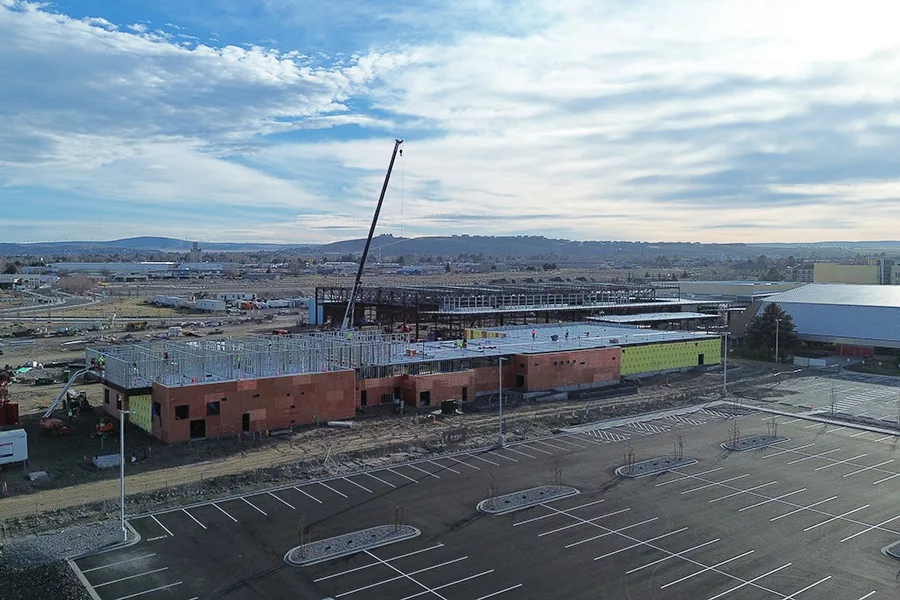
The Three Rivers Convention Center expansion in Kennewick is one of many commercial projects underway throughout the Tri-Cities. Architecture and engineering firms forecast a positive year ahead fueled in part bythis and other commercial projects.
Photo by Nathan FinkeNow is the time when the summer travel season begins to heat up but the state’s hospitality industry is feeling burned.
Despite hosting World Cup games in the coming weeks, it’s not shaping up to be the boom many hoteliers had hoped for. Seattle’s lodging demand is 4.3% below where it was a year ago, Anthony Anton, president and CEO of the Washington State Hospitality Association, recently told his members during a webinar.
Industry officials and experts cite declining tourism demand, slower convention and business travel, rising operating costs, changing consumer preferences and a “dysfunctional” relationship with state lawmakers as reasons for the state’s lodging industry to be in “critical stress.”
“We have a recipe for disaster on our hands,” Anton said.
And the Tri-Cities isn’t immune. Hotel occupancy in the Mid-Columbia is down 1.5% from last year, Kevin Lewis, president and CEO of Visit Tri-Cities, told the Tri-Cities Area Journal of Business.
“For the most part we’re holding our own in a tough environment, but occupancy numbers are not what we hoped for,” he said.
Taran Patel, managing principal of A-1 Hospitality, which operates three Pasco hotels and is currently building an AC Hotel by Marriott at the Three Rivers Convention Center in Kennewick, told the Journal that the market still hasn’t hit its high-water mark of 2019. He said the the Tri-Cities’ room inventory should be viewed in the context of a market that is still recovering from pandemic disruptions, noting that many hotels were shut down or converted to apartments during the pandemic.
State of industry
The current state of the industry is piling onto a not-great 2025: Tourism traffic from Canada and internationally declined 26% and 16.5%, respectively, according to state tourism officials. Total visitor spending managed to inch up less than 1% to $25.3 billion and visits to the state were relatively flat.
“Growth was fueled entirely by the domestic day visitor market, masking declines in higher-value overnight and international segments,” according to a release from State of Washington Tourism, or SWT.
But there are some silver linings and industry representatives are hopeful tourism traffic can still pick up and that challenges can be overcome.
Tourism represents the state’s fourth-largest industry, contributing tens of billions of dollars to business and generating billions of dollars in local and state tax revenues. In the Tri-Cities, tourism contributes hundreds of millions of dollars and sustains thousands of jobs through taxes, lodging, restaurants, retail sales and more.
But according to data compiled for the state by travel research firm Tourism Economics, leisure travel in Washington declined 0.8% in 2025, and the state’s share of total international visitation fell from 2.2% to 1.9%. Hotel demand was down 1.1% in 2025, exceeding the national average of a 0.4% decline. Direct state tourism employment declined 1.1% to 152,186 jobs.
So far in 2026, Lewis said the Tri-Cities’ convention business took an initial hit but has since rebounded. He added that the sports tourism market, which includes the annual Ironman triathlon in September, remains strong, but business and leisure travel segments “seem to be feeling the pinch now.”
Geopolitical issues appear to be a major driver in the decline in international travelers, industry officials said. Last year’s federal government shutdown and the partial shutdown that affected Transportation Security Administration workers at airports at the start of the year also contributed.
Anton noted Baby Boomers continue to prefer hotels while Gen Z travelers prefer vacation rentals booked through Airbnb and Vrbo instead of hotels. That changing market share combined with rising operating costs and encroaching state regulations have many hotel operators back on their heels.
“We need to reset the relationship (with the state government),” Anton said.
Bright spots
There were some bright spots for the Washington tourism industry last year. Business travel continued to grow, increasing 13.9% for a second consecutive year. Average per-person spending edged up to $228 per visit, though international visitors continued to spend at dramatically higher rates, averaging $1,084 per visit compared to $212 for domestic travelers. And tax revenues related to tourism grew 2.3%, reaching $3.5 billion.
And in the Tri-Cities, overall hotel room rates have remained consistent, which means revenues have still managed to grow 0.5% for the year.
“Despite all of the challenges, our group sales and marketing efforts have been productive. Group bookings are on pace with last year and a recent marketing campaign produced a $43 to $1 return on ad spend(ing),” Lewis said.
Meanwhile, Anton and state tourism officials see a bill signed by Gov. Bob Ferguson this spring as a means to strengthen tourism promotion efforts that will support the industry. The bill, which became law on June 11, will allow the state’s private sector to establish and oversee an industry-sponsored self-assessment that could yield as much as $25 million annually for tourism promotion efforts.
“We’re hopeful that this funding mechanism will help us restore lost destination market share as well as offer critical resources during economic downturns so we can recover sooner and more fully across our state,” said David Blandford, SWT’s CEO, in a statement.