This air base keeps Tri-Cities patients connected to advanced care
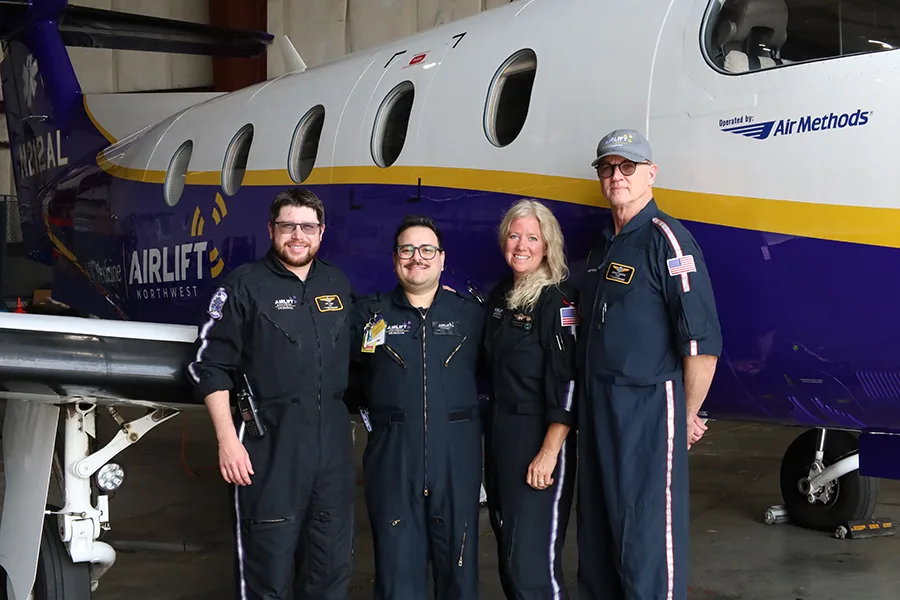
From left, Nick Jensen, pilot; Adam Longoria, certified flight nurse; Becca Bohlke, certified flight nurse; and Dennis Busche, pilot, are part of Airlift Northwest’s Yakima crew, helping transport patients in critical condition from regional hospitals throughout the state to larger Seattle hospitals.
Photo by Rachel VisickYakima is home to a base for a life-saving air medical program, ready to respond at a moment’s notice and working a bit like a fire station – except with planes, pilots and nurses.
They play a key role in the region’s emergency transportation network, linking the Tri-Cities to west side hospitals to get patients the care they need.
Operating out of seven Washington bases and one Alaska base, the University of Washington School of Medicine’s Airlift Northwest program helps transport patients in need from regional hospitals around the state to larger Seattle hospitals for advanced care.
The program is more than just emergency transportation: highly-skilled nurses accompany each flight, stabilizing patients from hospital to hospital.
The program operates through a contract with Air Methods, an air medical company that owns the program’s airplanes, and trains and takes care of the pilots. Airlift Northwest provides the medical care with UW-employed nursing staff.
Dennis Busche, a pilot with Airlift Northwest and Air Methods, said the air medical transportation system is especially important for the western United States since there’s so many rural areas that may not be able to provide advanced care.
The Yakima base serves a special role in the Airlift Northwest program as the only Washington base with fixed-wing aircraft. The other bases in the state use helicopters, but since they can’t fly in bad weather, the planes at the Yakima base are essential for transporting patients. Helicopters can bring patients to an airport where the Airlift Northwest planes can pick them up.
The Yakima base is also centrally located, so that the planes can reach just about any Washington airport in 30 minutes, Busche said. The planes fly to the Tri-Cities, Ellensburg, Omak and even out of state to bring patients to the west side.
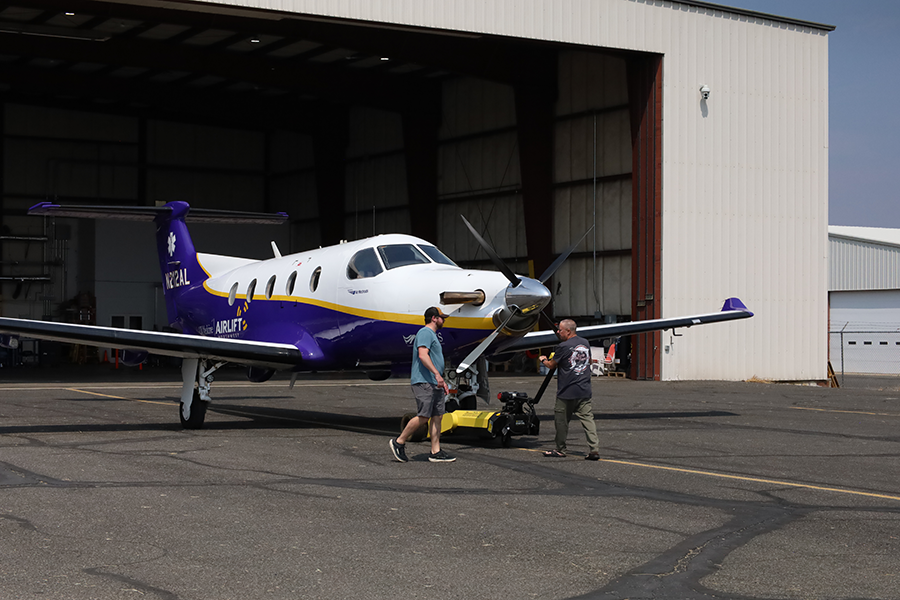
Airlift Northwest has seven Washington bases and one Alaska base, and a Yakima base is the only one in the state with fixed-wing aircraft, enabling it to serve a special role in connecting regional hospitals to larger west side hospitals.
| Photo by Rachel Visick24/7 operations
Like a fire station, the base is set up so that pilots and nurses can fly out at any hour of the day or night. Nurses operate on 24-hour schedules while pilots work 12-hour shifts, sleeping in beds at the base when they’re not needed for a mission.
The base is also equipped with restrooms, showers, TVs and computers for the crew to take advantage of on slow days or in between missions.
Crews clock in at 8 a.m. and 10 a.m., while Busche starts his shift at 2 p.m. to help cover the overlap. The base has three planes, two of which are operational at any given time, while the third serves as a spare. Several full-time mechanics are on staff to keep the planes running smoothly.
When a call comes in, pilots are notified first. They’re only given the destination and the weight of the patient so that they can make the decision to fly the mission based solely on current air traffic, weather conditions and other aviation conditions.
Busche, who had previously worked for FedEx before starting with Airlift Northwest and Air Methods in February, said that it’s different than flying scheduled flights as he did previously. At Airlift Northwest, he’s “waking up from a dead sleep and going to an airport you’ve been to once in your life,” he said.
Pilots are responsible for researching the airport and conditions, factoring in the weight of the patient, sometimes all at 2 a.m.
If a pilot accepts the mission, then nurses are filled in on the details and the team assembles in about 15 minutes from call to takeoff.
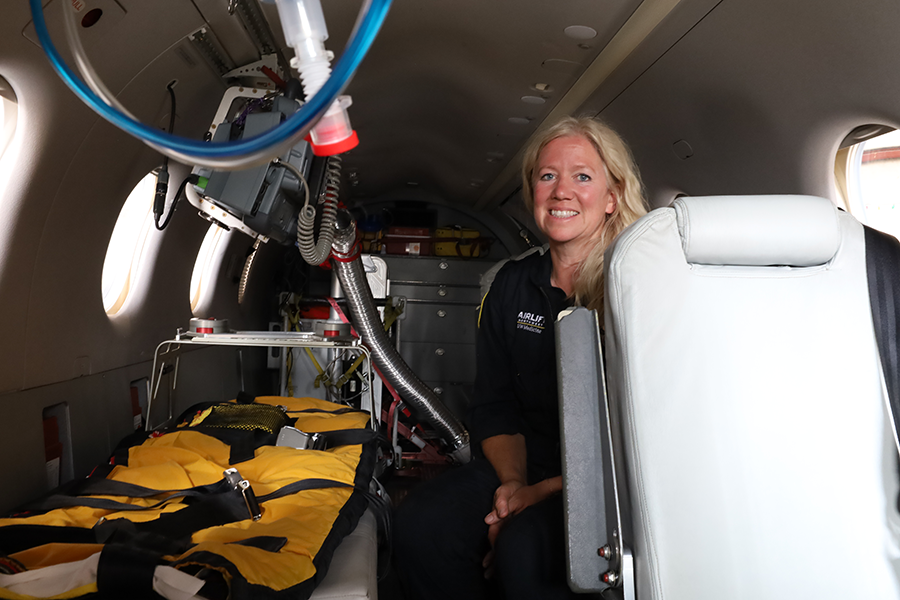
Becca Bohlke, certified flight nurse with Airlift Northwest, sits in one of the planes used to transport patients. Skilled nurses are key to keeping patients stable while transferring them from hospitals to ambulances to the air.
| Photo by Rachel VisickSkilled nurses
Before taking off, pilots and nurses both have pre-flight checks to make, and blood needs to be packed into a cooler for transport. One pilot and two nurses go out on each flight.
Once a plane arrives at an airport, an ambulance is usually waiting to meet it – but not necessarily a patient. The nurses that staff Airlift Northwest are trained to stabilize critical patients, so they go out to the patient in the ambulance, then ride back to the plane with them. The planes have a large cargo door where a ramp or hydraulic lift can be used to load the patient on a gurney.
The planes then operate like a mobile ICU, Busche said, decked out with on-board oxygen and the ability to regulate cabin pressure to minimize complications.
Nurses can perform more procedures than a typical nurse, who must have doctors’ orders first. The Airlift Northwest nurses have standing orders to do what is needed, from intubations to mixing their own drips. They “are lab, pharmacy, housekeeping and everything,” said Becca Bohlke, a certified flight nurse who has worked with the program for 11 years.
That means that patients aren’t delayed in receiving care. The nurses are trained and frequently check in with UW doctors as part of the program.
In some specialty cases, like with a heart issue or when the patient is under 6 years old, pilots will pick up a special team from Seattle before flying out to the patient.
While dealing with new scenarios every day and working in the tight space of the plane may sound challenging, “it’s what makes it fun and interesting,” Bohlke said. She never knows how the day will go or what she might see, she said.
The nurses also enjoy the team environment, getting to know others at the base, and the support for their education from the doctors they work with.
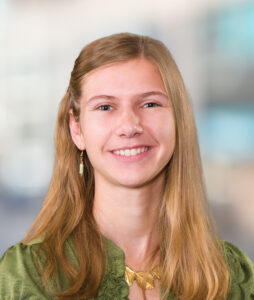
The Tri-Cities connection extends beyond patient transport. The Yakima crew recently welcomed a young pilot from the Tri-Ciites to see their work firsthand. Eden Welch, a recent Richland High School graduate, rode along with Busche to see a medical mission in real time and stayed for an entire shift.