
Dome sweet dome
Finding a home with real curve appeal
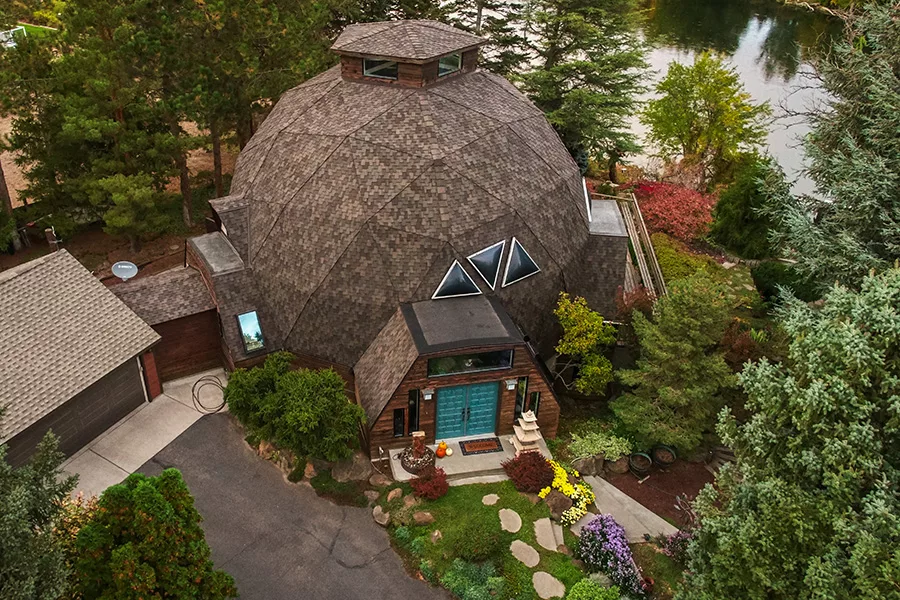
The geodesic dome home of Tracy and Marcie Daines sits along the Yakima River in Richland. Tracy Daines built much of the home himself in the mid-1970s from a kit provided by a California company.
Courtesy UpAngle Drone Services/Palmer RoofingThe Daines and Willard families used to live in single-story, ranch-style homes like the many that fill Tri-City neighborhoods.
But the unique design of their current residences breaks sharply from the pattern. Their dome-shaped homes look more like science experiments than traditional residences.
Tracy Daines lives in a shingled geodesic dome along the Yakima River in Richland. The openness of the design was part of its appeal, he said, especially during the long, dark winters as his first wife “would get depressed.” “She liked it because it’s open,” said Daines, a retired welding engineer.
Jim Willard, a farmer who lives north of Prosser, was drawn to a different kind of dome: a concrete monolithic structure he built largely on his own terms. “Not necessarily the most cost-effective, but the way I wanted it,” he said.
Once promoted as a potential solution to the U.S. housing shortage after World War II, dome homes failed to gain traction and were dismissed as “smart but not wise” by one former advocate of the design.
Decades later, Daines and Willard say the unconventional designs are exactly why they stay. Despite the quirks – or perhaps because of them – they both say they wouldn’t trade their curved walls for traditional ones.
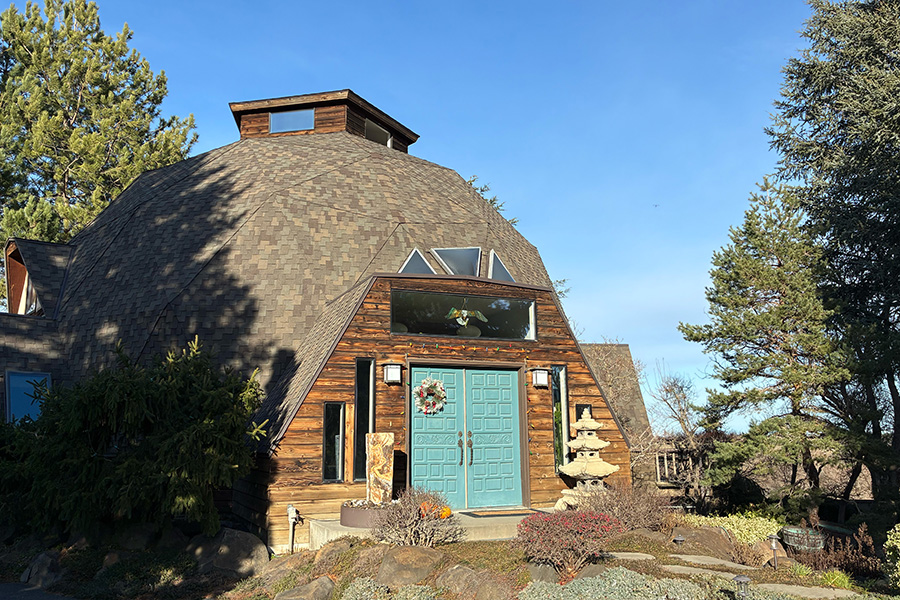
Tracy Daines’ geodesic dome home sits nestled among trees and other landscaping along the Yakima River in Richland.
| Photo by Ty BeaverSearching for a perfect home
Daines and his first wife, Charlotte, considered two housing designs while looking for a home to live in the mid-1970s. They toured a model of an A-frame on the East Coast and then a geodesic dome offered by a California company. The dome won out, and Daines promptly ordered the $10,000 kit of materials to build it.
He had help with the sheetrock, plumbing and electrical work, but he otherwise constructed the entire 4,000-square-foot, three-story home himself.
“I built up enough vacation time where I arranged with my boss to work just four days a week,” he said, leaving three days each week to work on the house. “And I worked on it after work each night.”
Willard said he and his wife worked on the design for their home over 10 years. He hired a contractor with experience in monolithic concrete dome construction and used inflatable concrete forms from a Texas company.
However, much of his own labor is in the house, with construction starting in 2001 and his family moving into it in 2006.
“This isn’t an overnight project, and it is still under construction,” Willard said. “This afternoon I’m going to be building some more kitchen cabinets for it.”
Dome home evangelists
The geodesic dome, recognizable by its triangle-shaped panels arranged in hexagons or pentagons, was popularized and promoted by architect R. Buckminster Fuller. He envisioned a home manufacturing process that would deliver them to building sites ready-made.
“They could be ‘installed’ anywhere, the way a telephone is installed, and with little additional difficulty,” according to the Buckminster Fuller Institute website. “When one (U.S. government) official flew to Wichita, Kansas, to see this house, which Beech Aircraft and Fuller built, the man reportedly gasped, ‘My God! This is the house of the future!’”
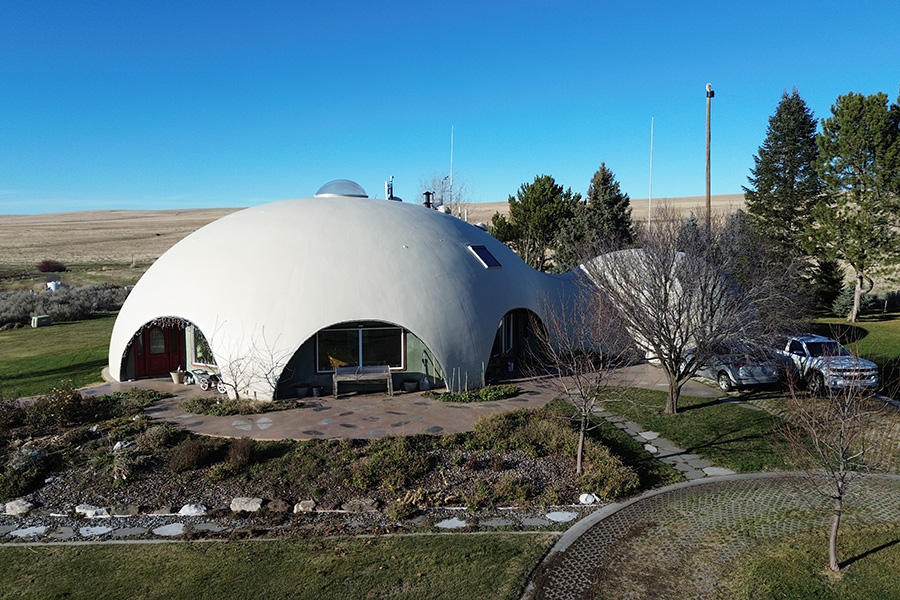
The concrete monolithic dome home of Jim Willard sits among open agricultural land north of Prosser.
| Photo by Nathan FinkeMonolithic domes have a smooth appearance akin to something you’d see in the setting of a science fiction movie, like Luke Skywalker’s childhood home on Tatooine. They are the same concept behind igloos, the snow structures used by some bands of Inuit peoples in the Arctic. Usually seen in more commercial or industrial buildings, monolithic dome homes were one of the signature designs of architect Wallace Neff, who called them “bubble houses.”
“What if the Flintstones and the Jetsons’ homes had a rendezvous?” reads a listing for the $1.8 million 1946 Andrew Neff House in Pasadena, noting the home “even comes with your very own bomb shelter. I guess that makes it a true ‘atomic’ age modern home.”
Curve appeal
Willard’s home, which sits in the middle of open agricultural land, is reminiscent of something space age. It rises 28 feet above the ground with a 64-foot diameter. Its attached similarly rounded garage is 18 feet tall with a 36-foot diameter. A circular driveway winds in front of the home.
Inflatable forms facilitated its construction, with six to seven layers made up of 127 cubic meters of concrete and rebar making up the shell.
“It was an interesting process,” Willard said. “I didn’t believe you could stick concrete vertically, but you can.”
The house doesn’t fill the entire diameter of the dome; the ground floor walls and windows are set back, with the dome serving as a canopy of sorts. That allows for lots of natural light while shielding the interior of the home from the harsh summer sun.
The master bedroom and en suite bathroom are on the ground floor.
Structural steel frames the walls and holds up the second floor, which has two bedrooms and a bathroom once occupied by the Willard children. Those rooms are now a guest room and a space for the couple’s collection of jigsaw puzzles.
Among some of the other unique features is the lack of air conditioning. Instead, the Willards pump cold well water through the radiant heating pipes installed in the ground floor’s concrete slab, keeping the house comfortably cool in the summer.
And Willard also made sure to carry the rounded motif into other design elements, namely with arched or rounded doorways.
“I realized that I do not like sharp edges or square edges,” he said.
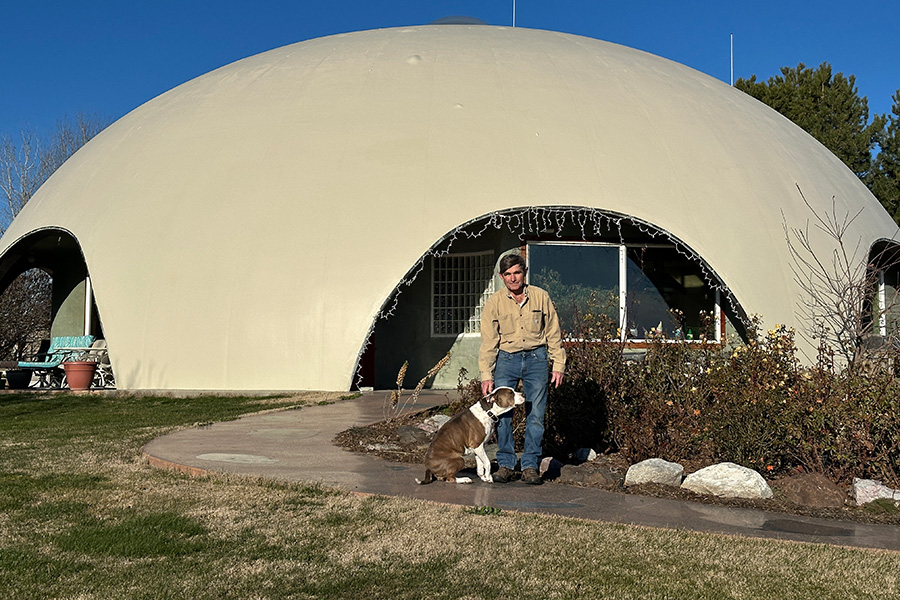
Jim Willard’s Prosser home doesn’t have air conditioning. The dome home stays cool in summer by using cold well water through the radiant heating pipes installed in the ground floor’s concrete slab.
| Photo by Nathan FinkeAbundant space and light
Daines said the kit for his dome only came with the basic components, primarily the redwood framing and triangular panels. He and his first wife otherwise customized the home to their vision.
There is a bedroom and bathroom on each of its three full floors. The second floor is a mezzanine, with the bedroom open to the living room below. A spiral staircase in the office space on that floor leads up to a loft with a dome skylight.
The living room is fully open to the top of the dome’s 30-foot height, with triangular windows at intervals about halfway up. Reaching it from the front door requires walking across stepping stones that run through interior landscaping and an indoor pond.
“I probably wouldn’t have put a pond in, but that’s what she wanted,” Daines said.
It’s a room that Marcie Daines, his second wife, also has come to enjoy.
“I like the open space and the light,” she said.
A bedroom, bathroom, pantry and kitchen ring the edge of the dome opposite the living room, with the dining room as a central pivot. A deck encircles the outside of the dome, offering views up and down the river.
“We eat dinner out here most nights in the summer,” Daines said.
The walkout basement has a small workshop, laundry, a bedroom, bathroom and a sitting room.
Daines installed a heat pump to heat and cool the house, with well water to irrigate the landscaping and gardens outside. And despite the incredibly high ceiling, it only costs about $142 per month in electricity to heat comfortably, he said.
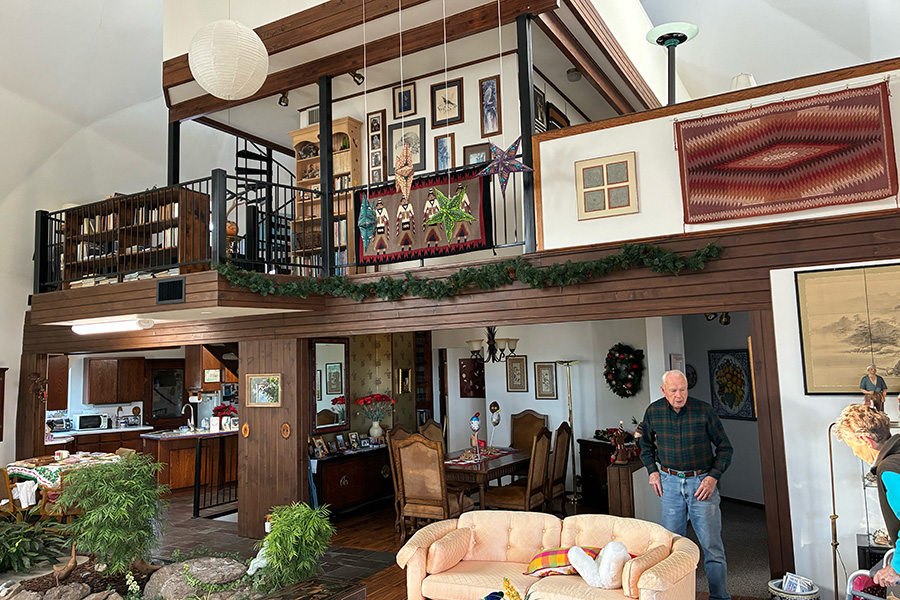
Tracy Daines walks through the living room and into the dining area of his geodesic dome home located along the Yakima River in Richland. The second floor mezzanine, with the master bedroom and office, rises above him.
| Photo by Ty BeaverDome home bubble bursts
Domes as homes were in vogue in the 1960s through 1970s with lauded benefits including the inherent sturdiness of geodesic domes, ability to enclose the largest space in relation to its surface area, and energy efficiency.
But they didn’t catch on for a variety of reasons. Building materials, such as plywood and sheetrock, are manufactured to be rectangular, and the dome design is often incompatible with many building codes, zoning and insurance requirements. Plus, they require a lifestyle shift.
“The open space floor plan, while leaving room for creativity and customization, was unfamiliar in the U.S., although common elsewhere,” Dana Fortune, a history teacher who studies sustainable housing, told Architectural Digest. “If the dome is built out of concrete, the walls are harder to decorate, furniture can’t be pushed against walls as easily, and resale value was a concern.”
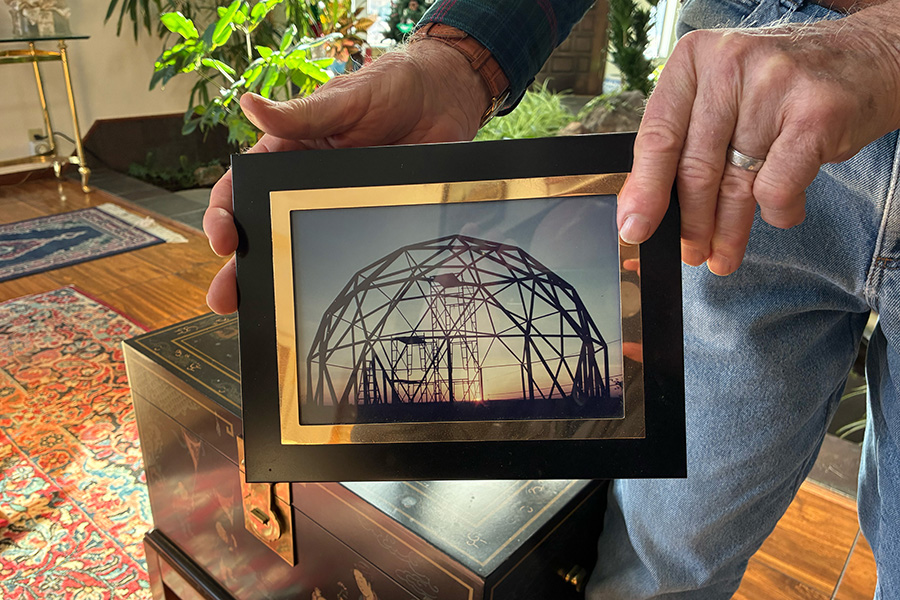
Tracy Daines holds a framed photo taken in the mid-1970s after he had fully erected the redwood framing for his geodesic dome home located along the Yakima River in Richland.
| Photo by Ty BeaverThe well-rounded life isn’t for everyone
Willard and Daines acknowledge there are caveats to living in a dome.
Both said that domes are much more acoustically active than traditionally designed homes. Each have adapted to that aspect and made design choices to combat it.
“I have a suspended library that breaks up a lot of the sound,” Willard said.
Upkeep can be pricey in a geodesic dome, where the line between outer wall and roof is blurred. Daines just had his roof redone at the same cost as he paid for the kit to build it nearly 40 years ago.
And the rest of the world’s wariness of them can cause some frustration.
“We didn’t have fire insurance on it for a decade or more,” Willard said. “Insurance companies … didn’t understand it. They wouldn’t insure it except for an unreasonable amount.”
Would-be dome owners need to be aware such structures to be more expensive and take longer to build, additionally requiring contractors knowledgeable of their design.
“I don’t think I can recommend it because they don’t make them anymore,” Daines said, referring to the company that provided the kit for his dome.
But Willard said that shouldn’t hold people back.
“There’s still some challenging areas we haven’t figured out how to address yet, but we’ll figure it out,” Willard said. “Other than that, it’s a nice place to live.”