Maturing market
Hop industry adapts to life after the boom
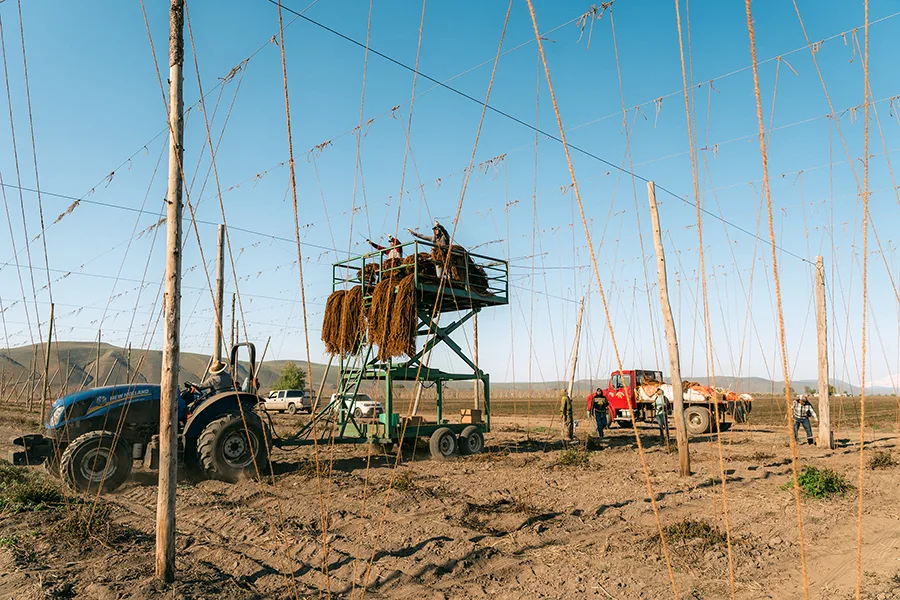
The value of Washington hops totaled $329 million in 2025.
Courtesy Hop Growers of AmericaWashington’s hop industry continues adjusting to oversupply and softer post-pandemic demand after reaching a production high-water mark in 2022, when the U.S. led the world in hop production.
More than 31,100 acres were planted in 2025, a 6.5% decline from the previous year. In 2022, 42,000 acres were planted in hops.
From that 2025 acreage, over 62 million pounds of hops were produced, correlating to a 3.2% drop over the previous year.
Still, industry leaders say the current downturn reflects less of a collapse than a market correction following years of rapid growth driven by the craft beer boom. As beer consumption shifts and demand cools, growers and brewers are searching for new opportunities in exports, hospitality and nonalcoholic beverages.
“When one valley has about a third of the world market share … it’s highly volatile,” said Maggie Elliott, science and communications director for Hop Growers of America.
“It was hard to determine when the peak was going to happen. The industry experienced an unprecedented skyrocket in craft beer … then all of a sudden draft beer sold on premises like restaurants, at football games, etc. just evaporated during the pandemic and that really pushed us into oversupply.”
Domestic beer shipments declined 5.9% in 2025, totaling 139 million barrels from 2024’s 147.7 million barrels, according to the Beer Institute.
The craft beer industry also has struggled over the last two years, with overall U.S. beer production and imports down 1% in 2024, while craft brewer volume sales fell 4% in 2024 and about 5% in 2025, according to a Brewers Association report.
Still, the total value of the hop crop rose to $329 million, up from $320.7 million in 2024, according to the National Agricultural Statistics Service of the U.S. Department of Agriculture, or USDA.
The U.S. supplied 35% of the world’s hops in 2025, with 75% of that production coming from Washington farms.
“We’ve reached market saturation. (The hops market) will contract and (it)’ll rebalance but it’s not like it’s going to crash or disappear,” Elliott said.
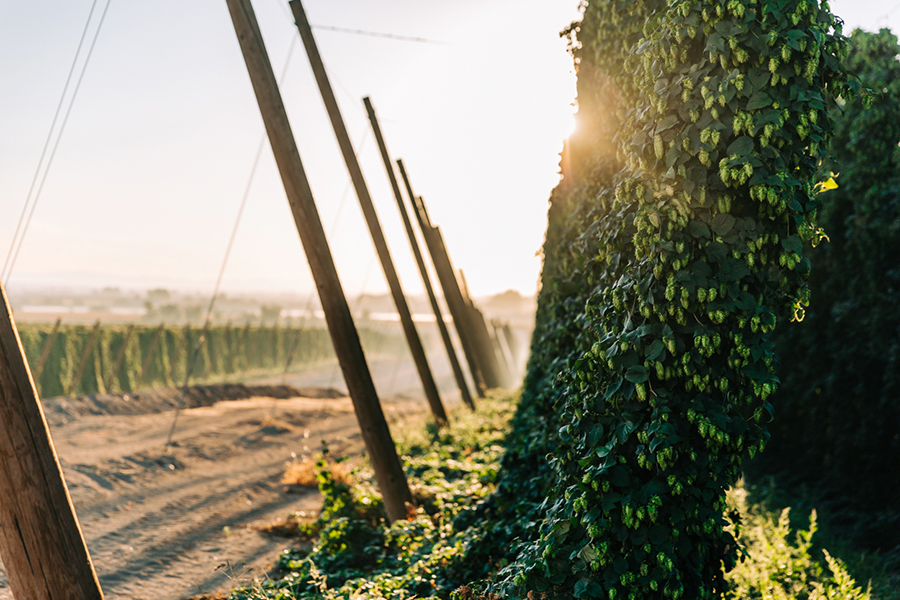
Hop cones and extracts ranked No. 7 among the state’s top agricultural exports, with Belgium, Germany and United Kingdom serving as the largest export markets.
| Courtesy Hop Growers of AmericaSteadier trajectory
Jason Champoux, CEO of Yakima Chief Ranches, the breeding and propagation side of Yakima Chief Hops, said the industry is now returning to a steadier growth trajectory with acreage and production declines moderating compared to previous years.
“There is still a tremendous amount of optimism for a market that’s trying to align with the changing tastes and preferences of consumers,” he said.
No easy choices
For growers, contracts continue to provide stability in a market still working through oversupply.
“Hops are unique though. Of course they are a perennial plant – their roots are in the ground year after year … but whereas you can’t just have apple trees not grow apples, if you don’t trellis hops, the crop won’t go anywhere,” Elliott said.
“The grower has the option to not string and just water the plant and not put all the inputs on it or the labor,” she said.
That approach is less costly than removing the crop entirely and ripping out the 18-foot trellises altogether, though growers seeking to transition into other commodities face limited alternatives.
“What really distinguishes this downturn is that there are ups and downs (in price) in any commodity, but there are so many commodities down at the same time there’s nowhere to turn,” Elliott said, noting the only exception is cattle.
Water availability also remains a concern as the Yakima River Basin enters a fourth consecutive drought year, though reservoir levels are starting higher than they were last year.
“Last year they literally ran out of water and had to shut it off. In recent memory, that has not happened,” Elliott recalled.
She said the Roza Irrigation District is operating at about half the allocation this season and has planned early season shutoff periods to preserve water for later in the growing season.
“People with babies (new hop plants) in the ground this year with no well are going to be in a pinch,” Elliott said.
Some growers have managed to shield themselves from recent fertilizer volatility by locking in purchases well in advance after supply disruptions during the Covid-19 pandemic and the early years of Russia’s war in Ukraine.
Still, growers remain exposed to rising diesel and shipping costs tied to global instability.
“Diesel will continue to be an issue. I think (the Iran war) is going to have long-term impacts … the cost of shipments will go up and a lot of secondary pressures that will not be favorable for our industry,” Elliott said.
Another concern is the future of existing free trade agreements as the Trump administration considers a different approach to international trade.
Diversifying beyond beer
On the brewer side, the market continued to contract in 2025. The Brewer’s Association reported 268 new brewery openings and 434 closings across the nearly 10,000 breweries in the U.S.
Champoux said plenty of breweries that continue to succeed are those that have diversified beyond beer sales alone.
“That leads more into the hospitality experience that craft brewers are offering. Is it family-friendly or pet-friendly?” Champoux said.
“One of most profitable parts of business is breweries that have restaurant service,” Elliott said.
Breweries are also increasingly serving as event venues and community gathering spaces through concerts, classes, collaborations and other activities.
“Beer is community – it’s brought people together for thousands of years,” Champoux said.
Another emerging opportunity is the growth of lower-alcohol and nonalcoholic beverages.
In January 2026, the USDA released new dietary guidelines for alcohol that advise Americans to drink less.
She said beer consumption has declined less than other alcoholic beverages because of its generally lower alcohol content.
The industry is also monitoring the effects of GLP-1 weight-loss medications, which can reduce alcohol consumption among users.
Despite their premium price point, nonalcoholic beers are seeing rapid growth.
Elliott said it is the fastest growing market sector in both the U.S. and Europe.
Elliott said nonalcoholic beverages account for roughly 1% to 2% of the U.S. market compared to about 7% in Europe.
She said that consumers tend to prefer the flavor of nonalcoholic beer over nonalcoholic wine and spirits.
The good news for hops and barley growers is the same core ingredients and amount are used in making nonalcoholic brews.
“The only difference is the yeast that is used,” Champoux said.
Nonalcoholic brew flavor selections have drastically expanded over the last 10 years, he added.
“It is a very pressing endeavor that a lot of brewers are looking at. They’re trying to come up with more nonalcoholic beer styles,” Elliott said.
Hops are indelibly intertwined with the fate of beer, Elliott said, with 99.9% of hops going to beer “so there are very few other uses.”
As people continue to seek products that fit their lifestyle and own health goals, the hops industry is aligning to meet customers where they’re at, Champoux said.
Champoux said some companies are exploring alternative uses for hops, but have yet to find anything commercially viable.
“If there’s a light on the horizon, it’s that other countries are growing in population and in economic power and people will want to drink beer. Think of a country like India with billions of people,” Champoux said.
Elliott said the industry has weathered similar cycles before: “Beer will always have a cultural presence in U.S. ... It’s a rocky downturn, but there are family farms who have witnessed these cycles for multiple generations so I know that they’ll hang in there.”