Commercial Real Estate
Market maintains its footing
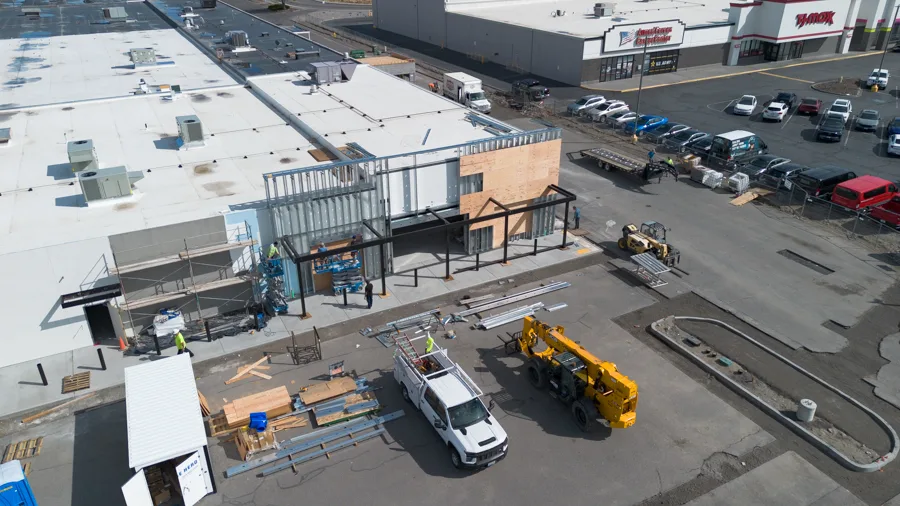
This 25,000-square-foot building at 7411 W. Canal Drive in Kennewick is being renovated inside and out ahead of a Nordstrom Rack opening in November 2026.
Photo by Nathan FinkeWhile the Tri-Cities isn’t seeing a banner year in commercial real estate, it’s also not having a bad one, experts say. The commercial market has been holding fairly steady.
“I wouldn’t say we’re having a booming market, we’re having a consistent market,” said Rob Ellsworth, senior advisor with SVN Retter & Company in Kennewick.
Cheryl Stewart, executive director of the Inland Northwest Associated General Contractors, described the market in Eastern Washington as “a little soft.” It’s not necessarily a downturn, she said, but not as strong as it’s been in the past.
Land sales have picked up, Ellsworth said, clearing the way for future development.
But Stewart said that while contractors have enough work, with backlogs and projects coming up, there’s not a lot of ramping up for new big projects and not much growth.
Sector outlooks
Some sectors have been seeing more growth than others.
Private commercial construction is doing well and growing, but at a slower rate, Stewart said. The region has healthcare projects and manufacturing is going strong, she said, while retail and office developments are seeing a slowdown.
Data centers also have been under discussion in the Tri-Cities region, and while they could be a boon for the construction industry, public sentiment has begun to turn against them as people raise concerns about power and labor availability, Stewart said.
Transmission lines and power station work are going strong, she said.
The AGC’s 2026 Construction Outlook survey for Washington mirrored those trends, with 57% of respondents expecting the value of data center projects to be higher than 2025 and 43% of respondents expecting the value of power projects to be higher.
On the flip side, 59% said they expected the value of private office projects to be lower, 54% expected higher education projects to be lower, 54% expected K-12 school projects to be lower, and 48% expected retail to be lower.
The low expectations surrounding school projects is part of a trend of public commercial projects seeing less growth. Stewart said that there have been fewer bonds passed for new schools, which means less new school construction.
While the Tri-Cities hasn’t had new schools to build this year, a renovation of the career and technical education wing of Pasco High School was high on the list of this year’s Top Construction Projects with a $13.2 million permit issued for the work.
Another piece of public commercial projects is roadwork. While the Washington state Department of Transportation has its biggest budget to date, Stewart said that the funding is often project specific, so contractors don’t see it unless there’s a big project in the area – like the Highway 12 expansion in Walla Walla County.
The more regular maintenance and preservation work, which Stewart called the “bread and butter,” has been uncertain over the last few years, although cities and counties are still doing some of that work.
On the leasing side, the industrial market has slowed, Ellsworth said. While the sector was once underbuilt, the market has now caught up and there’s more of an ample supply, he said.
Office and retail are both consistent on the real estate side, and Ellsworth has been seeing new retail buildings come to market and have success. 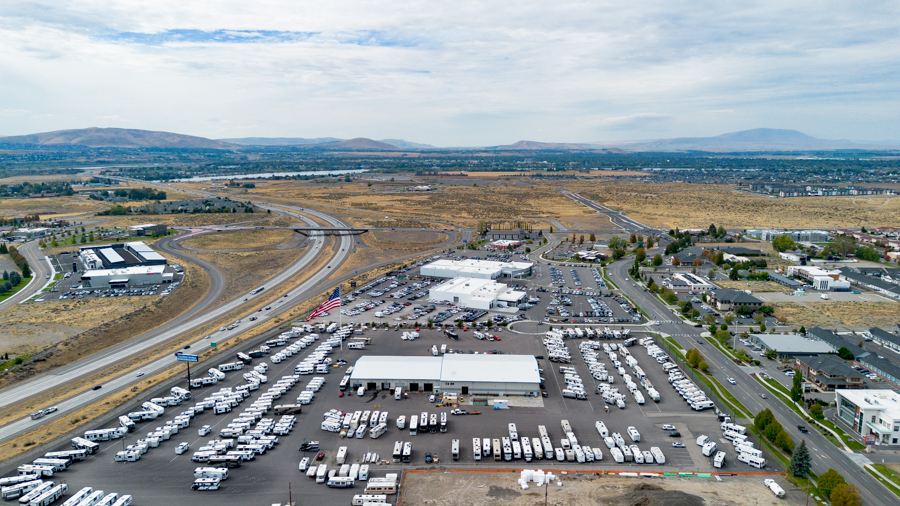
More development is expected to fill in the vacant land west of Broadmoor Boulevard. Pictured in the foreground is Pasco’s Camping World off Sandifur Boulevard.
| Photo by Nathan FinkeCity by city
There are several areas of the Tri-Cities showing growth spurts: the Broadmoor and Road 100 area of west Pasco, the Southridge area of Kennewick, the Queensgate area of Richland – which is always popular but has limited options, Ellsworth said – and interest is picking up in West Richland as it grows.
Kennewick has seen several commercial projects in its core Columbia Center area, from the Habit Burger opening on Canal Drive to plans for a nearby Nordstrom Rack. An $11 million permit was issued for a Holiday Inn Express at 7715 W. Quinault Ave. In the Southridge area, an 85,000-square-foot Department of Veterans Affairs clinic is planned.
Pasco projects also topped the charts of the Tri-Cities Top Construction Projects list with $48 million in permits issued for the Amazon warehouse at 1202 S. Road 40 E. The warehouse has opened its doors as employees shift from the currently operational facility next door. Meanwhile, a major commercial development anchored by a yet-to-be-named grocery store is planned for the Broadmoor area of Pasco by Ohio-based Visconsi Companies Ltd.
West Richland’s commercial development is growing as well, with the Mid-Columbia Children’s Museum planning to build its facility off of Keene Road and the city’s first McDonald’s making plans for a spot off of West Van Giesen Street. The city recently saw a massive land sale when 1,000 acres of its Lewis and Clark Ranch land sold for $263.7 million to Trammell Crow Company, a developer whose work includes data centers.
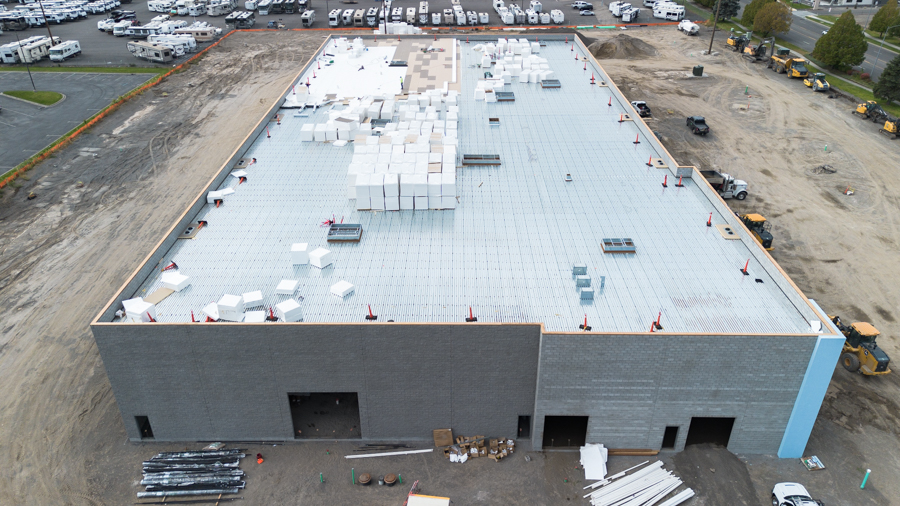
Corwin Ford is building a new dealership at 9204 Sandifur Parkway in Pasco near the Broadmoor Park outlet mall.
| Photo by Nathan FinkeIndustry challenges
One challenge in the real estate market is for companies coming into the Tri-Cities looking for large-scale industrial spaces to rent. It’s something the area is lacking, Ellsworth said, with lots of buildings on the scale of 2,500 square feet up to 10,000 square feet, but very few at 20,000 square feet and up.
On the construction side, workforce is still a challenge. The industry has been facing hiring difficulties with a shortage in the trades, including a particularly strong demand for electricians, Stewart said.
Data center construction would be especially dependent on the availability of electricians. Material prices also present difficulties. Uncertainty in prices is stalling some projects, Stewart said, with some owners hesitant to build due to prices on materials like structural steel or lumber.
Ellsworth said he’s also seen some people delaying their plans until something shifts.
Labor costs have risen significantly, Stewart said, adding to the total costs needed when building. Since it’s been going on for a few years now, more owners are starting to prepare for the higher costs. It’s “not as much of a shock anymore,” she said. “The uncertainty has become predictable.”
Despite the climbing costs, “we will continue to build,” she said, and the market seems like it will hold steady.
“I’m optimistic about material prices stabilizing” and other trades and tariff issues being worked out, she said. Though there isn’t a lot of growth or any major changes, she said she’s not seeing the indicators for a downturn, keeping things fairly flat.
Overall, the Tri-Cities is still seeing a “really good trend of growth in our area,” Ellsworth said. As the Tri-Cities’ population continues to grow over the next three to five years, it will only create more demand, he said.