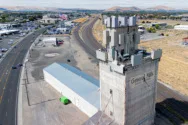
Hanford site team, partners complete melter test ahead of schedule
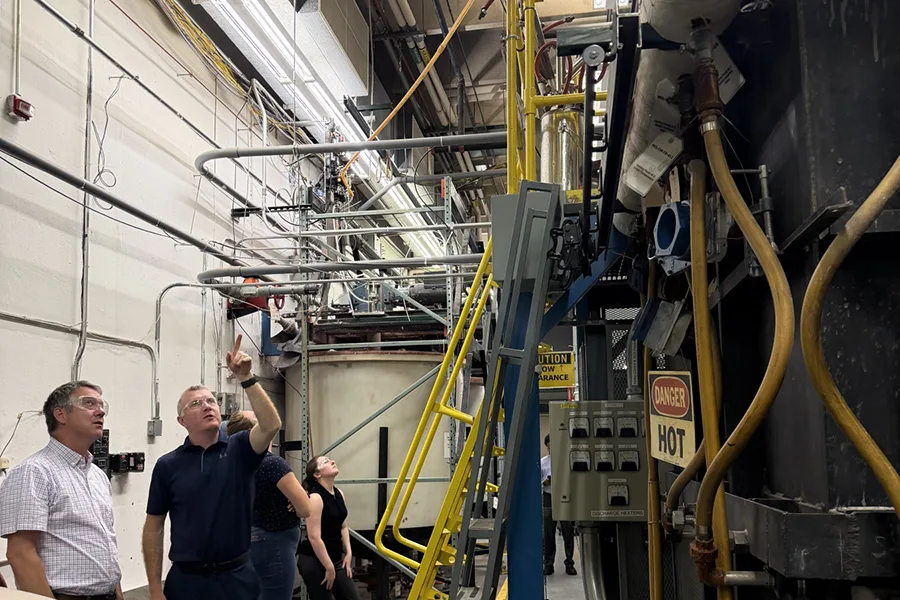
Team members from the Hanford Site’s High-Level Waste Facility are pictured at the Vitreous State Laboratory, where they observe a one-third scale melter like the High-Level Waste Facility will use at Hanford.
Courtesy DOEHanford site contractors, U.S. Department of Energy officials and other partners recently completed a test of technology for the still-under-construction High-Level Waste Facility of the site’s Waste Treatment and Immobilization Plant two months ahead of schedule.
The test, which was conducted at the Vitreous State Laboratory (VSL) at Catholic University of America in Washington, D.C., allowed the team to assess challenges facing the melter and emissions system that the high-level waste portion of the plant, commonly called the vit plant, is facing and support ongoing engineering and design, according to a release.
“This test highlights how strategic partnerships are shaping the future of the Hanford cleanup mission,” said Mat Irwin, Hanford’s assistant manager for the WTP, in a statement. “By partnering with technical and industry experts, we are able to accelerate progress, identify potential challenges and ensure that the HLW Facility is ready to safely and efficiently treat high-level waste when operations begin.”
Vitrification – the process of transforming hazardous waste into a stable glass form – will be used at the vit plant to treat up to 56 million gallons of hazardous waste stored in 177 underground tanks, a legacy of nuclear weapons manufacturing from World War II through the Cold War.
The low-activity waste portion of the facility is currently in the hot commissioning phase before it begins operating 24/7. The facility, designed and built by Bechtel National, took decades and billions of dollars to realize. As of June 23, the low-activity waste portion of the facility had treated 125,234 gallons of tank waste, filling 88 stainless steel containers for long-term storage.
VSL has the largest collection of waste glass melters in the United States, including a one-third scale of the melter and emissions treatment system like what the high-level waste facility will use. It was the second of six tests to be performed to validate melter and emissions treatment system design.
Bechtel is advancing the design for direct-feed high-level waste to 90% complete while enclosing the HLW Facility.