Tri-Cities Airport sees opportunity in airline industry turmoil
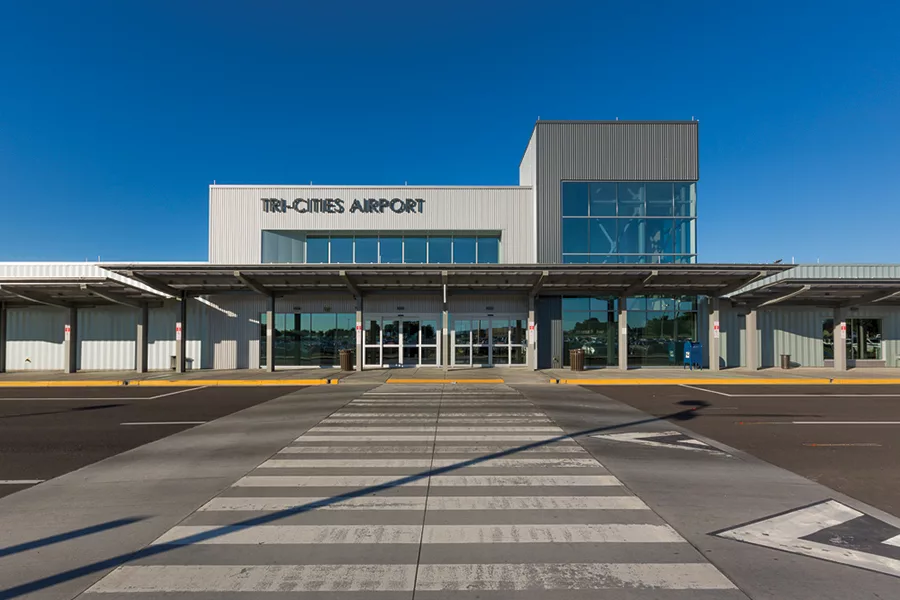
Around the country, airlines are cutting flights, and the Tri-Cities Airport is no exception.
The departure of Avelo Airlines from the Tri-Cities as well as the whole West Coast market contributed to the nearly 400 routes that were canceled since the summer of 2025.
But since then, the Tri-Cities has added not just one flight, but two. And its existing routes continue to perform well. And that’s why, despite the economic uncertainty looming over the air travel industry, Jack Penning sees opportunity for the Pasco airport.
“We lost one but we added two. We doubled what we got back because of planes becoming available,” Penning, a consultant with Volaire Aviation, recently told Port of Pasco commissioners. “We stand to benefit from any shake-up that happens in the industry.”
Penning said there will still be challenges and he anticipates the port will need to sweeten incentives for airlines to establish highly-desired routes here, such as to Dallas-Fort Worth. But the Tri-Cities continues to buck the trend of most other airports – and airlines have taken notice.
“The overarching factor is we don’t have enough seats,” Penning said.
Steady Growth
Currently, five airlines offer 23 daily flights to 11 destinations from Pasco. Along with Avelo, Breeze Airways canceled a route it planned to offer between Pasco and Provo, Utah, before its scheduled launch this spring. However, Allegiant and Alaska Airlines have added routes to California’s Orange County and Portland.
The airport has largely seen steady growth in travelers post-pandemic. There was a decline in passengers flying out between September 2025 and March 2026 compared to those same periods the prior year. Airport manager Buck Taft attributed that partly to a decline in the number of seats available following Avelo’s departure from the market, but also limited flights to San Francisco due to construction at the California airport.
April traffic was up 11% compared to the same month the prior year, with 39,504 travelers departing from Pasco’s gates. Data presented by Penning showed the airport filling 82% of its seats, with only four other airports in the Pacific Northwest filling a higher share.
Threat assessment
While the Tri-Cities tends to buck national trends around air travel, Penning said the current economic uncertainty does present a threat. Ongoing layoffs hitting the tech industry and some other sectors, record low consumer confidence and high oil prices are likely to make some reticent to travel. And oil prices, while they’ve fallen back from the record highs earlier this spring, are also affecting airlines.
“Airlines are paying $4.50 a gallon right now before refinement,” he told commissioners. “At $4.50 per gallon, there’s no way you can be profitable.”
At the same time, industry analysts have yet to see signals that consumers are calling off summer travel plans. And perhaps counterintuitively, high gas prices tend to lead to lower airfares so airlines can keep planes flying, Penning said.
“If people are paying $5 for gas, they aren’t going to pay $200 to fly to Los Angeles,” he said.
Incentives to entice
Penning said he anticipates airlines adding 500 flights nationwide over the next five years as airlines bring 1,000 planes currently on order into service. It’s critical the Tri-Cities compete to be the destination for some of those flights, he said.
The airport continues to have discussions with American Airlines regarding a future route to Dallas-Fort Worth. Penning said there’s even the possibility of a nonstop flight from the Tri-Cities to Honolulu since Alaska Airlines acquired Hawaiian Airlines, as data indicates there would be an estimated 66 passengers departing and arriving from the Tri-Cities each day.
But economic conditions are making airlines skittish, and they are seeking stronger assurances and incentives for new routes. Penning said the San Luis Obispo airport offered an airline a $2 million incentive for a Dallas-Fort Worth route. Riskier markets are offering $3 million to $4 million for similar routes.
The port may want to start building community partnerships that could build upon the current $850,000 incentive the port is offering for a Dallas-Fort Worth route, Penning said.
“We may be asking for more than (community members) simply getting on airplanes in the future,” he said.