
Hanford work continues but it’s unclear for how long
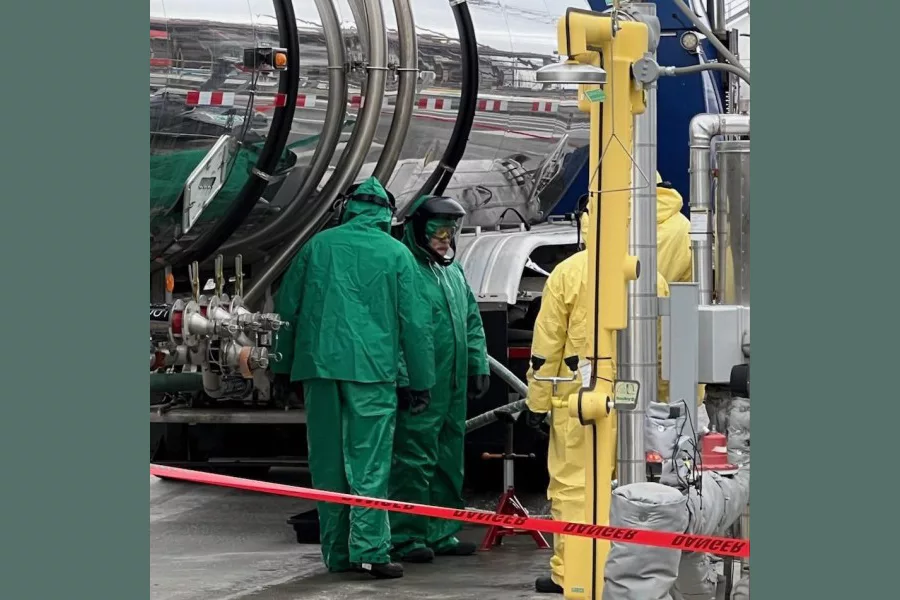
Workers unload sodium hydroxide into the Low-Activity Waste facility at Hanford.
Courtesy Bechtel National Inc.The longest federal government shutdown in U.S. history continues to roil the nation but work at the Hanford site is continuing for now.
“DOE’s Hanford site is not currently experiencing a lapse in funding and continues to operate in a normal capacity, with staff reporting to work and carrying out the Hanford mission safely,” Olivia Tinari, a spokesperson for the U.S. Department of Energy, told the Tri-Cities Area Journal of Business in an emailed statement.
The shutdown, which began Oct. 1, has impacted nearly every aspect of the federal government, with nearly a million people furloughed nationwide while millions of other federal employees, including members of the military, work without pay.
However, Hanford site contractors reportedly have enough funding remaining from prior appropriations to keep workers on the job through November. And as of Nov. 10, the Senate had advanced a continuing resolution that would reopen the government, though it still must pass through Senate procedural steps and then gain approval from the House.
At Hanford, financial conditions reportedly vary from contractor to contractor, as indicated by one contractor’s initial plan to temporarily lay off hundreds in mid-October due to the shutdown. And at some point, those past appropriated funds will run out.
“For now, everyone is still at work, and will be for at least a few more weeks,” David Reeploeg, vice president of federal programs for Tri-City Development Council or TRIDEC, told the Journal. “After that, things become less certain.”
Threatened funding
The Hanford site is the most significant cleanup effort of DOE’s Office of Environmental Management. The site’s most recent congressionally-approved annual budget was roughly $3 billion, paying for the about 13,000 workers, many of them employed by contractors and subcontractors, cleaning up the site’s legacy of plutonium processing for nuclear weapons.
Even before the shutdown, current and future funding for the Hanford cleanup has recently been threatened.
In June, U.S. Sen. Patty Murray, D-Washington, grilled Energy Secretary Chris Wright on how he wasn’t releasing funds as defined in a continuing resolution that set spending at the Hanford site at its 2025 fiscal year levels.
Specifically, a subcontractor with a role connected to the Environmental Restoration Disposal Facility, or ERDF, was previously working under a $1 million contract for the 2024 fiscal year. But its FY 2025 contract called for $25 million as its staff ramped up their scope of work and without those appropriations, the subcontractor was preparing to lay off staff.
DOE released the funding to the subcontractor after the hearing. However, shortly after, the White House and DOE released more detailed spending proposals for the 2026 fiscal year, allocating $34 million less to the site compared to 2024 spending levels.
Possible layoffs
Days after the shutdown began, contractor Hanford Tank Waste Operations and Closure, known as H2C, notified Hanford Atomic Metal Trades Council, one of the unions representing its workforce, that it planned to lay off 733 workers temporarily on Oct. 16 if Congress failed to fund the government.
“Due to the lapse in government appropriations, Hanford Tank Waste Operations and Closure (H2C) has been directed by (the U.S. Department of Energy) to reduce operations to a ‘minimum safe’ staffing level, effective Oct. 20, 2025,” according to the notice from Mike O’Conner, H2C’s labor relations manager.
That letter was reportedly later rescinded. But it raised questions about operation of the Waste Treatment Plant, a collection of facilities and infrastructure commonly known as the vitrification or vit plant, that was set to begin processing waste stored in Hanford’s underground tanks as part of the final round of preparations known as hot commissioning. Processing began on Oct. 15 and H2C is set to run the facility once it is fully operational.
Representatives of H2C and the other contractors on the site declined to comment to the Journal on the status of their operations, instead referring questions to DOE.